Introduction
The Base Product Specification (BPS) provides a generic, interoperable framework for representing products of all kinds—whether Data Products, AI Products, software components, services, or any physical/digital goods.
BPS establishes a conceptual foundation upon which domain-specific product descriptor specifications (e.g., CMXPDS/CMXPROD for Comic Products, DPDS/DPROD for Data Products, AIPDS/AIPROD for AI Products) may be consistently defined, governed, and integrated.
Purpose
The purpose of the BPS is to:
- Provide a neutral meta-model for describing products across domains.
- Support consistent governance and lifecycle management.
- Enable unified product marketplaces that integrate heterogeneous product types.
- Facilitate interoperability between emerging and existing specifications.
Scope
The specification is intended for use in:
- Physical/Digital product creation and publishing platforms that provide product creation, deployment and publishing services to product owners.
- Enterprise data and AI platforms that must govern and expose both Data and AI Products.
- Software and services ecosystems where consistent product semantics reduce fragmentation.
- Cross-industry collaborations requiring a standard product description independent of implementation or domain.
BPS does not prescribe technical deployment details for any specific domain; instead, it defines an abstract foundation from which such details may be derived.
Motivation
Despite the ubiquity of products in human enterprise, existing specifications are domain-specific and fragmented:
- Data Products are described by DPDS (deployment) and DPROD (semantic description).
- AI artifacts are partially described by ONNX, PMML, Model Cards, or risk frameworks such as NIST AI RMF.
- Physical products are covered by ontologies such as GoodRelations or ETIM.
- Service and software products use diverse cataloging approaches.
This fragmentation hinders governance, discoverability, and interoperability.
BPS addresses this challenge by defining a base layer applicable to all product types.
The Vision
BPS is not only a documentation convenience. It is intended as a productization grammar that enables products to be compiled and operated end-to-end through self-service.
In the target state:
- BPS provides the universal grammar for product descriptors.
- Domain specifications (AIPS, CMXPS, MOVPS, etc.) provide domain-specific “type systems” that make products computable and enforce domain validity.
- Product Factory Intelligence (PFI) compiles declarative product intent and descriptors into real, provisioned products by selecting blueprints, wiring tooling and infrastructure, applying policy, and generating lifecycle artifacts.
- The Product Development Experience Plane (PDEP) provides the self-service interface through which a Product Owner (PRO) can manage the full lifecycle from ideation to marketplace publication and evolution. E.g HDIP conceptual architecture (Holistic Data & Information/intelligence platform) which is specifically for Data and AI Products only provides PDEP for DPRO (Data Product Owner) and AIPRO (AI Product Owner) to own the full lifecycle of Data / AI product.
This architecture enables a new economic actor: the Symbiant : A single entity micro-enterprise (human + machine intelligence) capable of creating and stewarding products with autonomy, agency, and accountability, without needing a traditional large cross-functional team.
From Grammar to Factory to Economy
BPS should be viewed as the grammar of product descriptors:
- Grammar alone cannot produce meaning.
- When combined with a domain vocabulary (e.g., CMXPS, DPDS/DPROD, AIPS), it enables precise and actionable specifications.
- When combined with PFI, it enables product creation to shift from manual, role-heavy delivery to automated compilation.
- When delivered through PDEP, it enables self-service product ownership across the full lifecycle.
In other words:
BPS + domain specifications make products describable and valid.
PFI makes products buildable at scale.
PDEP makes productization self-service.
Together they enable the Symbiant economy.
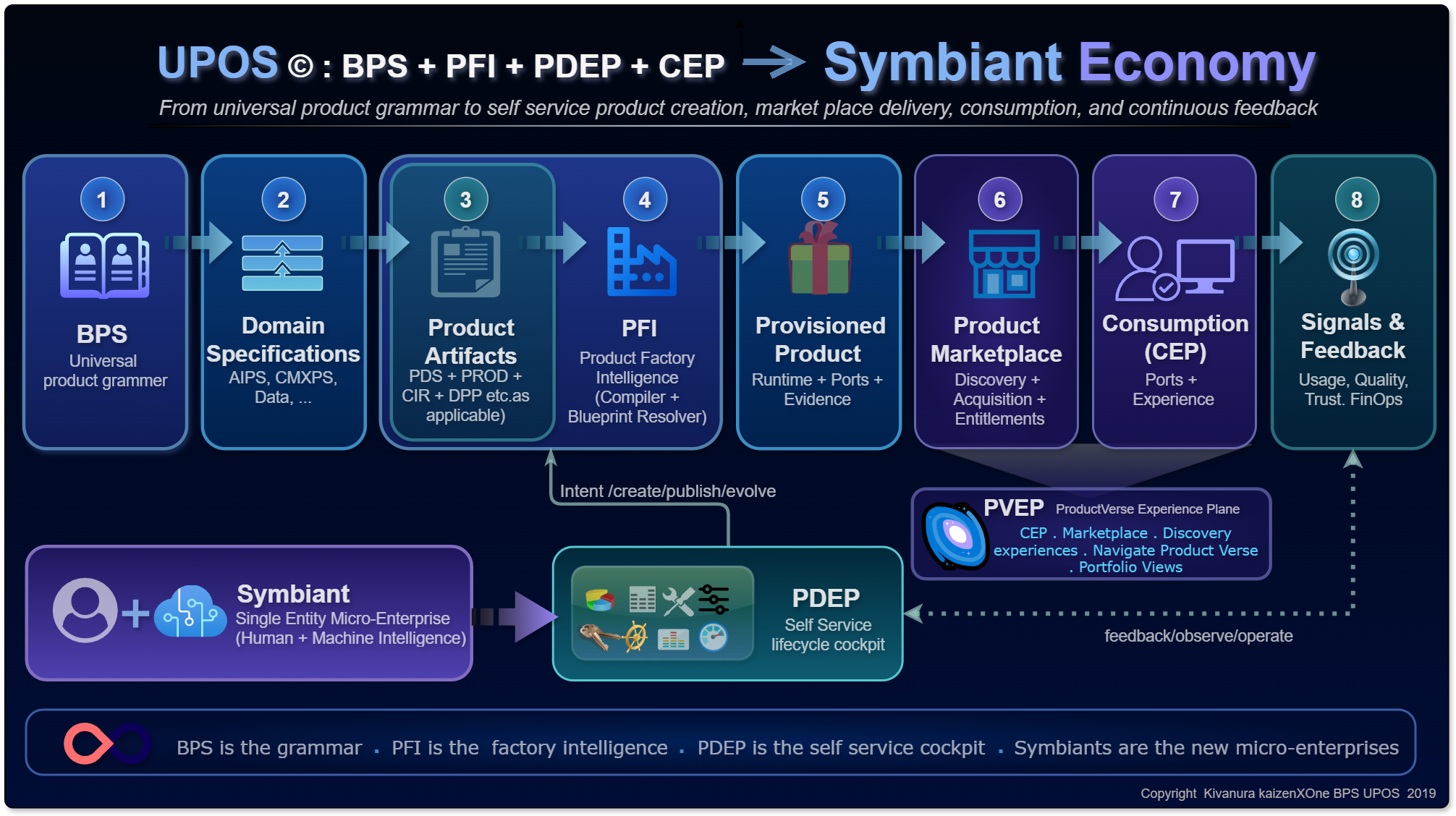
UPOS© - Universal Productization Operating System Meta Architecture
UPOS© (Universal Product Operating System) is a product-kind agnostic meta-architecture that defines the canonical planes, architectural building blocks, and lifecycle patterns required for self-service product creation, provisioning, marketplace participation, consumption, and continuous evolution. UPOS is an abstract reference architecture and is not intended to be implemented verbatim; instead, it guides the design of domain-specific architectures such as HDIP©.
Following is a high level exec view of UPOS :
Position in Standards Landscape
BPS is intended to complement existing domain specifications rather than replace them. It provides:
- Alignment with W3C vocabularies (DCAT, PROV-O) for data and provenance.
- Compatibility with ISO/IEC AI and software engineering standards.
- Extensibility to support new product categories such as digital twins or simulation models.
Expected Audience
BPS is targeted at:
- Standards bodies developing domain-specific product descriptors.
- Enterprises building holistic governance frameworks for Data and AI.
- Researchers and practitioners in data management, AI ethics, and product lifecycle management.
- Architects and engineers designing unified product marketplaces.
- Product platform teams building self-service product factories and product experience planes.
Scope and Limitations
The Base Product Specification (BPS) is a meta-framework for describing products. It defines the universal split between:
- PDS (Product Descriptor Specification): deployment blueprint
- PROD (Product Ontology/Description): semantic blueprint
This split is applicable across all product domains.
What BPS is for
- Providing a conceptual skeleton for any future product specification.
- Ensuring that all product types can be described in a consistent and interoperable manner.
- Serving as a foundation layer for domain-specific specifications.
- Aligning diverse product ecosystems (data, AI, software, physical) under a common meta-model.
- Enabling factory-style compilation of products when paired with PFI and delivered through PDEP.
What BPS is not for
-
BPS is not a domain-specific implementation spec.
- It does not define dataset schemas (data).
- It does not define bias metrics or model cards (AI).
- It does not define electrical tolerances or logistics (physical).
- It does not define API endpoints or manifests (software).
-
BPS cannot be used on its own to describe products in practice.
-
BPS does not replace domain specifications such as DPDS/DPROD (Data Products) or AIPDS/AIPROD (AI Products).
Strategic Implication
BPS introduces a universal product kernel—a minimal yet extensible set of concepts that can be specialized into domain-specific descriptors. It aims to become a foundation for coherence across the fragmented landscape of product specifications, and a grammar for product factories that enable self-service productization at scale.
In summary: BPS is the grammar. Domain specifications provide the vocabulary. PFI provides the compiler/factory. PDEP provides the self-service cockpit. Together, they enable the Symbiant economy.