🧭 HDIP©: A Holistic Data & Information Platform Architecture + Data Mesh
1. The Problem We Are Solving
Modern enterprises are overwhelmed, & this is not by lack of data, but by fragmentation of value.
- Data exists in silos
- AI capabilities are scattered
- Access is slow and policy-heavy
- Business users depend on technical intermediaries
- Value is difficult to measure
Even with Data Mesh adoption, many organizations still face:
- Over-engineering at the edge
- Inconsistent user experience
- Weak linkage between data → usage → value → ROI
2. What is HDIP©?
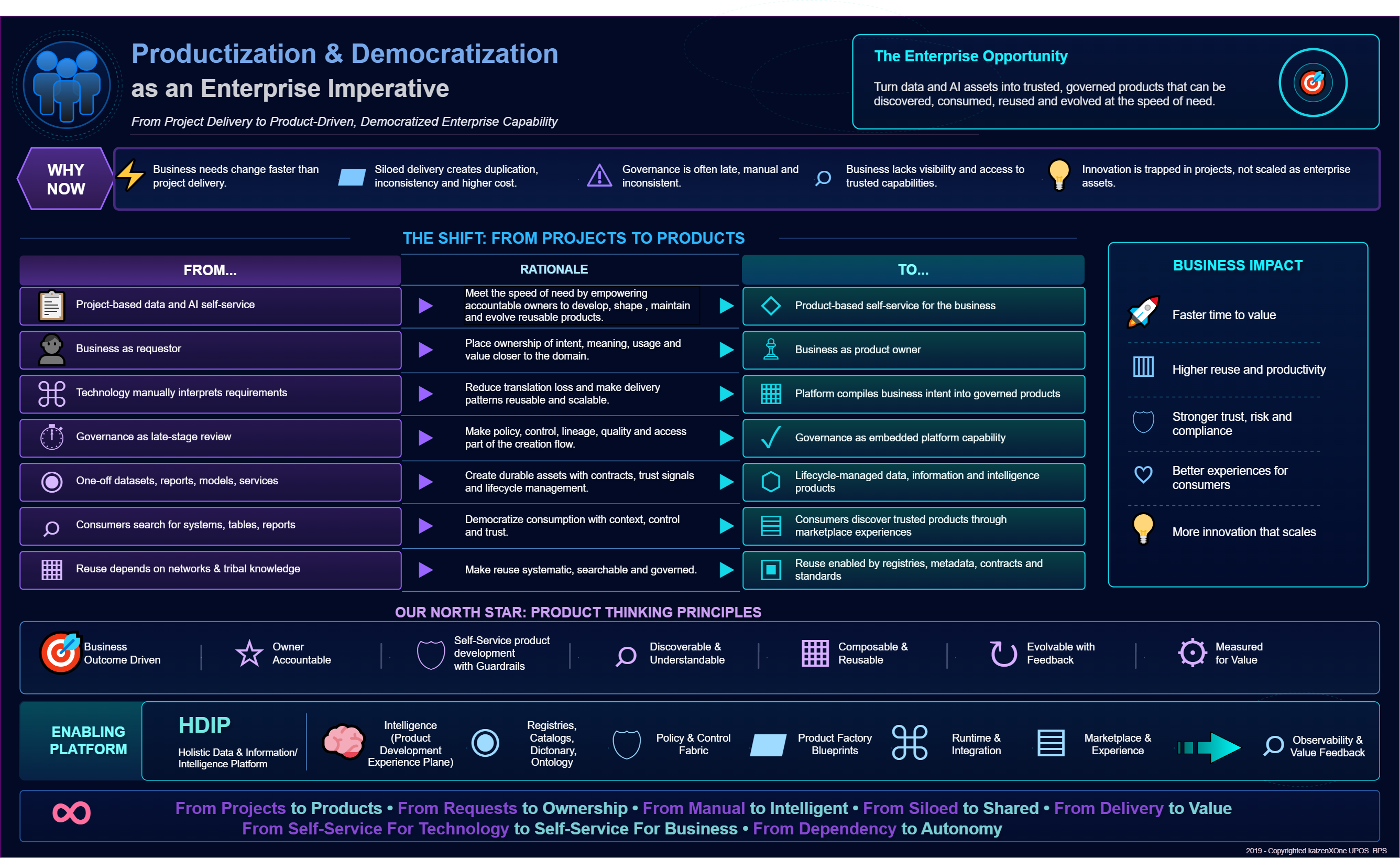
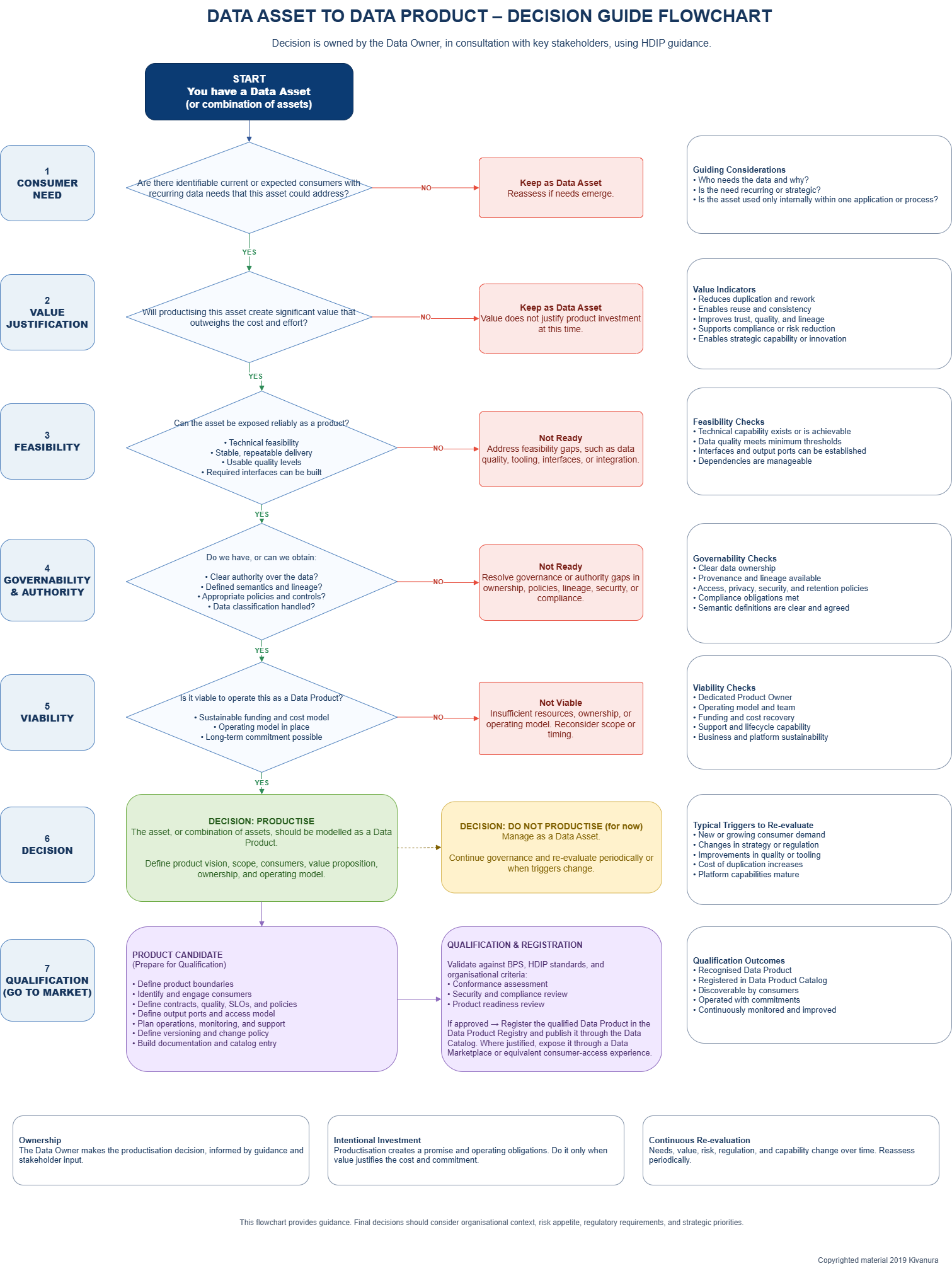
2.1 DATA ASSET TO DATA PRODUCT promotion guidance in HDIP©
Data Productisation is an intentional investment decision led by Data Owner. A Data Asset should be promoted to, or composed into, a Data Product only where an identifiable consumer need, a meaningful value proposition, sustainable accountability, and sufficient product qualification justify the additional promise and operating obligations.
2.2 Consumer classes that usually need a Data Product (Typical)
| Consumer class | Typical need | Product expectation |
|---|---|---|
| Regulatory and compliance consumers | Formal evidence, reproducibility, lineage, control | Very strong |
| External consumers | Contractual clarity, security, support, entitlement | Very strong |
| Cross-domain consumers | Stable semantics and independence from source implementation | Strong |
| Critical operational consumers | Availability, timeliness, incident support, change control | Very strong |
| Enterprise-wide shared consumers | Consistency across many teams and use cases | Strong |
| Downstream Data Products | Machine-readable contracts, provenance, compatibility | Strong |
| AI and automated decision consumers | Stable features, permissible use, quality and drift information | Strong |
| Executive and statutory reporting consumers | Trusted measures, reconciliation, accountability | Strong |
2.3 Consumer classes where a Data Asset is typically enough
| Consumer class | Typical need | Product expectation |
|---|---|---|
| Regulatory and compliance consumers | Formal evidence, reproducibility, lineage, control | Very strong |
| External consumers | Contractual clarity, security, support, entitlement | Very strong |
| Cross-domain consumers | Stable semantics and independence from source implementation | Strong |
| Critical operational consumers | Availability, timeliness, incident support, change control | Very strong |
| Enterprise-wide shared consumers | Consistency across many teams and use cases | Strong |
| Downstream Data Products | Machine-readable contracts, provenance, compatibility | Strong |
| AI and automated decision consumers | Stable features, permissible use, quality and drift information | Strong |
| Executive and statutory reporting consumers | Trusted measures, reconciliation, accountability | Strong |

**HDIP (Holistic Data & Information Platform aka Holistic Data & Intelligence Platform) is an architectural model that transforms how enterprises:
- Create products (Data & AI)
- Consume them
- Measure their value continuously
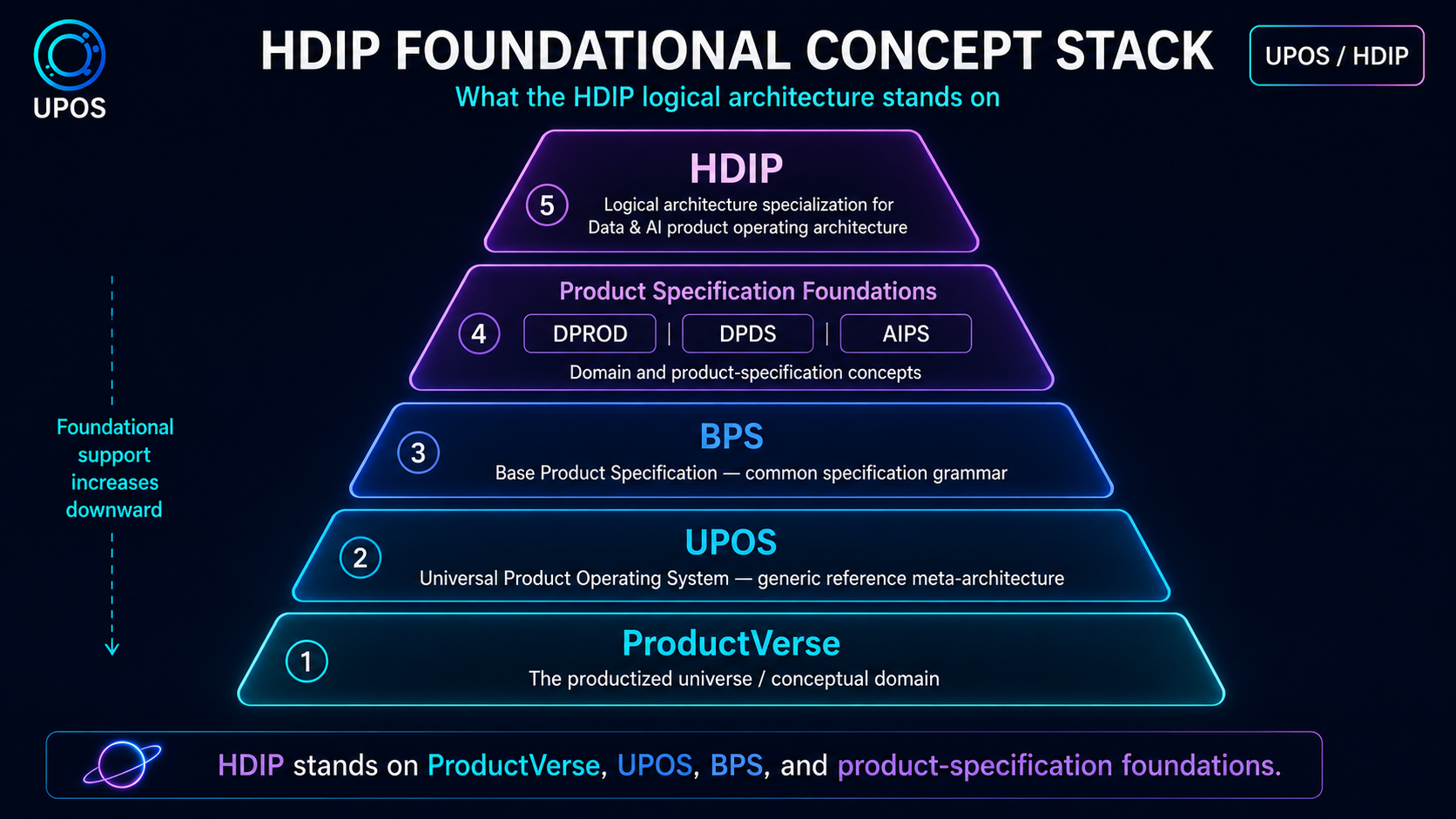
HDIP roots are based in BPS (Base Product Specification) and hence by default aligns with Data Mesh principles, however it extends them into a full enterprise operating model. BPS was created to support productization any product not just data. Within this broader productization frame, HDIP© has also taken into account several relevant architectural movements and patterns since 2017.
Data --> Intelligence --> Information
3. Data Mesh Paradigm via a vis HDIP Architecture
Data Mesh introduced four key ideas:
- Domain ownership
- Data as a product
- Self-serve platform
- Federated governance
HDIP retains these foundations and provides a logical architecture for Data Mesh Paradigm from Data perspective, however it addresses what Data Mesh Paradigm leaves implicit and open:
🔴 What HDIP Adds
| Gap in Data Mesh | HDIP Advancement |
|---|---|
| Focus on data products | Unified Data + AI Products i.e Data + Intelligence loop to create information |
| Limited consumer modeling | Full Consumer Lifecycle (CIR → Value → Feedback) |
| Weak experience layer | Consumer Experience Plane (CEP) |
| No value tracking | Consumer Observability & Value Plane (COVP) |
| implicit Engineering heavy creation | Intent-driven, business-first creation |
| Static consumption | Continuous value loop with ROI visibility |
4. The Core Shift: From Pipelines to Products to Value
HDIP introduces a fundamental shift:
❗ Not “build pipelines” ❗ Not even just “build data products”
🔴 But: Deliver measurable business value through products
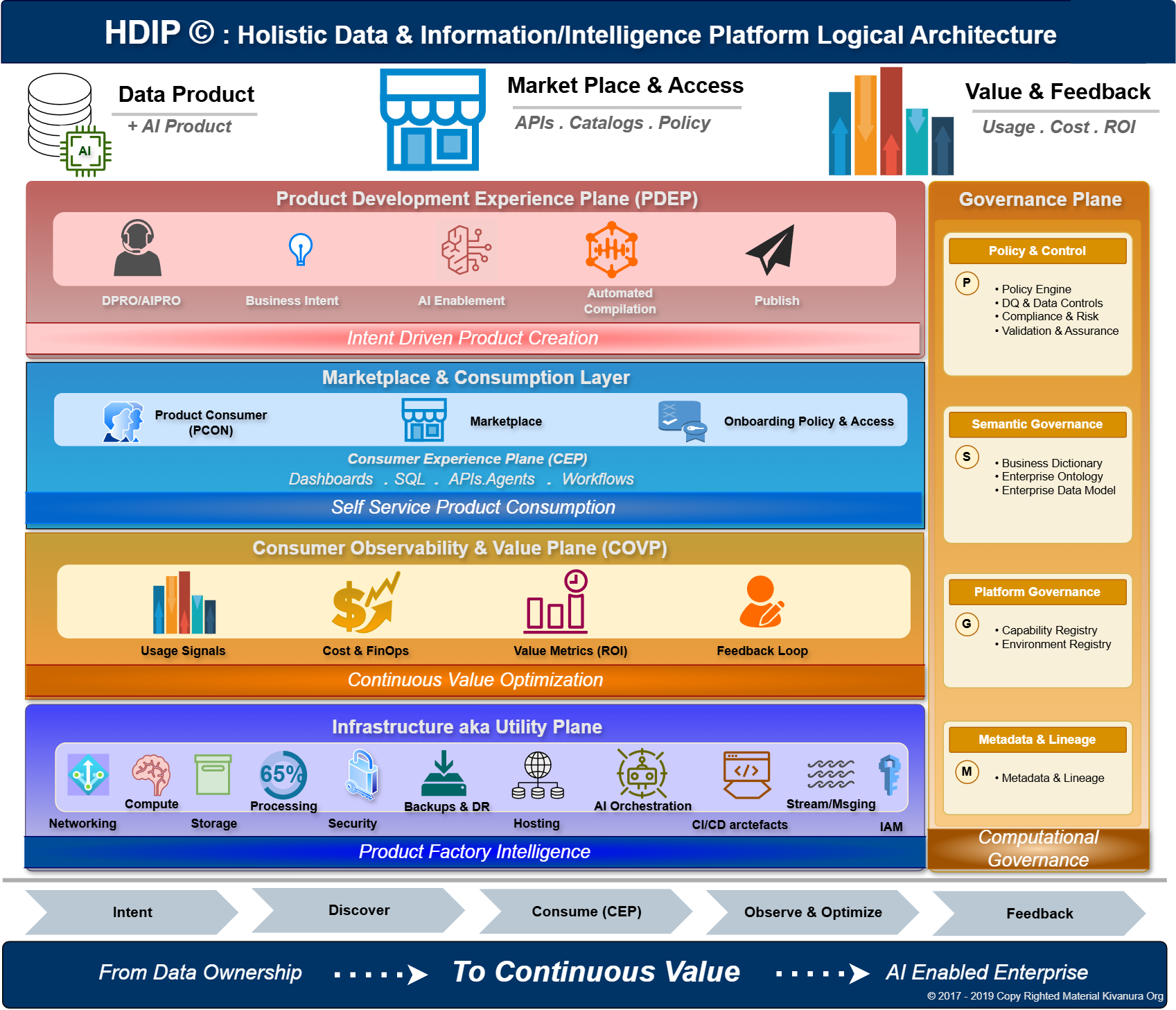
5. The Three Core Planes of HDIP
🟦 1. Product Development Experience Plane (PDEP)
Where products are created.
-
Business users define intent
-
Platform compiles:
- Data products
- AI products
-
No need for:
- pipelines
- tools
- infrastructure knowledge
👉 The platform acts as an automated technology organization
🟩 2. Marketplace & Consumption Layer
Where products are discovered and accessed.
-
Unified Marketplace
-
Products exposed via:
- APIs
- SQL
- streams
-
Governed access:
- RBAC / ABAC / policy-driven
👉 Marketplace is for discovery and acquisition, not creation
🟨 3. Consumer Experience & Value Plane
Where HDIP truly differentiates.
🔹 Consumer Experience Plane (CEP)
Different users experience the same product differently:
- Business → dashboards
- Analysts → SQL
- AI teams → datasets
- Systems → APIs
- Agents → workflows
🔹 Consumer Observability & Value Plane (COVP)
Tracks:
- Usage
- Cost (FinOps)
- Value (ROI)
- Feedback
👉 This creates a continuous value loop
6. The Consumer Lifecycle (New Capability)
Traditional architectures stop at delivery.
HDIP introduces:
Intent → Discover → Access → Consume → Observe → Value → Feedback → Decision
This means:
- Every product consumption is measurable
- Every consumer becomes part of a feedback system
- Value is continuously optimized
7. Fluid Roles: Consumer ↔ Producer
In HDIP:
-
A user starts as a Product Consumer (PCON)
-
When their need evolves:
- They transition into a Product Owner (DPRO / AIPRO)
Example:
- A business user consumes Payment + Surveillance data
- Realizes need for reconciliation
- Creates a Reconciliation Data Product
👉 This creates a self-sustaining ecosystem
8. Composability as a First-Class Capability
HDIP enables:
- Single product consumption
- Multi-product federation
- Full composability
Example:
-
Combine:
- Payment Data Product
- Surveillance Data Product
- Account Data Product
→ Create: Reconciliation Data Product
9. AI-Native Enterprise Enablement
HDIP is inherently AI-ready:
- AI Products are first-class citizens
- Data + AI products can be composed
- Agentic workflows emerge naturally
Example:
- Coverage agents consuming multiple products
- Producing insights autonomously
10. Governance Without Friction
HDIP embeds governance into the platform:
- Policy-driven access
- Data quality and controls integrated
- No manual committee bottlenecks
👉 Governance becomes computational, not procedural
11. Why This Matters to Executives
🧭 For CIO / CTO
- Standardized platform for data + AI
- Reduced engineering dependency
- Faster time-to-value
💼 For Business Heads
- Direct access to products
- No dependency on technical teams
- Measurable ROI on usage
🧠 For CEO
-
Data becomes a strategic asset with visible value
-
AI adoption becomes scalable and controlled
-
Organization becomes:
- Faster
- More adaptive
- More intelligent
12. The End State Vision
An HDIP-enabled enterprise looks like this:
-
Products are:
- Discoverable
- Governed
- Reusable
-
Users:
- Declare intent
- Consume seamlessly
- Measure value continuously
-
Platform:
- Compiles
- Governs
- Optimizes
13. Final Thought
BPS (Base product Specification) is a critical foundational step forward for productization & democratization of product creation.
HDIP Logical Architecture also aligns with Data Mesh philosophy for data, goes beyond it, makes things more explicit and completes the journey:
🔴 From Data Ownership → To Product Thinking beyond Data → To Experience → To Continuous Value
🚀 Closing Statement
HDIP transforms the enterprise from a data-driven organization into a value-driven, product-centric, AI-enabled ecosystem—where every interaction with data and AI is measurable, governable, and continuously improving.