GEARA 0.1 - Generic Enterprise Analytics Reference Architecture
| Attribute | Value |
|---|---|
| Specification | Generic Enterprise Analytics Reference Architecture |
| Acronym | GEARA |
| Version | 0.1 |
| Status | Normative Draft / Executable Release Candidate |
| Specification Type | Generic Reference Architecture |
| Scope | Governed Enterprise Analytics Architecture |
| Semantic Foundation | GEARM 0.1 |
| Data Semantic Foundation | GEDRM 0.1 |
| Product Semantic Foundation | BPS / PIN and applicable Product-family specifications |
| AI Product Semantic Authority | AIPS |
| Primary Data Architecture Companion | GEDRA |
| Normative Architectural Authority | This human-readable GEARA specification |
Specification Status
GEARA 0.1 establishes the initial normative conceptual baseline for the Generic Enterprise Analytics Reference Architecture. It defines the logical responsibility model, cross-cutting architectural fabrics, interactions, capabilities, Architecture Building Blocks, contracts, registries, governed metadata, governance and control architecture, security/privacy/trust architecture, lifecycle and resilience architecture, conformance model, architectural invariants, reference views, and canonical architectural patterns required to support governed enterprise analytics.
GEARA 0.1 is the architectural counterpart of GEARM 0.1. GEARM defines the generic semantic model for enterprise analytics; GEARA defines how architectural responsibility for realizing, governing, operating, consuming, assuring, and evolving those semantics is organized.
The GEARA 0.1 machine-readable artifact programme is now closed through GEARA-A15 as GEARA-0.1-RC1, an Executable Release Candidate. GEARA-A1 through GEARA-A14 establish the canonical architecture registries, invariant catalogue, conservative RDF/OWL and SHACL formalization, JSON-LD and JSON Schema representations, governed Profile schema, canonical examples, positive and negative testcases, automated conformance runner, cross-artifact reconciliation, and governed regression baseline. GEARA-A15 freezes the complete A1-A14 release subject through a manifest and SHA-256 inventory, records explicit known limitations and promotion policy, and requires the established machine gates to remain satisfied before the candidate is considered closed. Promotion from Executable Release Candidate to final Released status remains a separate governed publication decision.
Publication note: GEARA is published within the BPS specification ecosystem but defines an independent generic reference architecture for enterprise analytics. BPS remains the semantic authority for generic Product concepts referenced by GEARA. GEARM remains the semantic authority for generic enterprise analytics concepts referenced by GEARA.
Signature proposition: GEARM defines meaning; GEARA defines architectural responsibility for realizing that meaning.
Machine-Readable Artifact Downloads
- GEARA-A1 — Canonical Architecture Registry: geara-0.1.architecture-registry.yaml
- GEARA-A2 — Architecture Relationship Registry: geara-0.1.relationship-registry.yaml
- GEARA-A3 — Architecture Invariant Catalogue: geara-0.1.invariant-catalogue.yaml
- GEARA-A4 — RDF / OWL Representation: geara-0.1.ttl
- GEARA-A5 — JSON-LD Context: geara-0.1.context.jsonld
- GEARA-A6 — SHACL Constraint Layer: geara-0.1.shacl.ttl
- GEARA-A7 — Structural JSON / JSON-LD Schema: geara-0.1.schema.json
- GEARA-A8 — GEARA Profile Schema: geara-0.1.profile.schema.json
- GEARA-A9 — Canonical Example Set: example index
- GEARA-A10 — Positive Test Cases: testcase manifest
- GEARA-A11 — Negative Test Cases: testcase manifest
- GEARA-A12 — Automated Conformance Runner: run-geara-conformance.py
- GEARA-A13 — Cross-Artifact Reconciliation Report: geara-0.1.reconciliation-report.json
- GEARA-A13 — Reconciliation Runner: run-geara-reconciliation.py
- GEARA-A14 — Regression Baseline: geara-0.1.regression-baseline.json
- GEARA-A14 — Regression Report: geara-0.1.regression-report.json
- GEARA-A14 — Regression Runner: run-geara-regression.py
- GEARA-A15 — Release Closure: release README · manifest.json · SHA256SUMS · RELEASE-NOTES.md · run_release_closure.py · release-closure-report.json
GEARA-A1 establishes the canonical machine identity layer for GEARA-owned architectural elements while preserving external semantic authority boundaries. GEARA-A2 establishes canonical architecture predicates for responsibility, topology, realization, interaction, dependency/binding, Contract obligations, registry/discovery, governance/authority, provision/consequence, provenance/evidence, lifecycle/change, conformance/Profile, and adjacent-specification mapping. A2 preserves the normative rule that relationship participation does not by itself imply ontology inheritance, ownership transfer, or authority transfer. GEARA-A3 preserves all 123 section 14 architectural invariants one-to-one as stable machine records, with requirement-level, validation-class, source, and A1/A2 reference metadata; its classification metadata does not redefine the normative invariant statements. GEARA-A4 provides a conservative RDF / OWL representation of A1-A3: GEARA-owned architecture elements are represented as OWL classes, A2 relationships as RDF properties, explicit A2 symmetry is preserved, specializes is represented directionally as a subproperty of rdfs:subClassOf, and A3 invariants are first-class RDF resources. A4 does not infer domain/range, disjointness, inverse, transitive, functional, or other stronger semantics not established by the normative sources. GEARA-A5 provides the JSON-LD 1.1 compact-term context for the complete A1 architecture-element vocabulary, complete A2 relationship vocabulary, A4 representation metadata, invariant/family/type/reference namespaces, and standard RDF/OWL/SKOS/Dublin Core prefixes. It deliberately declares no default @vocab; relationship terms are IRI-valued through @type: @id; and A5 does not mint unqualified aliases for externally owned semantic or architecture concepts. GEARA-A6 provides SHACL coverage metadata for all 123 A3 invariants and conservative executable constraints for 21 Hybrid invariants where an explicit semantic or relationship collapse can be detected safely. A6 contains 24 executable NodeShapes because three invariants have both resource-level and relationship-level machine-detectable fragments. The remaining 82 Hybrid invariants are explicitly marked HybridAssessmentRequired, while all 20 Architecture-Assessment invariants are marked AssessmentOnly. Every A6 executable constraint remains partial: Architecture Assessment is still required, and SHACL PASS SHALL NOT be interpreted as complete GEARA conformance. GEARA-A7 provides the Draft 2020-12 structural JSON / JSON-LD schema for canonical architecture resources, graph documents, local terminology mappings, responsibility realizations, Contract and Registry declarations, applicability statements, Extensions, Deviations, assessment-evidence references, and conformance claims. A7 validates representation structure only and does not replace A6 SHACL or Architecture Assessment. GEARA-A8 provides the Draft 2020-12 Profile schema for governed GEARA specialization. It can select architecture elements, require capabilities, ABBs, Registry responsibilities and Contract families, declare mandatory realizations and concrete Contract schemas, add risk/provenance/assurance/resilience/technology requirements, preserve explicit Profile specialization, narrow applicability, require additional evidence, and declare Extensions or organization mappings. A8 permits only the seven A3 SHOULD invariants and thirty-two Appendix H SHOULD requirements to be tightened from SHOULD to SHALL; it does not provide a Profile-level deviation/waiver mechanism and does not permit Profile or Extension namespaces to reuse the canonical GEARA namespace. Profile-schema PASS remains structural only and SHALL NOT establish semantic preservation, applicability correctness, parent-Profile compatibility, external-specification conformance, or complete GEARA conformance. GEARA-A9 provides thirteen informative examples: one for each CP1–CP10 canonical pattern, one local terminology/architecture mapping, one governed A8 Profile, and one integrated Early Warning pattern composition. A9 examples exercise A1–A8 representation while remaining informative; example validity SHALL NOT be interpreted as normative pattern prescription or complete GEARA conformance. GEARA-A10 establishes twenty-one deterministic positive testcases under the GEARA-TC-001–GEARA-TC-021 band. TC001–TC013 are testcase copies of the A9 examples; TC014–TC021 provide direct positive coverage for Responsibility Realization, Architectural Contract Declaration, Registry Declaration, Applicability Statement, Extension, Assessment Evidence Reference, Conformance Claim, and Deviation records. testcases/manifest.json declares the expected machine-validation layers for each fixture and reserves the 100–399 bands for A11 negative classes. Positive machine PASS SHALL NOT be interpreted as completed Architecture Assessment or complete GEARA conformance. GEARA-A11 populates the reserved negative bands with twelve structural-invalid A7 fixtures (GEARA-TC-100–GEARA-TC-111), twenty-three architecture-semantic-invalid fixtures (GEARA-TC-200–GEARA-TC-222) that collectively exercise all twenty-four current A6 executable Shapes, and fourteen Profile-invalid A8 fixtures (GEARA-TC-300–GEARA-TC-313). Architecture-semantic-invalid fixtures are required to remain A7-valid and JSON-LD-expandable before their targeted A6 violation is evaluated. Expected negative detection is layer-specific evidence only and SHALL NOT be interpreted as complete architecture assessment. GEARA-A12 establishes conformance/run-geara-conformance.py as the deterministic manifest-driven machine-test runner. It executes A7 JSON Schema validation, A8 Profile-schema validation, offline A5 JSON-LD expansion, and the current A6 target-node SHACL-SPARQL constraint subset, then compares actual results with testcases/manifest.json. A12 fails closed on unsupported A6 Shape structure and does not require pyshacl. A complete suite PASS means only that all seventy testcase outcomes matched the A10/A11 oracle; it SHALL NOT be represented as complete GEARA architectural conformance because Architecture-Assessment and Hybrid judgement remain applicable. GEARA-A13 establishes reconciliation/run-geara-reconciliation.py and the deterministic reconciliation/geara-0.1.reconciliation-report.json. A13 reconciles A1/A2 identity and relationship integrity, A3 normative invariant parity, A4 RDF/OWL representation, A5 context mappings, A6 invariant/Shape coverage, A7/A8 schema reference sets, A9 examples, the A10/A11 testcase oracle, A12 runner behaviour, and specification integration. A13 PASS is internal cross-artifact evidence only; it SHALL NOT be represented as complete GEARA architectural conformance and SHALL NOT replace Architecture Assessment or Hybrid judgement.
1. Introduction
1.1 Purpose
GEARA provides a generic, technology-neutral reference architecture for governed enterprise analytics.
It defines architectural responsibilities and relationships required to move from governed Information Need and Analytical Intent through design, realization, execution, Information formation, provision, consumption, Decision integration, Outcomes, Feedback, and controlled evolution.
GEARA is intended to provide a stable architectural language across enterprises in which analytics may be distributed across domains, platforms, Products, AI capabilities, human analytical processes, agentic systems, external services, and organizational boundaries.
GEARA value proposition: GEARA provides a common architectural language so that analytical meaning, realization, governance, consumption, provenance, trust, and evolution can remain coherent even when implementations are distributed across domains, technologies, platforms, Products, AI capabilities, and organizational boundaries.
1.2 Scope
GEARA applies to enterprise analytical capabilities including, but not limited to:
- direct analytical consumption;
- descriptive, diagnostic, monitoring, comparative, predictive, detection, prescriptive, and exploratory analytics;
- interactive analytics;
- analytical chaining and synthesis;
- Information Product realization and provision;
- AI-assisted analytics;
- Decision Support;
- automated Decision integration;
- human-machine analytical processes;
- agentic analytical interaction;
- federated enterprise analytics;
- governed analytical self-service;
- analytical Outcome, Value, Feedback, and evolution;
- resilience, degraded operation, recovery, and lifecycle change.
GEARA is graph-shaped and SHALL NOT be interpreted as a mandatory project lifecycle, mandatory runtime sequence, or universal workflow.
1.3 Non-Goals
GEARA is not:
- an analytics methodology;
- a Product ontology;
- a Data Product specification;
- an AI Product specification;
- a Decision ontology;
- a cloud reference implementation;
- a vendor-selection framework;
- a dashboard or BI architecture;
- an organizational operating model;
- a mandatory centralized analytics platform;
- a maturity model;
- a certification authority.
GEARA does not prescribe a particular vendor, programming language, data-processing engine, AI technology, cloud, deployment topology, organizational structure, architecture notation, or analytical method.
1.4 Governing Architectural Principles
The following propositions summarize the intended character of GEARA:
- GEARM defines meaning; GEARA defines architectural responsibility for realizing that meaning.
- The owner builds the use case; the platform supplies the engineering.
- Autonomy inside constraints; escalation at the boundary.
- Analytics forms Information; Productization creates a Promise.
- Implementation consolidation is permitted; semantic and architectural collapse is not.
- Architecture is graph-shaped and responsibility-based, not a mandatory workflow.
- Evidence should be produced by construction rather than reconstructed only after the fact.
- Federation does not imply weak governance; centralization does not imply strong governance.
1.5 Normative Language
The key words SHALL, SHALL NOT, SHOULD, SHOULD NOT, and MAY indicate requirement strength.
- SHALL / SHALL NOT — mandatory where the requirement is applicable to the declared conformance scope.
- SHOULD / SHOULD NOT — strongly recommended architectural default. A different approach MAY be used where the alternative preserves the intent and the deviation is explainable.
- MAY — permitted architectural option.
GEARA distinguishes three content classes:
- Normative — establishes required GEARA meaning, architecture, or conformance;
- Informative — explains normative architecture;
- Illustrative — demonstrates architecture through examples and diagrams.
Examples and diagrams do not independently establish new normative requirements.
2. Purpose, Scope and Architectural Boundary
2.1 Reference Architecture Boundary
GEARA is a logical reference architecture, not a reference implementation.
Reference Architecture
    defines
architectural responsibilities and relationships

Reference Implementation
    demonstrates
one concrete realization
GEARA defines what architectural responsibilities must exist where applicable. Enterprise, domain, solution, and deployment architectures determine how those responsibilities are realized.
2.2 Architecture Derivation Chain
The canonical derivation chain is:
GEARM
Semantic Reference Model
    ↓
GEARA
Generic Reference Architecture
    ↓
GEARA Profile
Context-specific constraints
    ↓
Enterprise / Domain Architecture
Organization-specific realization
    ↓
Solution Architecture
Implementation design
    ↓
Deployment Architecture
Physical realization
A downstream architecture MAY specialize or profile GEARA, but SHALL preserve applicable GEARA and GEARM core invariants when claiming alignment.
2.3 Semantic Model and Architecture Separation
GEARM
    answers
WHAT DOES IT MEAN?

GEARA
    answers
HOW IS ARCHITECTURAL RESPONSIBILITY ARRANGED?
A GEARM Reference Model domain SHALL NOT be treated as implying a one-to-one GEARA Plane.
Core invariant: GEARM Domain != GEARA Plane.
2.4 Product Boundary
GEARA does not define Product qualification or Product Intrinsic Nature.
BPS and applicable Product-family specifications remain authoritative for generic Product semantics including Product, Product Family, Product Kind, Product Identity, Product Intrinsic Nature, Product Promise, Product Owner, Product Lifecycle, Product Port, and Product Version.
GEARA supports both:
Analytical Information
    → Direct Consumption
and:
Analytical Information
    → Information Proposition
    → intentional Productization
    → Information Product
    → Output Port
    → Consumer
Productization is optional and intentional. Analytical processing, persistence, publication, repeated consumption, an API, or marketplace registration SHALL NOT by themselves establish Product qualification.
2.5 Data Boundary
GEARA references Data and Data Product capabilities but does not absorb generic Data architecture.
GEDRM remains the semantic authority for generic enterprise data concepts. GEDRA provides the generic reference architecture for governed enterprise Data responsibilities. Applicable Data Product specifications govern Data Product semantics.
GEDRA / governed Data architecture
        ↓
Data Product / governed Data interface
        ↓
GEARA analytical dependency
2.6 AI Boundary
AIPS remains authoritative for AI Product semantics.
GEARA MAY discover, bind, invoke, monitor, and consume an AI Product as part of an Analytical Process. Such use SHALL NOT imply that the containing Analytical Process, Analytical Output, or Information Product becomes an AI Product.
AIPS
  ↓ governs
AI Product
  ↓ discovered / bound / invoked by
GEARA
2.7 Decision Boundary
GEARA models Recommendation, Decision, Action, and Outcome architecture only to the depth required to preserve analytical integration boundaries.
Information != Recommendation
Recommendation != Decision
Decision != Action
Action != Outcome
GEARA Decision integration SHALL NOT be interpreted as universal ownership of Decision semantics or Decision authority.
2.8 Technology, Topology and Organization Independence
GEARA MAY be realized through centralized, federated, distributed, domain-owned, shared-platform, SaaS, cloud, on-premises, edge, human, machine, or hybrid arrangements.
Physical consolidation or distribution does not determine conformance. Logical responsibilities and relationships do.
3. Ecosystem Relationships and Semantic Authority
3.1 Semantic Authority
Semantic Authority is the recognized authority responsible for canonical meaning, identity, distinctions, and relationships within a defined semantic scope.
Semantic Authority SHALL remain distinguishable from:
- platform operation;
- registry operation;
- Product ownership;
- analytical ownership;
- approval authority;
- policy authority;
- implementation ownership.
3.2 Canonical Authority Boundaries
| Conceptual Scope | Primary Semantic / Architectural Authority |
|---|---|
| Generic Product semantics | BPS / PIN |
| Generic enterprise analytics semantics | GEARM |
| Generic enterprise analytics architecture | GEARA |
| Generic enterprise Data semantics | GEDRM |
| Generic enterprise Data architecture | GEDRA |
| AI Product semantics | AIPS |
| Data Product semantics | Applicable Data Product specification |
| Context-specific architecture | Applicable GEARA Profile / enterprise or domain architecture |
GEARA MAY reference externally governed concepts but SHALL NOT silently redefine them.
3.3 Imported Concepts
GEARA imports concepts such as Analytics, Analytical Process, Metric, Indicator, Prediction, Recommendation, Decision, Action, Outcome, Product, AI Product, and Data Product by reference to their appropriate semantic authorities.
Architectural use of an imported concept does not transfer semantic ownership to GEARA.
3.4 Local Terminology
A conforming architecture MAY use local terminology if the mapping preserves semantic and architectural meaning.
local label equality
    !=
semantic equivalence
A local term called Alert, Decision, Product, or Metric SHALL NOT be assumed equivalent to the corresponding GEARM or BPS concept without semantic alignment.
3.5 Profiles and Enterprise Specialization
A GEARA Profile MAY select, constrain, specialize, or tighten GEARA requirements for a defined context. A Profile SHALL NOT weaken or contradict a mandatory GEARA or GEARM core invariant while claiming alignment.
GEARA itself remains generic. HDIP or another platform architecture MAY later define an opinionated profile with mandatory registries, intent interfaces, runtime capabilities, marketplaces, or policy mechanisms.
4. Core Architectural Terminology
4.1 Plane
A Plane groups coherent primary architectural responsibilities associated with a particular aspect of governed enterprise analytics.
A Plane does not imply:
- one application;
- one platform;
- one team;
- one deployment unit;
- one GEARM domain;
- one mandatory step in a workflow.
4.2 Fabric
A Fabric represents a cross-cutting architectural responsibility that applies across multiple Planes. A Fabric does not represent a sequential processing stage.
4.3 Foundation
The Shared Platform / Utility Foundation represents common technical and utility capabilities upon which GEARA responsibilities may be realized. The Foundation does not establish analytical semantic authority.
4.4 Architectural Capability
An Architectural Capability is an ability the architecture must provide to support governed enterprise analytics.
A capability describes an ability such as discovering a governed Metric, resolving a Product dependency, executing an Analytical Process, exposing governed Information, or preserving provenance continuity.
4.5 Architecture Building Block
An Architecture Building Block (ABB) is a logical architectural element that groups responsibilities required to provide one or more Architectural Capabilities.
An ABB MAY be physically consolidated with other ABBs or distributed across several implementation components.
4.6 Implementation Building Block
An Implementation Building Block (IBB) is a concrete application, service, platform capability, deployed component, human process, or technology used to realize one or more ABBs.
Capability != ABB
ABB != IBB
IBB != Product ontology
4.7 Architectural Contract
An Architectural Contract is a governed declaration of expectations, references, obligations, constraints, or bindings between architectural responsibilities.
An Architectural Contract is not synonymous with an API schema, event schema, deployment descriptor, Product Promise, or implementation interface, although those may realize part of a Contract.
4.8 Registry
A Registry is a governed architectural capability for recording, indexing, discovering, and resolving identities, versions, states, and relationships of governed entities.
Registry operation SHALL NOT automatically confer semantic, Product, or analytical authority.
4.9 Governed Metadata
Governed Metadata is metadata whose meaning, identity, lifecycle, and use are managed sufficiently to support reliable analytical architecture.
4.10 Governed Operating Envelope
A Governed Operating Envelope is the set of conditions within which an authorized analytical actor or capability may operate without additional case-by-case approval.
Inside the envelope, authorized self-service MAY proceed through guardrails. Outside the envelope, applicable escalation, gate, or exception handling MAY be required.
4.11 Trust Evidence
Trust Evidence is governed evidence that assists a Consumer, policy, or assurance function in determining whether Analytical Information is appropriate for an intended use.
4.12 Analytical Assurance
Analytical Assurance is the governed evaluation of whether an Analytical Use Case, realization, or output satisfies applicable requirements for meaning, quality, security, provenance, policy, and fitness within a declared scope.
5. Architectural Principles
5.1 Semantic and Authority Principles
- GEARA architectural responsibilities SHALL preserve applicable GEARM semantic invariants.
- Registries, workbenches, compilers, runtimes, platforms, and APIs SHALL NOT gain semantic authority merely by storing, generating, or executing governed definitions.
- Dependency and composition SHALL NOT imply ontology inheritance or ownership transfer.
- Local implementation terms MAY differ where explicit mappings preserve meaning.
5.2 Responsibility and Topology Principles
- GEARA Planes represent logical responsibilities, not mandatory physical platforms.
- One implementation MAY realize several Planes.
- One Plane MAY be distributed across several implementations.
- Plane order SHALL NOT be interpreted as a mandatory lifecycle or runtime sequence.
- Applicable cross-cutting obligations remain applicable regardless of the Plane path taken.
5.3 Productization and Consumption Principles
- GEARA SHALL support both direct analytical consumption and intentional Information Productization.
- Productization SHALL NOT be inferred from publication, repeated use, API exposure, persistence, or marketplace registration.
- Productization is cross-plane and SHALL NOT be modeled as a mandatory independent analytical stage.
5.4 Governance and Self-Service Principles
- Deterministic governance SHOULD be implemented as automated guardrails where reliable machine evaluation is possible.
- Human gates SHOULD be reserved for genuine judgement, accountable authorization, material risk acceptance, or unresolved ambiguity.
- Self-Service SHALL NOT mean ungoverned infrastructure access.
- Platform-supplied engineering SHOULD reduce avoidable bespoke engineering dependency.
5.5 Evidence and Trust Principles
- Runtime and material interactions SHOULD produce applicable provenance, quality, and observability evidence by construction.
- Trust SHALL be evaluated contextually using evidence rather than assumed from platform, popularity, or location.
- Quality and Fitness for Use SHALL remain distinguishable.
- Missing or stale evidence SHALL NOT be treated as positive assurance.
5.6 Lifecycle and Evolution Principles
- Semantic, Process, Logic, Product, Port, interface, realization, deployment, policy, and assurance versions SHALL remain distinguishable.
- Historical interpretability SHOULD be preserved where required for provenance, audit, regulation, or Decision reconstruction.
- Upstream version change SHALL NOT imply automatic downstream upgrade unless governed compatibility policy permits it.
- Rollback SHALL NOT rewrite historical evidence of what actually executed.
5.7 Conformance Principles
- Conformance SHALL be based on architectural responsibilities, relationships, contracts, controls, and invariants rather than naming, diagrams, or technology.
- Conformance SHALL be scoped.
- Machine validation complements but does not replace architecture assessment where ju:wdgement is required.
- Core GEARA does not define maturity or percentage conformance scores.
6. GEARA Responsibility Model
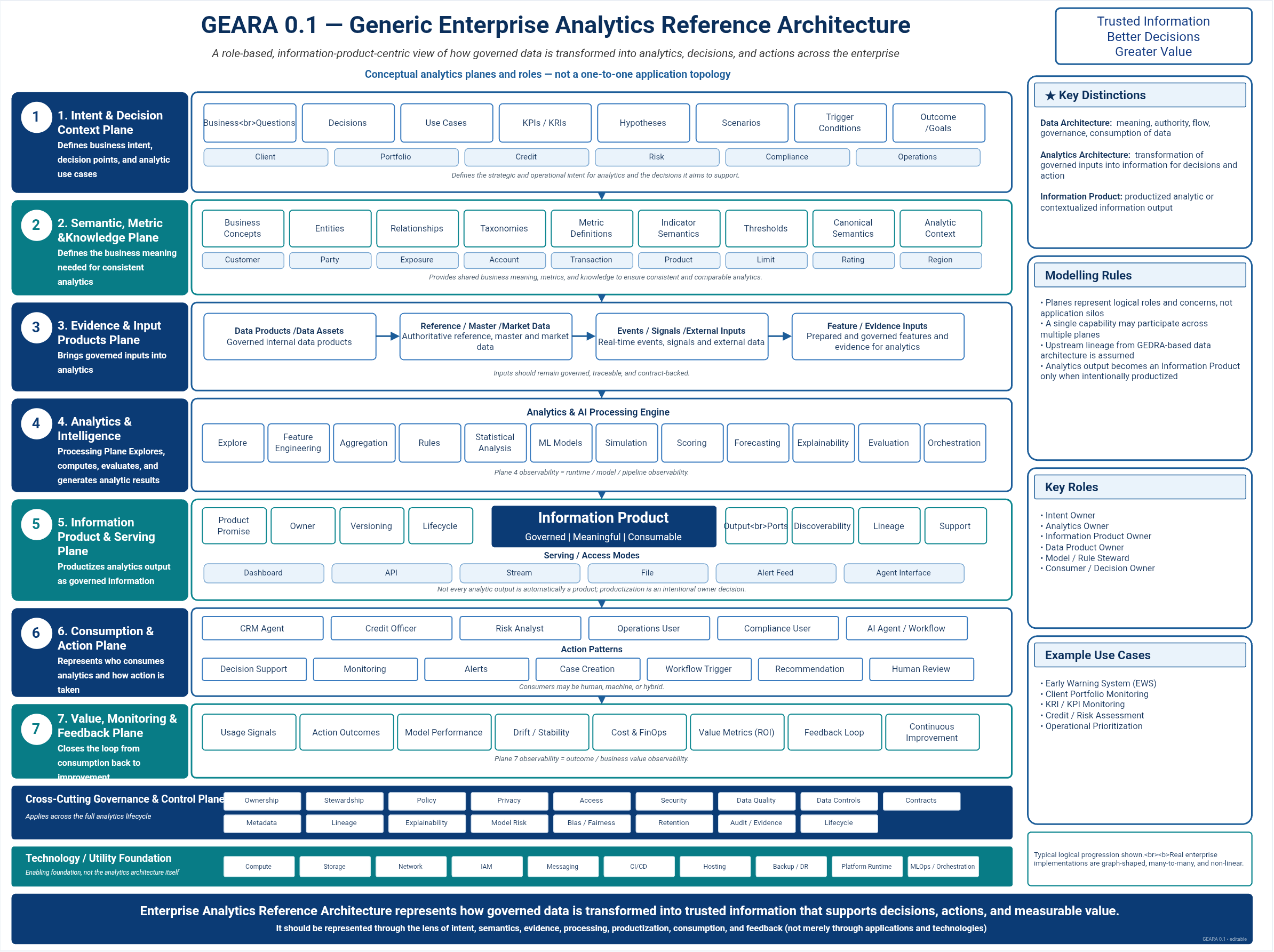
6.1 Architectural Decomposition
GEARA defines five primary responsibility Planes, five cross-cutting Fabrics, and a Shared Platform / Utility Foundation.
P1  Intent, Semantics & Design
P2  Discovery, Composition & Realization
P3  Analytical Runtime & Information Formation
P4  Provision, Consumption & Decision Integration
P5  Outcome, Value & Evolution
Cross-cutting Fabrics:
Governance / Policy / Assurance
Security / Privacy / Entitlement
Provenance / Evidence / Observability
Quality / Trust
Lifecycle / Version / Change
Foundation:
Shared Platform / Utility Foundation
The decomposition is logical. It SHALL NOT be interpreted as five physical systems.
6.2 P1 — Intent, Semantics & Design
The Intent, Semantics & Design Plane provides architectural responsibility for expressing what analytical capability is required and defining the governed meaning necessary to realize it.
P1 responsibilities SHOULD include, where applicable:
- Information Need capture;
- Analytical Intent definition;
- Analytical Use Case definition;
- Analytical Subject and Population definition;
- governed semantic discovery and authoring;
- Metric, Indicator, KPI, KRI, Threshold, Classification, Score, and State definition references;
- expected Analytical Output definition;
- analytical dependency declaration;
- Information Proposition design;
- Product Intent and Product Promise reference where Productization applies;
- Consumer and access intent;
- policy, quality, security, provenance, and lifecycle requirements;
- versioned design metadata.
P1 answers:
What are we trying to achieve, what does it mean, and what governed analytical contract are we designing?
P1 SHALL NOT be interpreted as merely a semantic registry or metadata tool.
6.3 P1 Semantic Authority Boundary
P1 enables authoring, discovery, governance, and reference of semantics but SHALL NOT assume authority over concepts owned elsewhere.
- Product semantics remain governed by BPS and applicable Product-family specifications.
- Data semantics remain governed by GEDRM and applicable Data specifications.
- AI Product semantics remain governed by AIPS.
- GEARM remains authoritative for generic analytical semantics.
A P1 platform MAY store a Metric Definition without becoming its Semantic Authority.
6.4 P2 — Discovery, Composition & Realization
The Discovery, Composition & Realization Plane provides architectural responsibility for transforming governed analytical design into a validated, deployable analytical realization.
P2 responsibilities SHOULD include, where applicable:
- Product discovery;
- Semantic discovery;
- Analytics Capability discovery;
- AI Product discovery;
- dependency resolution;
- input and semantic binding;
- analytical composition;
- rules and Threshold binding;
- AI Product invocation binding;
- compatibility and impact analysis;
- semantic, policy, security, quality, and runtime validation;
- testing and simulation;
- intent realization / compilation;
- runtime binding;
- deployment generation and release preparation;
- registry registration;
- change-impact analysis.
P2 is the primary architectural home of governed analytical self-service and the Symbiant realization model.
6.5 Intent-Driven Realization
The target interaction is:
Governed Intent
      ↓
Governed Definition
      ↓
Discover
      ↓
Compose
      ↓
Validate
      ↓
Test / Simulate
      ↓
Compile / Translate / Configure
      ↓
Bind to Runtime
      ↓
Deploy
GEARA does not require literal code compilation. An Intent Realization Capability MAY compile, interpret, configure, orchestrate, translate, or generate implementation from governed intent.
Self-service proposition: The owner builds the use case; the platform supplies the engineering.
6.6 P3 — Analytical Runtime & Information Formation
The Analytical Runtime & Information Formation Plane provides architectural responsibility for executing governed analytical realizations and forming Analytical Outputs and Information.
P3 responsibilities SHOULD include, where applicable:
- governed input acquisition;
- batch, streaming, event-driven, interactive, scheduled, continuous, or human-assisted execution;
- Data Product consumption;
- Information Product consumption;
- AI Product invocation;
- Metric calculation;
- Indicator and Threshold evaluation;
- rule execution;
- classification and scoring;
- detection and anomaly evaluation;
- prediction and forecasting;
- simulation and scenario execution;
- assessment, interpretation, explanation, and synthesis;
- analytical state management;
- intermediate output handling;
- runtime quality checks;
- provenance, evidence, and operational telemetry emission.
P3 is a logical runtime responsibility and SHALL NOT require one centralized analytics platform.
6.7 Runtime Semantic Binding
P3 SHOULD execute a governed realization that explicitly binds applicable semantic and dependency versions.
Example:
Metric Definition v3
        ↓ bound by P2
Analytical Process v7
        ↓ executed by P3
Metric Observation
        ↓ provenance
used Metric Definition v3
Generated SQL, Python, rules, model invocation, or configuration SHALL NOT replace the governed semantic definition.
6.8 P4 — Provision, Consumption & Decision Integration
The Provision, Consumption & Decision Integration Plane provides architectural responsibility for exposing Analytical Information to governed Consumers and integrating that Information with downstream Recommendation, Decision, Action, and workflow environments.
P4 responsibilities SHOULD include, where applicable:
- direct Analytical Output provision;
- Information Product output provision;
- Output Port operation;
- API, stream, event, query, subscription, notification, file, interactive, or agent interface provision;
- Product discovery and marketplace integration;
- Consumer discovery and onboarding;
- Consumer entitlement enforcement;
- Consumption Event capture;
- interactive analytics;
- Recommendation integration;
- Decision-system integration;
- Action and workflow integration.
P4 SHALL NOT be interpreted as a dashboard/BI layer. Consumers MAY be humans, applications, services, agents, workflows, Products, or downstream Analytics.
6.9 Direct and Productized Provision
P4 SHALL support both:
Analytical Information
      ↓
Direct Provision
      ↓
Consumer
and:
Analytical Information
      ↓
Information Proposition
      ↓
intentional Productization
      ↓
Information Product
      ↓
Output Port
      ↓
Consumer
Direct analytical consumption is first-class and is not an inferior architectural state.
6.10 Decision Integration Boundary
P4 MAY integrate Information and Recommendations into Decision environments. It SHALL preserve the semantic distinction among:
Information
Recommendation
Decision
Action
Outcome
P4 integration SHALL NOT imply that the analytics platform universally owns Decision policy or Decision authority.
6.11 P5 — Outcome, Value & Evolution
The Outcome, Value & Evolution Plane provides architectural responsibility for observing the effect and usefulness of analytical Information and feeding governed evidence back into analytical evolution.
P5 responsibilities SHOULD include, where applicable:
- Outcome Observation integration;
- Consumer Feedback;
- Recommendation disposition analysis;
- Decision and Action Feedback;
- false-positive and false-negative evidence;
- analytical effectiveness assessment;
- Information Product effectiveness assessment;
- Value evidence and Value assessment;
- usage interpretation;
- Outcome attribution evidence;
- drift evidence;
- evolution triggers and change proposals.
P5 distinguishes operational health from analytical effectiveness.
Runtime latency / failures / throughput
    !=
Did the analytical Information help?
6.12 Governance / Policy / Assurance Fabric
The Governance Fabric spans P1–P5 and provides cross-cutting responsibility for:
- policy;
- control;
- regulatory constraints;
- semantic governance;
- Product governance integration;
- approvals where judgement is required;
- exception and waiver handling;
- assurance;
- conformance;
- segregation of duties.
GEARA SHOULD favor embedded guardrails over unnecessary manual gates where policy can be evaluated reliably by machine.
6.13 Security / Privacy / Entitlement Fabric
The Security Fabric spans P1–P5 and integrates enterprise security capabilities for:
- identity;
- authentication;
- authorization;
- entitlement;
- purpose limitation;
- privacy;
- confidentiality;
- data minimization;
- sensitive metadata protection;
- provenance access control.
Security SHALL NOT be treated as solely a P4 access concern.
6.14 Provenance / Evidence / Observability Fabric
The Provenance Fabric provides cross-cutting architectural responsibility for preserving and exposing evidence concerning design, realization, execution, consumption, Decisions, Actions, Outcomes, and evolution.
Applicable evidence MAY include:
- Definition Provenance;
- Semantic Provenance;
- Logic and Method Provenance;
- Product and AI Product Provenance;
- Execution Provenance;
- Consumption Provenance;
- Decision and Action Provenance;
- Outcome and Feedback Provenance;
- operational telemetry.
Provenance and Observability MAY share implementation but SHALL remain semantically distinguishable.
6.15 Quality / Trust Fabric
The Quality / Trust Fabric provides cross-cutting responsibility for evaluating and exposing fitness and trust characteristics relevant to analytical Information.
It MAY integrate:
- input quality;
- semantic quality;
- analytical quality;
- AI/model quality;
- Information Product quality;
- freshness;
- completeness;
- uncertainty;
- reproducibility;
- known limitations;
- Fitness for Use.
Quality dimensions SHALL NOT be collapsed into a universal opaque score by core GEARA.
6.16 Lifecycle / Version / Change Fabric
The Lifecycle Fabric provides cross-cutting responsibility for controlled evolution of semantic definitions, processes, logic, Products, dependencies, interfaces, realizations, deployments, policies, controls, and assurance evidence.
It MAY govern:
- identity and version;
- lifecycle state;
- currentness;
- compatibility;
- deprecation;
- retirement;
- migration;
- rollback;
- resilience;
- change impact;
- historical interpretability.
6.17 Shared Platform / Utility Foundation
The Foundation MAY include:
- compute;
- storage;
- network;
- messaging and eventing;
- orchestration;
- scheduling;
- runtime hosting;
- identity infrastructure;
- secrets and key infrastructure;
- logging and telemetry transport;
- API/service infrastructure;
- deployment infrastructure.
Foundation technology enables GEARA responsibilities but SHALL NOT define GEARM semantics or inherit analytical ownership.
6.18 Productization as Cross-Plane Concern
Information Productization spans multiple Planes:
P1
Information Proposition / Product Intent / Product Promise reference

P2
Product realization / dependency resolution / lifecycle preparation

P3
Information formation

P4
Output Ports / publication / discovery / consumption

P5
Product effectiveness / feedback / evolution
Productization therefore SHALL NOT be interpreted as a separate mandatory GEARA Plane.
6.19 Self-Service / Symbiant as Architectural Property
Governed analytical self-service is an architectural operating property spanning the model, with primary realization in P1 and P2 and dependencies on P3, P4, and the cross-cutting Fabrics.
Accountable Owner
        +
Governed Platform Capability
        =
Symbiant Analytical Capability
Self-service means guarded abstraction and reusable engineering, not unrestricted tool access.
7. Architectural Interactions and Flows
7.1 Interaction Contexts
GEARA distinguishes five broad interaction contexts:
- Design-Time — define governed analytical intent and meaning.
- Realization-Time — transform governed design into deployable realization.
- Run-Time — execute Analytics and form Information.
- Consumption / Decision-Time — expose and use Information.
- Evolution-Time — use evidence and Feedback to evolve analytical capability.
These contexts MAY overlap. One version MAY execute while another is being designed and validated.
7.2 Canonical Interaction Backbone
P1
Intent, Semantics & Design
        ↓ governed design
P2
Discovery, Composition & Realization
        ↓ deployable realization
P3
Analytical Runtime & Information Formation
        ↓ Information / Analytical Outputs
P4
Provision, Consumption & Decision Integration
        ↓ consumption / Decision / Action relationships
P5
Outcome, Value & Evolution
        ↓ Feedback / change motivation
        └──────────────→ P1 / P2 / P3 / P4
This backbone is explanatory, not a mandatory waterfall.
7.3 Interaction Types
GEARA interactions MAY represent:
- Definition Transfer;
- Reference;
- Discovery;
- Dependency Binding;
- Validation;
- Compilation / Translation;
- Deployment;
- Invocation;
- Consumption;
- Publication;
- Subscription;
- Event Propagation;
- Evidence Emission;
- Feedback;
- Change Proposal;
- Provenance Linkage.
Not every architectural relationship is a data flow.
7.4 Design and Discovery Iteration
P1 and P2 SHOULD support iterative design and discovery.
P1 -------------------- P2
 |                        |
 | define need            |
 |------ discover ------->|
 |<----- candidates ------|
 | select / design        |
 |------ bind intent ---->|
Design and discovery are iterative rather than strictly sequential.
7.5 Reuse Before Duplication
During design and realization, the architecture SHOULD enable discovery of existing governed semantics, Products, capabilities, and analytical assets before creation of local equivalents.
Reuse is not mandatory where existing constructs are unsuitable. The objective is governed discovery before unnecessary duplication.
7.6 Governed Analytical Design Contract
The P1→P2 interaction SHOULD provide sufficient governed design information to realize the Analytical Use Case, including where applicable:
- Analytical Use Case identity;
- Information Need and Analytical Intent;
- semantic-definition references;
- Population;
- input dependency requirements;
- expected output definitions;
- required Analytics Capabilities;
- policy, security, quality, and provenance requirements;
- Consumer intent;
- Product Intent where applicable.
P1 need not specify low-level implementation detail.
7.7 Realization-Time Flow
Governed Design
      ↓
Discover dependencies
      ↓
Resolve versions
      ↓
Bind semantics
      ↓
Compose Analytical Process
      ↓
Bind runtime capabilities
      ↓
Validate policy / compatibility
      ↓
Test / simulate
      ↓
Compile / translate / configure
      ↓
Prepare deployment
      ↓
Register realization
7.8 Semantic and Technical Validation
Semantic Validation
    asks
Does this mean what we claim?

Technical Validation
    asks
Can this implementation execute correctly?
Semantic validity and technical validity SHALL remain separately assessable.
7.9 Runtime Realization Contract
P2 SHOULD provide P3 with a governed runtime realization identifying, where applicable:
- Analytical Process identity and version;
- executable Analytical Logic;
- input Product bindings;
- semantic-definition bindings;
- AI Product bindings;
- parameterization;
- rules and Threshold versions;
- runtime policy;
- observability and provenance configuration;
- output definitions;
- deployment metadata.
P3 SHOULD NOT reconstruct governed meaning independently where the design contract already defines it.
7.10 Runtime Interaction
Governed Input(s)
      +
Semantic Definitions
      +
Analytical Process
      +
Runtime Context
      ↓
Analytical Execution
      ↓
Analytical Output Occurrence(s)
      ↓
Information Formation
Runtime MAY consume Data Products and Information Products, invoke AI Products, reference semantic definitions, evaluate rules, and consume previous Analytical Outputs.
7.11 Mixed Runtime Modes
One Analytical Use Case MAY combine modes such as:
- streaming detection;
- batch historical baseline calculation;
- request/response AI invocation;
- interactive analyst exploration.
An Analytical Use Case is not required to have one runtime mode.
7.12 Evidence Side-Flow
Material execution SHOULD conceptually produce both:
Analytical / Business Output
        +
Governance / Evidence Output
Evidence MAY feed provenance, quality, observability, audit, assurance, and lifecycle capabilities.
7.13 Direct Analytical Consumption Flow
P1 Design
      ↓
P2 Realization
      ↓
P3 Analytical Output
      ↓
P4 Direct Provision
      ↓
Consumer
No Information Product is required.
7.14 Information Product Provision Flow
P1
Information Proposition
+ Product Intent
+ Product Promise reference
      ↓
P2
resolve dependencies / realize Product
      ↓
P3
form analytical Information
      ↓
P4
Information Product / Output Port / discovery / onboarding
      ↓
Consumer
7.15 Analytical Chaining
An Analytical Output MAY become a governed input to downstream Analytics without Productization at every intermediate boundary.
Process A → Output A → Process B → Output B
Productization remains optional and intentional.
7.16 AI-Assisted Analytics Flow
P1
Analytical Use Case / output semantics
      ↓
P2
Discover AI Product / validate fitness / bind version
      ↓
P3
prepare input / invoke AI Product / receive output
      ↓
classify output using GEARM semantics
      ↓
post-process / synthesize
      ↓
P4 provision
An AI Product output SHOULD be represented as its applicable semantic type such as Prediction, Classification, Score, or Explanation rather than an opaque universal AI Output type.
7.17 Interactive Analytics Flow
Consumer
   ↓
P4 interactive interface
   ↓
P3 runtime
   ↓
query / calculate / simulate
   ↓
P4 result
   ↓
Consumer
P3↔P4 interactions MAY repeat iteratively.
7.18 Exploratory-to-Governed Promotion
Exploratory analysis MAY produce candidate Metrics, rules, or insights. A candidate SHALL NOT silently become a canonical governed semantic definition.
Explore
  ↓
Candidate definition / insight
  ↓
Governed review / promotion
  ↓
P1 semantic governance
  ↓
P2 realization
7.19 Decision-Support Flow
Analytical Information
      +
Recommendation where applicable
      +
Policy / context
      ↓
Decision Actor
      ↓
Decision Event
Analytics informs the Decision; Decision authority remains separately governed.
7.20 Automated Decision Integration
Where governance permits:
Analytical Information
      +
Decision Policy
      +
Delegated Authority
      ↓
Authorized Machine Decision
      ↓
Action Integration
Technical capability SHALL NOT be treated as sufficient evidence of Decision authority.
7.21 Outcome and Feedback Flow
Consumption / Decision / Action
      ↓
Outcome
      ↓
Outcome Observation
      ↓
P5 effectiveness / Value / Feedback
Outcome evidence MAY originate from systems external to the analytical platform.
7.22 Feedback Routing
Feedback MAY target different responsibilities:
P5 → P1 semantic / intent review
P5 → P2 realization improvement
P5 → P3 runtime tuning
P5 → P4 consumer / provision improvement
Feedback SHALL NOT itself authorize semantic or Product change.
7.23 Semantic Change Propagation
Semantic Definition v3 → v4
      ↓
P2 impact analysis
      ↓
affected Processes / Products / Consumers
      ↓
new realization
      ↓
version compatibility / migration
      ↓
P5 impact monitoring
Structural compatibility SHALL NOT substitute for semantic compatibility.
7.24 Provenance Continuity
Upstream Provenance
      ↓
P2 binding evidence
      ↓
P3 execution / derivation provenance
      ↓
P4 consumption / Decision provenance
      ↓
P5 Outcome / Feedback provenance
GEARA SHOULD preserve resolvable linkage across distributed boundaries without requiring a universal centralized provenance store.
7.25 Failure and Exception Interaction
GEARA SHOULD support governed handling of failures and exceptions during discovery, validation, deployment, execution, Product invocation, Information provision, consumption, Decision integration, and Action execution.
Possible behaviors MAY include:
- fail execution;
- reject or quarantine;
- use an approved fallback;
- degrade with explicit status;
- continue under policy;
- escalate for human review;
- require an exception.
A degraded or fallback result SHOULD NOT silently appear equivalent to the intended normal path where fitness or meaning is materially affected.
7.26 Canonical Interaction Patterns
GEARA recognizes the following interaction patterns:
F1  Governed Design Flow
F2  Intent-to-Realization Flow
F3  Analytical Runtime Flow
F4  Direct Analytical Consumption Flow
F5  Information Product Provision Flow
F6  AI-Assisted Analytics Flow
F7  Interactive Analytical Flow
F8  Analytical Chaining Flow
F9  Decision-Support Flow
F10 Automated-Decision Integration Flow
F11 Outcome & Feedback Flow
F12 Semantic Change Propagation Flow
F13 Upstream Dependency Change Flow
F14 Provenance Continuity Flow
F15 Exploratory-to-Governed Promotion Flow
These are composable patterns rather than mandatory stages.
8. Architectural Capabilities and Building Blocks
8.1 Capability Taxonomy
GEARA groups capabilities into:
- Design & Semantic Capabilities;
- Discovery & Realization Capabilities;
- Runtime & Information Formation Capabilities;
- Provision & Consumption Capabilities;
- Outcome & Evolution Capabilities;
- Cross-Cutting Governance Capabilities;
- Shared Foundation Capabilities.
A conforming architecture SHALL realize applicable capabilities but is not required to instantiate every named ABB as a separate component.
8.2 P1 Capabilities
Applicable P1 capabilities include:
- Information Need & Analytical Intent Management;
- Analytical Semantic Management;
- Semantic Mapping & Authority Resolution;
- Analytical Design Management;
- Information Proposition & Product Intent Design.
Reference ABBs
P1.1 Analytical Design Workbench
P1.2 Analytical Semantic Registry
P1.3 Semantic Mapping Registry
P1.4 Analytical Use Case Registry
P1.5 Information Proposition Designer
8.3 Analytical Design Workbench
The Analytical Design Workbench is a logical ABB supporting governed analytical design. It MAY provide:
- Information Need authoring;
- Analytical Intent and Use Case definition;
- semantic and dependency discovery;
- Population definition;
- expected-output definition;
- security, quality, and provenance requirement declaration;
- Product Intent where applicable.
The Workbench SHALL NOT become semantic authority merely by hosting authoring functions.
8.4 Analytical Semantic Registry
The Analytical Semantic Registry provides logical capability for registration, discovery, identity, versioning, mapping, and reference of governed analytical semantic definitions.
It MAY store or reference Measures, Metrics, Indicators, KPI/KRI designations, Thresholds, Populations, Classifications, Scores, and States.
Registry != Semantic Authority
The Registry MAY be federated.
8.5 P2 Capabilities
Applicable P2 capabilities include:
- Governed Discovery;
- Dependency Resolution;
- Compatibility & Impact Analysis;
- Analytical Composition;
- Policy & Constraint Validation;
- Analytical Test & Simulation;
- Intent Realization / Compilation;
- Deployment & Release Orchestration.
Reference ABBs
P2.1 Governed Discovery Service
P2.2 Dependency Resolver
P2.3 Compatibility & Impact Analyzer
P2.4 Analytical Composition Engine
P2.5 Policy Validation Engine
P2.6 Analytical Test & Simulation Harness
P2.7 Intent Realization Engine
P2.8 Deployment & Release Orchestrator
8.6 Governed Discovery
The architecture SHOULD support discovery of governed resources including Data Products, Information Products, AI Products, semantic definitions, Analytical Processes, rules, platform capabilities, and Output Ports.
Discovery MAY federate multiple registries and authoritative stores. Discovery does not require physical metadata centralization.
8.7 Dependency Resolution
The architecture SHOULD resolve governed dependency identity, type, version, availability, authority, lifecycle state, interface, and compatibility where applicable.
Dependencies MAY include Product, semantic, AI, rule, model, temporal, reference-information, and Analytical Process dependencies.
8.8 Compatibility & Impact Analysis
Compatibility analysis SHOULD distinguish at least:
- semantic compatibility;
- structural compatibility;
- interface compatibility;
- Product compatibility;
- policy compatibility;
- behavioral compatibility;
- Consumer compatibility;
- assurance compatibility.
Impact analysis SHOULD traverse relevant dependency relationships and identify affected Processes, Products, ports, Consumers, Decisions, policies, and assurance claims where applicable.
8.9 Analytical Composition
The architecture SHOULD support governed composition of Data Products, AI Products, Information Products, semantic definitions, rules, Thresholds, analytical logic, human analytical activities, and other Analytical Processes into an Analytical Process.
Composition SHALL NOT imply ontology inheritance or ownership transfer.
8.10 Intent Realization Engine
The Intent Realization Engine is the logical ABB for translating governed analytical design into deployable realization.
It MAY perform:
- semantic binding;
- dependency binding;
- runtime selection;
- logic or configuration generation;
- policy injection;
- provenance and observability instrumentation;
- deployment descriptor generation;
- registry registration.
The engine MAY compile, interpret, configure, translate, orchestrate, or generate. It SHALL NOT become semantic authority merely because it generates an implementation.
8.11 P3 Capabilities
Applicable P3 capabilities include:
- Governed Input Acquisition;
- Analytical Execution;
- AI Product Invocation;
- Rule / Condition / Threshold Evaluation;
- Analytical State Management;
- Information Formation & Synthesis;
- Runtime Evidence Emission.
Reference ABBs
P3.1 Governed Input Adapter
P3.2 Analytical Runtime
P3.3 AI Product Gateway
P3.4 Rule & Condition Evaluation Engine
P3.5 Analytical State Manager
P3.6 Information Formation / Synthesis Engine
P3.7 Runtime Evidence Emitter
8.12 Analytical Runtime
The Analytical Runtime represents logical responsibility for executing governed Analytical Processes.
It MAY be realized using SQL, stream processing, rules, statistics, simulation, ML/AI, human analytical tasks, agents, or combinations.
Analytical Runtime ABB != single analytics platform
8.13 AI Product Gateway
Where useful, an AI Product Gateway MAY provide governed AI Product discovery, version binding, input preparation, invocation, response capture, provenance reference, failure handling, and fallback handling.
A separate gateway component is not mandatory if equivalent capability exists elsewhere.
8.14 Analytical State Management
Where an Analytical Use Case maintains state, the architecture MAY provide governed state persistence and transition management with identity, effective time, semantic definition, and transition evidence.
Examples include Early Warning State, Fraud Monitoring State, or Portfolio Risk State.
8.15 Runtime Evidence Emission
Runtime SHOULD emit material evidence such as execution identity, Process version, semantic versions, input Product versions, AI Product version, logic version, output identifiers, quality observations, fallback mode, and operational telemetry where applicable.
8.16 P4 Capabilities
Applicable P4 capabilities include:
- Governed Information Provision;
- Information Product Provision;
- Consumer Discovery & Access;
- Consumer Entitlement;
- Interactive Analytics;
- Consumption Event Capture;
- Recommendation Integration;
- Decision Integration;
- Action / Workflow Integration.
Reference ABBs
P4.1 Information Provision Gateway
P4.2 Information Product Publisher
P4.3 Product / Marketplace Adapter
P4.4 Consumer Access Gateway
P4.5 Interactive Analytics Interface
P4.6 Consumption Evidence Emitter
P4.7 Recommendation Adapter
P4.8 Decision Integration Adapter
P4.9 Action / Workflow Adapter
8.17 Information Provision Gateway
The Information Provision Gateway represents logical responsibility for exposing governed Analytical Information through interfaces such as APIs, queries, events, streams, notifications, subscriptions, files, interactive experiences, or agent interfaces.
It MAY provide version routing, access enforcement, semantic metadata exposure, quality evidence, and provenance references.
It is not necessarily one API gateway.
8.18 Information Product Publisher
Where Productization applies, the architecture MAY support Product registration, Output Port registration, versioning, Product Promise publication, Consumer onboarding, subscription, and Product observability.
Information Provision and Information Product Provision SHALL remain distinguishable.
8.19 P5 Capabilities
Applicable P5 capabilities include:
- Outcome Observation Integration;
- Feedback Capture;
- Analytical Effectiveness Evaluation;
- Value Assessment;
- false-positive / false-negative evaluation;
- Consumer Experience Assessment;
- Evolution Initiation.
Reference ABBs
P5.1 Outcome Integration Service
P5.2 Feedback Service
P5.3 Analytical Effectiveness Evaluator
P5.4 Value Evidence & Assessment Capability
P5.5 Analytical Learning / Evolution Manager
Learning in this ABB name means governed analytical/organizational feedback and does not imply machine learning.
8.20 Cross-Cutting Governance Capabilities
Reference capabilities include:
GOV-01 Policy Definition & Registry
GOV-02 Policy Resolution
GOV-03 Guardrail / Control Evaluation
GOV-04 Approval / Gate Management
GOV-05 Exception & Waiver Management
GOV-06 Risk Classification
GOV-07 Separation-of-Duties Enforcement
GOV-08 Conformance Assessment
GOV-09 Assurance Evidence Correlation
GOV-10 Governance Decision Recording
GOV-11 Control Effectiveness Monitoring
GOV-12 Policy / Control Change Management
8.21 Cross-Cutting Security Capabilities
Reference capabilities include:
SEC-01 Identity Resolution
SEC-02 Authentication Integration
SEC-03 Authorization / Entitlement Evaluation
SEC-04 Purpose-Aware Access Control
SEC-05 Privacy Constraint Evaluation
SEC-06 Sensitive Metadata Protection
8.22 Cross-Cutting Provenance Capabilities
Reference capabilities include:
PVE-01 Stable Identity Resolution
PVE-02 Provenance Capture
PVE-03 Provenance Federation
PVE-04 Lineage Resolution
PVE-05 Evidence Correlation
PVE-06 Runtime Observability
PVE-07 Consumption / Decision / Action Traceability
PVE-08 Historical Reconstruction
A Provenance Federation ABB SHOULD enable resolution across distributed authoritative sources without requiring all provenance to be copied centrally.
8.23 Cross-Cutting Trust / Assurance Capabilities
Reference capabilities include:
TRUST-01 Quality Evidence Collection
TRUST-02 Uncertainty / Confidence Exposure
TRUST-03 Fitness-for-Use Evaluation
TRUST-04 Trust Evidence Federation
TRUST-05 Known-Limitation Discovery
TRUST-06 Trust Evidence Presentation

ASSURE-01 Analytical Assurance Assessment
ASSURE-02 Assurance Evidence Correlation
ASSURE-03 Assurance Currentness / Invalidation
ASSURE-04 Runtime Assurance Monitoring
ASSURE-05 Reassessment Triggering
8.24 Lifecycle Capabilities
Reference capabilities include:
LCM-01 Lifecycle State Management
LCM-02 Identity & Version Management
LCM-03 Currentness Evaluation
LCM-04 Dependency Impact Analysis
LCM-05 Compatibility Evaluation
LCM-06 Change Classification
LCM-07 Release Orchestration
LCM-08 Migration Management
LCM-09 Deprecation & Retirement Management
LCM-10 Rollback / Forward-Fix Management
LCM-11 Fallback & Degraded-Mode Management
LCM-12 Resilience / Continuity Coordination
LCM-13 State Recovery / Replay Management
LCM-14 Drift Detection
LCM-15 Change Provenance
LCM-16 Consumer Change Notification
8.25 Capability Realization Rules
- Applicable capability is required; a particular named ABB is not.
- One IBB MAY realize multiple ABB responsibilities.
- One ABB MAY be distributed across multiple IBBs.
- Capability Provider SHALL NOT automatically inherit Analytical, Product, Semantic, or Decision ownership.
- Human processes MAY realize applicable capabilities where governance permits.
- Agents MAY invoke capabilities without thereby acquiring semantic authority or Decision authority.
9. Architectural Contracts, Registries and Governed Metadata
9.1 Connective Constructs
GEARA distinguishes three connective architectural constructs:
Architectural Contract
    specifies governed expectations,
    obligations and bindings

Registry
    makes governed identities,
    versions and relationships discoverable

Governed Metadata
    records information required
    to interpret and operate them
Contract != Registry
Registry != Metadata
Metadata != Semantic Authority
9.2 Architectural Contract
An Architectural Contract MAY describe:
- intended semantics;
- required dependencies;
- required capabilities;
- exact versions or compatibility ranges;
- compatibility expectations;
- runtime obligations;
- provision obligations;
- quality requirements;
- security requirements;
- provenance requirements;
- lifecycle constraints.
The Contract is the governed meaning of the relationship, not its serialization.
9.3 Canonical Contract Families
GEARA defines seven logical Contract families:
C1  Analytical Design Contract
C2  Dependency Contract
C3  Runtime Realization Contract
C4  Provision Contract
C5  Consumer / Access Contract
C6  Evidence & Provenance Contract
C7  Change & Compatibility Contract
These do not imply seven files or seven systems.
9.4 Analytical Design Contract
The Analytical Design Contract expresses the governed analytical design to be realized. It SHOULD identify, where applicable:
- Analytical Use Case identity;
- Information Need;
- Analytical Intent;
- Analytical Subject;
- Population;
- semantic-definition references;
- expected Analytical Outputs;
- required Analytics Capabilities;
- dependency requirements;
- quality expectations;
- security constraints;
- provenance expectations;
- intended Consumers;
- Information Proposition;
- Product Intent where applicable.
The Contract captures governed intent rather than every low-level implementation decision.
9.5 Semantic References
Contracts SHOULD reference canonical governed identities and versions rather than unnecessarily copying complete semantic definitions.
reference canonical definition
    preferred over
uncontrolled duplicated definition text
This improves currentness, impact analysis, and provenance.
9.6 Dependency Contract
A Dependency Contract declares a governed dependency required by a design or realization. It SHOULD identify, where applicable:
- dependency identity;
- dependency type;
- semantic or Product authority;
- required version or compatibility range;
- required interface / Output Port;
- semantic characteristics;
- quality expectations;
- availability expectations;
- fallback policy.
GEARA distinguishes:
Dependency Intent
    "I require a governed exposure source"

Dependency Binding
    "Use Product X v5, port Y v2"
Dependency Intent and Dependency Binding SHALL remain distinguishable.
9.7 Runtime Realization Contract
The Runtime Realization Contract describes the governed realization that P3 is expected to execute. It SHOULD identify, where applicable:
- Analytical Process identity and version;
- semantic-definition versions;
- Product dependencies and versions;
- AI Product dependencies and versions;
- rules and Threshold versions;
- executable Analytical Logic reference;
- runtime capability requirements;
- parameterization;
- deployment identity;
- expected output definitions;
- applicable security policy;
- quality obligations;
- provenance and observability obligations;
- failure and fallback policy.
9.8 Realization Identity
Analytical Use Case, Analytical Process, Process Version, Runtime Realization, and Deployment SHOULD remain separately identifiable where material.
Analytical Design Version != Process Version
Process Version != Deployment Version
Runtime Realization != Deployment
9.9 Provision Contract
The Provision Contract describes how governed Analytical Outputs or Information are made available to Consumers. It MAY identify:
- Information / Analytical Output identity;
- semantic definition and version;
- Product identity where applicable;
- Product version;
- Output Port;
- delivery mode;
- interface version and schema;
- freshness and quality characteristics;
- entitlement requirements;
- provenance availability;
- compatibility expectations.
A direct Analytical Output MAY have a Provision Contract without being a Product.
9.10 Consumer / Access Contract
A Consumer / Access Contract describes the governed relationship under which a Consumer is permitted to receive or use analytical Information.
It MAY identify:
- Consumer identity or class;
- Information or Product consumed;
- authorized purpose;
- entitlement;
- permitted interfaces;
- usage and privacy constraints;
- version compatibility;
- subscription characteristics.
A Consumer / Access Contract is broader than Product onboarding.
9.11 Evidence & Provenance Contract
The Evidence & Provenance Contract declares evidence that a realization or interaction is expected to produce or preserve.
It MAY include requirements for:
- semantic provenance;
- dependency provenance;
- Process provenance;
- execution provenance;
- AI Product provenance;
- Product provenance;
- Consumption Events;
- Decision / Action / Outcome relationships;
- operational telemetry;
- quality evidence;
- retention and access.
Provenance depth SHOULD be proportionate to risk, consequence, and assurance need.
9.12 Change & Compatibility Contract
A Change & Compatibility Contract expresses compatibility expectations and change-handling obligations among governed dependencies, interfaces, semantics, Products, and Consumers.
It MAY identify:
- supported semantic versions;
- supported schema/interface versions;
- compatible Product versions;
- deprecation period;
- migration rules;
- breaking-change criteria;
- notification obligations.
Compatibility is directional and contextual. It SHALL NOT be represented solely as an intrinsic Boolean of one artifact where the relationship depends on another party.
9.13 Compatibility Dimensions
GEARA recognizes at least:
Semantic Compatibility
Structural Compatibility
Interface Compatibility
Behavioral Compatibility
Policy Compatibility
Product Compatibility
Consumer Compatibility
Assurance Compatibility
Passing one dimension SHALL NOT imply passing the others.
9.14 Contract Graph
Information Need
      ↓
Analytical Design Contract
      ├── references → Semantic Definitions
      ├── requires   → Dependency Contracts
      └── requires   → Evidence Contract
      ↓
Runtime Realization Contract
      ├── binds → Product / AI Product versions
      ├── binds → Logic / Runtime
      ↓
Provision Contract
      ↓
Consumer / Access Contract
Change & Compatibility Contracts govern evolution across the graph.
9.15 Registry
A Registry MAY store authoritative metadata, reference authoritative metadata elsewhere, federate multiple sources, or expose discovery/resolution interfaces.
Registry of Record
    authoritative for
registered record/state

Semantic Authority
    authoritative for
meaning
These responsibilities SHALL remain distinguishable.
9.16 Logical Registry Responsibilities
GEARA identifies the following logical registry responsibilities:
RR1  Analytical Use Case Registry
RR2  Analytical Semantic Registry
RR3  Product & Dependency Discovery
RR4  Capability Discovery
RR5  Analytical Realization Registry
RR6  Provision / Interface Registry
RR7  Policy & Constraint Registry
RR8  Provenance / Evidence Index
RR9  Lifecycle & Version Registry
They MAY be physically consolidated or federated.
9.17 Analytical Use Case Registry
The logical Use Case Registry SHOULD resolve, where applicable:
- Information Need;
- Analytical Intent;
- Analytical Use Case;
- accountability references;
- lifecycle state;
- semantic definitions;
- related realizations.
9.18 Analytical Semantic Registry
The logical Semantic Registry SHOULD resolve identity, version, authority, effective period, mappings, and specialization of governed analytical semantic definitions.
9.19 Product & Dependency Discovery
GEARA SHOULD reuse and federate existing Product, Data Product, AI Product, Data Catalog, Schema Registry, and other authoritative discovery systems where applicable rather than creating parallel copies by default.
9.20 Analytical Realization Registry
The Realization Registry SHOULD answer:
What governed realization currently implements this analytical design?
It MAY resolve Process version, realization, deployment, runtime binding, execution environment, and current deployment state.
9.21 Provision / Interface Registry
The logical Provision Registry MAY expose direct analytical interfaces, Product Output Ports, API versions, stream or event identifiers, query interfaces, subscriptions, and other provision mechanisms.
Interface Registry != Product Registry
9.22 Provenance / Evidence Index
The Provenance / Evidence Index enables resolution of where evidence resides and how identities relate to evidence. Actual evidence MAY remain distributed.
GEARA therefore favors a Federated Governed Registry Fabric rather than a mandatory mega-registry.
9.23 Registry Federation
                     Governed Discovery
                            |
         +------------------+------------------+
         |                  |                  |
   Semantic Registry   Product Registries  AI Registry
         |                  |                  |
         +---------+--------+---------+--------+
                   |                  |
             Realization          Policy
              Registry            Registry
                   \                /
                    \              /
                  Provenance Index
GEARA SHOULD prefer governed reference and federation over unnecessary duplication. Where metadata is copied, source authority, synchronization, freshness, version, and conflict handling SHOULD be explicit.
9.24 Governed Metadata Categories
GEARA recognizes the following generic metadata categories:
M1   Identity Metadata
M2   Semantic Metadata
M3   Intent Metadata
M4   Dependency Metadata
M5   Realization Metadata
M6   Interface / Provision Metadata
M7   Consumer / Access Metadata
M8   Governance / Policy Metadata
M9   Quality / Trust Metadata
M10  Provenance / Evidence Metadata
M11  Lifecycle / Version Metadata
M12  Temporal Metadata
These categories may overlap and need not reside together.
9.25 Identity Metadata
Material governed entities SHOULD have stable identities where they must be referenced across systems, versions, or time.
Labels SHALL NOT substitute for machine identity where semantic ambiguity is possible.
9.26 Temporal Metadata
Where material, GEARA SHOULD distinguish applicable temporal dimensions such as:
- effective time;
- observation time;
- processing time;
- publication time;
- consumption time;
- Decision time;
- Action time;
- Outcome time.
These SHOULD NOT be collapsed into a generic timestamp where the distinction affects meaning or provenance.
9.27 Definition and Occurrence Metadata
GEARA SHALL preserve distinctions such as:
Metric Definition metadata != Metric Observation metadata
Process Definition metadata != Execution metadata
Product metadata != Consumption Event metadata
9.28 Historical Preservation
Current-state metadata SHALL NOT overwrite historical definitions or evidence required to interpret previous executions.
Deprecation and retirement SHOULD preserve resolvable identity and version metadata for as long as historical interpretation requires them.
9.29 Version Binding Modes
GEARA MAY support:
EXACT
COMPATIBLE RANGE
LATEST COMPATIBLE
DYNAMIC
Dynamic or late binding SHALL remain governed and observable. Runtime provenance SHOULD capture the actual resolved version where material.
9.30 Contract Validation
Contracts MAY be validated across:
- structural validity;
- semantic validity;
- dependency validity;
- policy validity;
- runtime realizability.
Structural validity SHALL NOT substitute for semantic validity.
10. Governance, Control and Policy Architecture
10.1 Purpose
The Governance, Control & Policy architecture enables governed self-service, explicit authority, risk-proportionate control, automated guardrails, selective human approval, transparent exceptions, evidence-based assurance, and controlled evolution.
Governance principle: Governance SHOULD establish clear authority, explicit policy, embedded controls, and evidence-based assurance while allowing analytical owners to operate autonomously inside the governed operating envelope.
10.2 Governance Is Not Approval
Governance != Approval
Governance includes authority, policy, accountability, control, constraint, assurance, exception handling, evidence, and conformance. Approval is one possible mechanism.
More approvals or more controls SHALL NOT be assumed to imply stronger governance.
10.3 Governance Is Not Centralization
Federated governance MAY combine enterprise rules, domain authority, shared guardrails, and federated evidence.
Governance != Central Ownership
Centralization != Stronger Governance by definition
10.4 Authority Model
GEARA distinguishes, where applicable:
Semantic Authority
Analytical Ownership / Accountability
Product Authority / Product Ownership
Policy Authority
Control Ownership
Approval Authority
Exception / Waiver Authority
Decision Authority
Platform / Operational Authority
Assurance Authority
One actor MAY hold several authorities, but the responsibilities SHALL remain conceptually distinguishable.
10.5 Analytical Owner
The Analytical Owner is accountable for the governed Analytical Use Case or proposition, including appropriate intent, semantic fitness, dependency choice, Consumer need, and evolution.
Analytical Owner and Product Owner MAY coincide but are not necessarily identical.
10.6 Policy Authority and Control Owner
Policy Authority governs what behavior is required, permitted, prohibited, or conditional.
Control Owner is accountable for the design, adequacy, and lifecycle of a control used to satisfy policy.
Policy != Control
Policy Authority != Control Owner
10.7 Platform Authority Boundary
Platform teams MAY control runtime, deployment, operational service, and platform configuration, but platform authority SHALL NOT automatically confer:
- Semantic Authority;
- Analytical Ownership;
- Product Ownership;
- business Decision authority.
10.8 Policy
A Policy is a governed statement of required, permitted, prohibited, or conditionally permitted behavior.
Policy MAY constrain design, dependency use, runtime, Consumer access, Productization, AI invocation, data use, retention, provenance, and Decision integration.
10.9 Policy Hierarchy and Specialization
GEARA MAY support policy hierarchy such as:
External / Regulatory
        ↓
Enterprise Policy
        ↓
Division / Domain Policy
        ↓
Profile Policy
        ↓
Use-Case Constraint
Lower-level policy MAY specialize or tighten higher-level policy but SHOULD NOT silently weaken a mandatory upstream requirement.
10.10 Policy Conflict
Where applicable policies conflict, the architecture SHALL NOT silently choose one. Conflict SHOULD be surfaced to the applicable Policy Authorities according to enterprise/profile precedence rules.
GEARA does not impose one universal precedence algorithm.
10.11 Policy-as-Code
Where policy can be represented deterministically and evaluated reliably, GEARA SHOULD permit machine-executable policy and controls.
Policy Engine != Policy Authority
The engine executes governed policy representation; it does not own the policy meaning.
10.12 Guardrail and Gate
A Guardrail automatically or continuously constrains activity to a permitted operating space.
A Gate requires an explicit approval, decision, or determination before progression.
Guardrail != Gate
GEARA SHOULD prefer guardrails for deterministically evaluable rules and reserve gates for genuine judgement, accountable authorization, material risk acceptance, or unresolved ambiguity.
10.13 Control Classes
GEARA recognizes:
Preventive
Detective
Corrective
Directive
Evidentiary
A Control may execute at P1, P2, P3, P4, P5, or through cross-cutting infrastructure.
10.14 Shift-Left Governance
GEARA SHOULD validate as early as practical and enforce again at runtime where required.
P1 policy-aware design
P2 pre-deployment validation
P3 runtime enforcement
P4 Consumer entitlement
P5 effectiveness assurance
10.15 Risk-Proportionate Governance
Governance intensity SHOULD be proportionate to analytical consequence, regulatory significance, privacy sensitivity, AI involvement, automation/autonomy, external exposure, irreversibility, scale, and novelty.
GEARA supports risk classification but does not prescribe a universal risk-tier vocabulary. Profiles such as AIPS or enterprise governance MAY define exact tiers.
10.16 Separation of Duties
Separation of duties SHOULD be applied where material conflicts exist among authoring, approval, deployment, policy ownership, exception approval, and assurance.
GEARA does not require maximal segregation for every low-risk analytical activity.
same system != same authority
10.17 Governance Decision
A Governance Decision is an explicit determination concerning whether a governed analytical activity may proceed, continue, change, or receive an exception.
Governance Decision != Business Decision
10.18 Exception and Waiver
An Exception is a governed authorization permitting bounded deviation from an otherwise applicable policy, control, or constraint.
An Exception SHOULD identify:
- reason;
- scope;
- risk acceptance;
- authority;
- conditions;
- effective period and expiry;
- review date;
- compensating controls.
Exception != Policy Change
A Waiver MAY represent an explicit determination that a requirement does not apply within a defined scope, depending on enterprise terminology.
10.19 Break-Glass
A Break-Glass mechanism MAY permit urgent exceptional action where normal delay creates greater risk. It SHOULD be narrowly authorized, time-bounded, strongly evidenced, and subject to post-event review.
10.20 Governed Operating Envelope
The Governed Operating Envelope defines conditions under which an authorized analytical actor or capability may operate without additional case-by-case approval.
It MAY be constrained by:
- permitted Products;
- data classifications;
- AI Products;
- risk classification;
- Consumer scope;
- environment;
- Decision authority;
- runtime limits.
Governed autonomy proposition: Autonomy inside constraints; escalation at the boundary.
10.21 Delegated Authority and Autonomy
A machine or agent MAY receive delegated authority with explicit type, scope, constraints, effective period, and escalation conditions.
Automation != Autonomy
Technical Capability != Governed Authority
Delegation != automatic transfer of accountability
10.22 Control Evidence
Material control evaluation SHOULD be capable of producing evidence including control identity/version, policy reference, subject, context, result, time, actor/runtime, and exception reference where applicable.
Governance Decisions, approvals, and exceptions SHOULD be traceable where material.
10.23 Continuous Assurance
Where practical, GEARA SHOULD support continuous, event-driven, or change-triggered assurance based on generated evidence.
Observability != Assurance
Assurance != Audit
10.24 Control Effectiveness
A Control that always reports PASS is not automatically effective. Control effectiveness MAY consider false positives, false negatives, coverage, bypass, failure rate, exception rate, and latency.
Governance friction itself MAY be measured to identify unnecessary manual touchpoints, repeated exceptions, or approval queues that should be converted to reliable guardrails.
10.25 Governance and Symbiant
Accountable Owner
       |
       v
Self-Service Design
       |
       v
Automated Guardrails
       |
       +-- PASS → realization / deployment
       |
       +-- judgement required → selective Gate
       |
       +-- exception → Exception Authority
Governed self-service is not the absence of governance; it is governance embedded into reusable architecture.
11. Security, Privacy, Trust and Analytical Assurance
11.1 Security Boundary
GEARA defines analytical-security integration requirements and relies on enterprise security architecture for generic IAM, cryptography, network security, key management, endpoint security, and broader cyber operations.
GEARA security architecture
    integrates with
Enterprise Security Architecture

GEARA
    does not replace it
11.2 Identity, Authentication, Entitlement and Authorization
GEARA distinguishes:
Identity != Authentication
Authentication != Authorization
Authorization != Entitlement
Identity != Authority
Identity MAY apply to human Consumers, Analytical Owners, Decision Actors, Action Actors, services, agents, workloads, Products, or runtimes.
11.3 Human and Machine Identity
Human and machine identities SHALL remain distinguishable where the distinction affects authority, accountability, security, or provenance.
A service, workload, Product, or agent identity SHALL NOT be treated as a human identity merely for implementation convenience.
11.4 Purpose-Aware Authorization
Authorization MAY depend on Consumer, purpose, Product, data sensitivity, jurisdiction, risk classification, and context.
same Consumer
+ same Information
+ different Purpose
= potentially different authorization result
Role != Purpose
Where purpose materially affects access, the architecture SHOULD use governed purpose classification rather than unrestricted free text.
11.5 Fine-Grained Access
Access MAY be governed at Product, Output Port, Analytical Output, Population, Subject, attribute, provenance, or explanation level.
A Consumer permitted to see an Early Warning State need not be permitted to inspect all underlying transaction data or internal model details.
11.6 Information, Explanation and Provenance Access
Information Access != Full Provenance Access
Explanation != Provenance
Provenance MAY expose sensitive source data, identities, Decision history, model details, or proprietary logic and therefore MAY require independent entitlement.
11.7 Privacy and Data Minimization
Privacy SHOULD be considered at P1 and propagated through P2–P5.
The architecture SHOULD process, retain, and expose only data and metadata reasonably necessary for the governed analytical purpose, subject to applicable policy and regulation.
This applies to runtime inputs, Consumer identity, provenance, Decisions, Outcomes, and Feedback.
11.8 Derived-Information Sensitivity
Information Formation MAY create sensitivity not explicitly present in any individual input.
Examples include inferred financial vulnerability, fraud suspicion, credit deterioration, or other sensitive classifications.
Input Classification != Output Classification necessarily
Output sensitivity SHALL be governed explicitly rather than inherited mechanically in all cases.
11.9 Trust Evidence
Trust Evidence assists a Consumer, policy, or assurance function in determining whether Analytical Information is appropriate for an intended use.
Trust Evidence MAY include:
- semantic authority;
- provenance;
- input quality;
- analytical quality;
- freshness;
- uncertainty / confidence;
- AI assurance evidence;
- Product status;
- conformance evidence;
- runtime health;
- historical effectiveness;
- known limitations.
11.10 Contextual Trust
Trust != intrinsic universal property
Trust != Correctness
Trust != Quality
Trust != Provenance
Trust != Usage
The same Information MAY be fit for exploratory monitoring but not fit for an automated adverse Decision.
11.11 Quality Dimensions
GEARA distinguishes:
Input Quality
Semantic Quality
Analytical Process Quality
Analytical Output Quality
AI / Model Quality
Information Product Quality
Decision Quality
Outcome Effectiveness
These dimensions influence one another but SHALL NOT be collapsed into one universal quality concept.
11.12 Fitness for Use
Fitness for Use is the context-dependent determination that Analytical Information is sufficiently suitable for a specified intended use.
Fitness MAY depend on semantic relevance, freshness, quality, uncertainty, provenance, Consumer need, risk, Decision consequence, and policy.
Quality != Fitness for Use
11.13 Uncertainty and Confidence
Uncertainty MAY arise from data, method, model, assumption, sampling, temporal lag, missing context, or human judgement.
Uncertainty != Error
Confidence != Probability unless explicitly defined
Where confidence is material, its type, method, scale, source, and version SHOULD be interpretable.
11.14 Known Limitations
Known limitations SHOULD be represented where they affect Fitness for Use.
Examples include unsupported Populations, insufficient history, geography restrictions, known model limitations, data gaps, or invalid operating conditions.
No documented limitation != No limitation exists
11.15 Analytical Assurance
Analytical Assurance evaluates whether an Analytical Use Case, realization, or output satisfies applicable requirements for meaning, quality, security, provenance, policy, and fitness within a declared scope.
Analytical Assurance != Model Validation
Analytical Assurance != GEARA Conformance
Model validation, Product assurance, Data Product quality, and AI Product assurance MAY contribute to Analytical Assurance.
11.16 Assurance by Composition
Assurance of individual components SHALL NOT automatically establish assurance of their analytical composition or use.
Assured Components != Assured Composition
The composition itself SHOULD be assessed where material because unsuitable Population, stale data, incorrect semantics, or inappropriate dependency use can invalidate an otherwise assured component set.
11.17 Trust Evidence Packet
A Trust Evidence Packet is a governed, possibly federated collection of references to evidence relevant to evaluating analytical trust and fitness.
It MAY reference:
- semantic identity/version;
- provenance;
- quality evidence;
- uncertainty;
- AI assurance;
- Product status;
- runtime health;
- known limitations;
- conformance or assurance status.
The Packet is a logical construct and does not require one physical document.
11.18 Consumer Trust View
P4 MAY expose an appropriate Consumer Trust View aggregating semantic meaning, current version, freshness, quality, uncertainty, limitations, provenance summary, and assurance status.
GEARA SHOULD support layered transparency so a Consumer is not forced to interpret a raw metadata dump.
11.19 Machine-Readable Trust
Where automated Consumers or agents depend on analytical outputs, trust, quality, uncertainty, currentness, and fitness evidence SHOULD be machine-readable where practical.
Passing trust criteria SHALL NOT itself grant Decision authority.
11.20 Assurance Lifecycle
Analytical Assurance MAY include:
Design Assurance
Pre-Release Assurance
Runtime Assurance
Consumer / Use Assurance
Outcome / Effectiveness Assurance
Reassessment / Evolution
Not every use case requires every stage.
11.21 Assurance Currentness
An assurance result is relative to subject version, dependencies, policy version, assessment scope, and assessment time.
Material semantic, dependency, Population, AI Product, policy, provenance, or Product change MAY invalidate prior assurance and trigger proportionate reassessment.
11.22 Unknown Is Explicit
Unknown Quality != Good Quality
Missing Provenance != No Provenance Required
No Assurance Evidence != Assured
No recorded issue != Evidence of no issue
GEARA SHOULD preserve unknown or indeterminate states rather than interpret missing evidence as positive assurance.
12. Lifecycle, Versioning, Change, Resilience and Operational Evolution
12.1 Lifecycle Subjects
Lifecycle subjects MAY include Information Needs, Analytical Use Cases, semantic definitions, Analytical Processes, Analytical Logic, Runtime Realizations, dependency bindings, Information Products, Output Ports, interfaces, policies, controls, and assurance claims.
GEARA defines lifecycle responsibilities but not one universal lifecycle-state vocabulary.
12.2 Identity and Version
Logical Identity != Version Identity
Version != Modification Time
A logical concept MAY persist while governed versions evolve.
12.3 Independent Version Dimensions
GEARA recognizes independent version dimensions including:
Semantic Version
Analytical Process Version
Analytical Logic Version
Dependency Version
AI Product Version
Information Product Version
Output Port Version
Interface / Schema Version
Runtime Realization Version
Deployment Version
Policy / Control Version
Assurance Context / Evidence Version
These SHALL NOT be assumed to move in lockstep.
12.4 Semantic Version
A Semantic Version identifies a governed version of meaning. Changes to definition, subject, Population, grain, unit, scale, aggregation, temporal window, classification, Threshold meaning, or State semantics MAY require a new semantic version.
Structural Stability != Semantic Stability
12.5 Process, Logic, Realization and Deployment Version
Analytical Process, executable Logic, Runtime Realization, and Deployment SHALL remain separately identifiable where material.
An implementation optimization MAY change Logic or Deployment without changing semantic meaning.
12.6 Product, Port and Interface Version
Product Version != Output Port Version
Output Port Version != Interface Version necessarily
Interface Version != Semantic Version
Product-version rules remain governed by Product semantics. GEARA tracks architectural consequences.
12.7 Currentness
Currentness is the governed determination of whether a version, contract, realization, dependency, assurance result, or lifecycle state remains applicable for its intended context.
Latest Version != Current Applicable Version
Current != Universally Required
A supported prior version MAY remain current for a Consumer during controlled migration.
12.8 Effective Time
GEARA SHOULD distinguish publication, effective, deprecation, and retirement times where relevant.
Publication Time != Effective Time != Deprecation Time != Retirement Time
12.9 Change Taxonomy
GEARA recognizes:
CH1  Semantic Change
CH2  Analytical Design Change
CH3  Dependency Change
CH4  Analytical Process Change
CH5  Logic / Implementation Change
CH6  Product Change
CH7  Interface / Port Change
CH8  Policy / Control Change
CH9  Runtime / Infrastructure Change
CH10 Operational State Change
CH11 Assurance / Trust Change
A material change MAY belong to several classes.
12.10 Change Impact
Impact analysis SHOULD consider, where applicable:
- Semantic Impact;
- Dependency Impact;
- Process Impact;
- Product Impact;
- Consumer Impact;
- Decision Impact;
- Policy Impact;
- Security / Privacy Impact;
- Provenance Impact;
- Assurance Impact;
- Operational Impact.
12.11 Controlled Dependency Evolution
Upstream Version Change != Automatic Downstream Upgrade
Unless governed compatibility policy explicitly permits automatic resolution, an upstream change SHOULD undergo dependency resolution, compatibility assessment, impact analysis, testing, and controlled migration.
12.12 Compatibility Model
GEARA recognizes semantic, structural, interface, behavioral, policy, Product, Consumer, and assurance compatibility.
A change is breaking when it invalidates a required compatibility relationship. A breaking change need not alter a schema.
12.13 Coexistence
Multiple governed versions MAY coexist during migration where identity, Consumer mapping, compatibility windows, and retirement intent remain explicit.
Governed Coexistence != Uncontrolled Semantic Duplication
12.14 Deprecation and Retirement
Deprecation indicates that a version remains available or interpretable but should not normally be selected for new use.
Deprecated != Invalid
Retirement ends normal active use but SHALL NOT automatically erase historical identity, semantic definitions, or provenance required for historical interpretation.
Retired != Historically Erased
12.15 Rollout Strategies
GEARA MAY support implementation strategies including:
- Direct Replacement;
- Parallel Run;
- Canary;
- Blue/Green;
- Shadow Execution;
- Dual Publish;
- Consumer-by-Consumer Migration.
These are implementation patterns rather than semantic requirements.
12.16 Rollback and Forward Fix
Rollback restores a previously approved realization or deployment after a failed or unacceptable change.
Deployment Rollback != Semantic Rollback
Rollback != Historical Rewrite
Rollback SHALL preserve evidence of executions that actually occurred under the rolled-back version.
A forward fix MAY be used where rollback is unsafe or impossible.
12.17 Fallback and Degraded Operation
Fallback is a runtime alternative path when a preferred dependency or capability is unavailable or unsuitable.
Fallback != Rollback
Degraded Mode != Normal Mode silently
Where degradation materially affects quality, semantics, provenance, or fitness, the changed operating mode SHOULD be visible to authorized Consumers or downstream systems.
12.18 Resilience
Analytical Resilience is the ability to continue, recover, degrade safely, or restore analytical capability when dependencies, runtimes, interfaces, controls, or evidence capabilities fail.
Resilience MAY include:
- availability;
- recoverability;
- dependency resilience;
- semantic resilience;
- state resilience;
- provision resilience;
- control resilience;
- provenance resilience.
High availability alone SHALL NOT be treated as complete analytical resilience.
12.19 Cached and Last-Known-Good Information
Caching MAY support resilience but introduces freshness, semantic-version, and provenance concerns.
Last Known Good != Current Information
Fitness policy SHOULD determine whether cached or last-known-good Information is permitted for a particular use.
12.20 State Resilience
Stateful analytics MAY require state persistence, checkpointing, event replay, transition reconstruction, and semantic context sufficient for recovery.
Restoring technical state without restoring which semantic and Process versions governed that state MAY be insufficient.
12.21 Recovery, Retry, Replay, Recalculation and Backfill
GEARA distinguishes:
- Retry — another attempt to perform the same intended execution;
- Replay — reprocess historical inputs/events;
- Recalculation — intentionally form a new result for historical subject/time;
- Backfill — apply a capability retrospectively to periods in which it did not execute originally.
Historically Produced Result != Recalculated Result
Backfilled Result != Historical Runtime Observation
These occurrences SHOULD remain distinguishable in provenance.
12.22 Operational State
Operational state MAY include concepts such as Available, Degraded, Unavailable, Suspended, Recovering, or Retired.
Lifecycle State != Operational State
Operational State != Assurance State
State Change != Version Change
12.23 Drift
GEARA MAY support detection of:
- Data Drift;
- Semantic Drift;
- Model Drift;
- Behavioral Drift;
- Consumer / Use Drift;
- Policy Drift;
- Operational Drift.
Drift is divergence from governed expectation and SHALL NOT be treated as equivalent to a governed change.
Consumer / Use Drift is particularly important where an output originally used for human monitoring becomes used for automated Decision-making without explicit governance.
12.24 Currentness Propagation and Invalidation
A change in an upstream dependency, policy, assurance result, or semantic definition MAY invalidate downstream currentness even if downstream implementation bits do not change.
The architecture SHOULD support propagation of currentness or invalidation through governed dependency relationships.
12.25 Evolution Provenance
Material lifecycle change SHOULD be capable of tracing:
- what changed;
- from which version;
- to which version;
- why;
- who or what authorized it;
- when it became effective;
- which entities were affected.
Lifecycle transitions, rollout, rollback, fallback, recovery, retirement, and correction SHOULD produce sufficient evidence for Change and Evolution Provenance.
13. Conformance Model
13.1 Conformance Purpose
GEARA conformance evaluates whether an architecture preserves the applicable architectural responsibilities, relationships, contracts, controls, lifecycle principles, and GEARM semantic constraints required for governed enterprise analytics.
GEARA conformance SHALL NOT be based on:
- visual similarity to a reference diagram;
- use of a particular vendor product;
- deployment topology;
- organizational structure;
- presence of every named ABB;
- centralization of runtime, metadata, or provenance;
- technology sophistication.
Conformance principle: GEARA conformance is conformance to architectural meaning, responsibility, interaction, and control—not to implementation appearance.
13.2 Relationship to GEARM Conformance
GEARM
    governs semantic conformance

GEARA
    governs architectural conformance
GEARM Conformance and GEARA Conformance are distinct but complementary. Where a GEARA conformance scope includes GEARM-governed concepts, applicable GEARM semantic invariants SHALL be preserved.
13.3 Conformance Subject
A GEARA conformance claim SHALL identify what is being assessed.
Possible subjects include:
- enterprise analytics architecture;
- domain analytics architecture;
- platform architecture;
- Analytical Use Case architecture;
- Information Product architecture;
- analytics capability architecture;
- reference implementation;
- solution architecture.
Vague declarations such as the enterprise is GEARA compliant are insufficient without an explicit subject and scope.
13.4 Scoped Conformance
Every GEARA conformance assessment SHALL declare its scope, including as applicable:
- architecture subject;
- organizational/domain boundary;
- applicable Planes;
- applicable Fabrics;
- applicable interaction patterns;
- applicable Contracts;
- applicable GEARM concepts;
- applicable Profiles;
- applicable adjacent specifications.
GEARA uses Scoped Conformance rather than vague partial conformance where only part of GEARA is applicable.
13.5 Applicability
A requirement applies only where its subject exists within the declared scope.
Examples:
- AI Product controls apply only if an AI Product participates;
- Information Product provision requirements apply only where Productization occurs;
- Decision integration requirements apply only where Decision integration is in scope;
- Outcome provenance applies only where Outcomes are tracked.
Absence of an optional concept is not itself non-conformance.
13.6 Conformance Dimensions
GEARA recognizes ten assessment dimensions:
C1  Responsibility Conformance
C2  Interaction Conformance
C3  Capability Conformance
C4  Contract Conformance
C5  Governance & Control Conformance
C6  Security / Privacy / Trust Conformance
C7  Lifecycle & Change Conformance
C8  Provenance & Evidence Conformance
C9  GEARM Semantic Preservation
C10 Profile Conformance
These are assessment dimensions, not maturity scores.
13.7 Responsibility Conformance
The architecture SHOULD make it possible to identify where applicable P1–P5 responsibilities and cross-cutting Fabric responsibilities are realized.
Conformance does not require five systems. It requires applicable responsibilities to exist and remain distinguishable.
13.8 Interaction Conformance
Applicable architectural interactions SHOULD preserve governed design, realization, runtime, provision, consumption, Feedback, and evolution boundaries.
Transport choice does not determine conformance, but collapsing semantic distinctions does.
13.9 Capability Conformance
Applicable architectural capabilities SHALL be demonstrably realized. A named ABB is optional if equivalent capability exists through another logical or physical arrangement.
13.10 Contract Conformance
Where material, applicable Contract responsibilities SHALL be represented sufficiently to preserve governed intent, exact or compatible bindings, policy, quality, provenance, and change expectations.
Literal files named Analytical Design Contract or Runtime Realization Contract are not required if equivalent governed relationships exist.
13.11 Governance & Control Conformance
Governance and Control conformance evaluates explicit authority, policy/control separation, guardrails/gates, exceptions, risk proportionality, governed self-service, and evidence-based assurance.
More committees or manual approvals do not imply greater conformance.
13.12 Security / Privacy / Trust Conformance
Applicable Security, Privacy, Trust, and Assurance concerns include identity-aware access, authorization, purpose limitation, privacy/minimization, provenance access control, quality evidence, uncertainty, Fitness for Use, and Analytical Assurance.
13.13 Lifecycle & Change Conformance
Applicable Lifecycle and Change concerns include independent version dimensions, currentness, compatibility, change impact, historical interpretability, deprecation/retirement, rollback evidence, fallback transparency, resilience, and drift.
13.14 Provenance & Evidence Conformance
The architecture SHOULD preserve materially required relationships among design, semantics, dependencies, realization, execution, outputs, consumption, Decisions, Actions, Outcomes, Feedback, and evolution within the declared scope.
13.15 GEARM Semantic Preservation
GEARA implementations SHALL NOT reinterpret GEARM concepts for implementation convenience.
Examples:
transport event != GEARM Signal automatically
workflow status != GEARM Decision automatically
AI output != opaque universal semantic class
Implementation metadata SHOULD map to the correct GEARM concept where a GEARM concept is claimed.
13.16 Profile Conformance
A subject claiming Profile conformance SHALL satisfy both applicable GEARA core requirements and applicable Profile requirements.
A Profile MAY tighten a GEARA requirement but SHALL NOT contradict a core invariant while claiming GEARA alignment.
13.17 Conformance Results
GEARA uses the following normative assessment results:
CONFORMS
DOES_NOT_CONFORM
ASSESSMENT_INCOMPLETE
NOT_APPLICABLE
GEARA core does not define percentage, weighted, tiered, or maturity-style conformance scores.
13.18 Conformance Is Not Maturity
Conformance != Maturity
Conformance != Analytical Quality
Conformance != Business Value
Conformance != Operational Excellence
Conformance != Business Approval
Conformance != Regulatory Approval
Conformance != Analytical Assurance
A small architecture MAY conform fully. A sophisticated architecture MAY fail a core invariant.
13.19 Validation Classes
GEARA constraints are classified as:
Machine-Executable
Architecture-Assessment
Hybrid
Machine-Executable
Examples include resolving required identities and dependencies, checking version references, mandatory metadata fields, lifecycle state, provenance configuration, or registry relationships.
Architecture-Assessment
Examples include evaluating authority boundaries, governance proportionality, Product ownership separation, or whether a fallback preserves appropriate semantics and trust.
Hybrid
A requirement may combine machine-verifiable facts with architecture judgement, such as verifying that provenance is configured and then assessing whether its scope is sufficient.
13.20 Machine Validation Does Not Replace Architecture Assessment
Passing all machine-executable checks SHALL NOT by itself establish full GEARA conformance where applicable Architecture-Assessment or Hybrid requirements remain unevaluated.
Machine Validation
        +
Architecture Assessment
        =
Complete Conformance Evidence
where both apply.
13.21 Conformance Evidence
Evidence MAY include:
- scope declaration;
- architecture mappings and diagrams;
- capability mapping;
- Contract mapping;
- registry mapping;
- policy/control evidence;
- machine-validation results;
- architecture-assessment findings;
- deviation records;
- Profile declaration;
- version references.
13.22 Deviations
A deviation exists where an applicable mandatory GEARA requirement is not satisfied.
A deviation SHOULD identify requirement, reason, scope, risk, compensating architecture/control, authority, and duration where applicable.
A documented deviation remains a deviation and SHALL NOT be represented as conformant merely because it is approved operationally.
Governance Exception != GEARA Conformance Deviation
13.23 Conformance Currentness
A conformance result is relative to subject version, GEARA version, GEARM version, Profile version, assessment time, and evidence.
Material change MAY invalidate all or part of the assessment and trigger targeted reassessment.
13.24 Continuous Conformance
GEARA SHOULD support continuous, event-driven, or change-triggered conformance checking where machine-readable evidence permits.
Examples include detecting:
- unapproved dependency version;
- missing provenance configuration;
- retired semantic definition still bound;
- expired exception;
- invalid Product or AI Product status.
Continuous machine validation complements rather than replaces architecture review.
13.25 Minimum Conformance Claim
A minimum claim SHALL identify:
- GEARA version;
- subject;
- scope;
- applicable Profiles;
- assessment result;
- assessment method;
- known deviations.
A richer declaration MAY also identify GEARM version, adjacent specifications, Planes/Fabrics, topology, capability coverage, evidence date, and assessment authority.
13.26 Automated Machine-Test Runner
GEARA-A12 establishes conformance/run-geara-conformance.py as the executable runner for the deterministic A10/A11 testcase corpus. The runner uses testcases/manifest.json as the expected-outcome oracle and executes only the machine layers declared by each testcase: A7 structural JSON / JSON-LD Schema validation, A8 Profile Schema validation, offline A5 JSON-LD expansion, and the current A6 SHACL-SPARQL constraint subset.
The runner SHALL preserve the conformance boundary in section 13.20. A successful machine-test suite demonstrates that the packaged executable artifacts behave as expected for the selected fixtures; it does not establish that an arbitrary architecture conforms to GEARA, and it does not replace applicable Architecture Assessment or Hybrid judgement.
A12 executes the current A6 sh:targetNode + sh:sparql form directly with RDFLib so that pyshacl is not a mandatory runtime dependency. If later A6 constraints use an unsupported SHACL form, the A12 runner SHALL fail closed rather than silently omit those constraints.
13.27 Cross-Artifact Reconciliation
GEARA-A13 establishes reconciliation/run-geara-reconciliation.py as the deterministic cross-artifact reconciliation runner and reconciliation/geara-0.1.reconciliation-report.json as its canonical baseline report. A13 evaluates whether the established A1-A12 machine artifacts remain mutually consistent and continue to implement the normative human-readable architecture without silent identity drift, vocabulary drift, coverage drift, schema drift, testcase-oracle drift, or runner drift.
A13 reconciliation includes architecture-element and relationship identity integrity; invariant identity and verbatim-statement parity with section 14; conservative RDF/OWL representation; JSON-LD term and namespace alignment; SHACL coverage and Architecture-Assessment preservation; structural/Profile schema reference-set alignment; example/testcase resolution; semantic-negative Shape coverage; and deterministic execution of the complete A12 testcase suite.
A13 SHALL NOT reinterpret a machine-artifact inconsistency as permission to change settled architecture silently. A reconciliation failure identifies a defect or drift condition that requires investigation under the precedence and reopening rules in sections 19.6 and 19.10.
A13 PASS demonstrates internal consistency of the packaged executable stack. It SHALL NOT by itself establish complete GEARA architectural conformance, because applicable Architecture-Assessment and Hybrid requirements remain subject to the section 13 conformance model.
13.28 Regression Protection
GEARA-A14 — Regression Suite establishes regression/run-geara-regression.py as the deterministic regression runner, regression/geara-0.1.regression-baseline.json as the A13-derived protected baseline, and regression/geara-0.1.regression-report.json as the canonical A14 evidence report.
The regression baseline protects the established A1-A13 static machine tree outside the regression/ directory. Protection combines exact file hashes and sizes with semantic fences for architecture identities, relationship-strengthening boundaries, invariant statements, RDF/OWL formalization, JSON-LD context policy, SHACL Shape/coverage identity, schemas, examples, and testcase-oracle semantics. A14 reruns the complete A12 machine-test oracle twice and requires deterministic report equality. It preserves the canonical A13 84/84 reconciliation report and A13 runner byte-for-byte rather than rerunning A13's stage-coupled specification-status assertion against an intentionally advanced A14 document.
Representative mutation sentinels SHALL demonstrate that the protection model detects changes across the major artifact families. The regression baseline SHALL NOT be regenerated solely to make an unintended change pass. A baseline update requires an explicit governed correction or later-version change under sections 19.6 and 19.10.
Regression PASS demonstrates preservation of the encoded reconciled machine baseline and expected machine behaviour. It SHALL NOT establish complete GEARA conformance, waive a deviation, replace Architecture Assessment, or imply governance or regulatory approval.
13.29 Release-Candidate Closure
GEARA-A15 — Release Closure closes the planned GEARA 0.1 executable-artifact programme as GEARA-0.1-RC1, an Executable Release Candidate. A15 freezes the complete A1-A14 machine subject plus this normative specification through release/manifest.json, verifies the release subject and A15 support files through release/SHA256SUMS, records release notes and explicit known limitations, and executes a final release-candidate gate.
Because the GEARA-A14 regression runner contains intentionally stage-coupled specification assertions for the A14 document state, A15 does not reinterpret legitimate A15 specification advancement as regression drift. Instead, A15 verifies the canonical A14 33/33 PASS report and the A14 protected-file baseline, verifies the canonical A13 84/84 PASS reconciliation evidence, and reruns A12 live twice to require the established 70/70 testcase outcome and deterministic report behaviour.
A15 SHALL fail closed on manifest, checksum, protected-baseline, documentation, boundary-metadata, or release-gate mismatch. An A15 PASS closes the identified release candidate only. It SHALL NOT replace Architecture Assessment or Hybrid judgement, establish conformance of an arbitrary architecture, waive deviations, establish conformance to GEARM/BPS/AIPS/GEDRA or other specifications, or silently promote the candidate to final Released status.
The planned GEARA 0.1 A1-A15 executable-artifact programme is complete for RC1. Future architecture or machine-artifact changes SHALL follow governed change/versioning and, where they affect the established baseline, SHALL trigger the applicable A12-A15 gates and an intentional new release candidate or specification version.
14. Architectural Invariants
14.1 Purpose
An Invariant states a distinction or relationship that SHALL remain true across conforming interpretations and implementations. Invariants are more fundamental than ordinary implementation guidance.
Where an architectural recommendation appears to conflict with a core invariant, the invariant takes precedence unless a later normative GEARA version explicitly revises it.
GEARA-A3 establishes geara-0.1.invariant-catalogue.yaml as the machine-readable catalogue of the 123 invariants in sections 14.2–14.11. Each statement is reproduced verbatim from this specification. Requirement-level, validation-class, machine-checkability, and A1/A2 linkage fields are formalization metadata and SHALL NOT weaken, replace, or reinterpret the normative text. A3 does not itself implement executable constraints; GEARA-A6 now records the conservative machine-executable coverage and preserves Architecture Assessment for all applicable invariants.
14.2 Semantic Preservation Invariants
- GEARA-INV-001 — Applicable GEARM semantic concepts SHALL retain their canonical meaning.
- GEARA-INV-002 — GEARM Domain != GEARA Plane.
- GEARA-INV-003 — Analytical Output != Information Product.
- GEARA-INV-004 — Recommendation != Decision.
- GEARA-INV-005 — Decision != Action.
- GEARA-INV-006 — Analytics != AI.
- GEARA-INV-007 — Transport Event != Analytical Signal.
- GEARA-INV-008 — Workflow State != Decision unless explicitly governed as a Decision Event.
- GEARA-INV-009 — API != Product qualification.
- GEARA-INV-010 — Marketplace registration != Product qualification.
14.3 Plane and Responsibility Invariants
- GEARA-INV-020 — GEARA Plane != mandatory physical platform.
- GEARA-INV-021 — One platform MAY realize several Planes.
- GEARA-INV-022 — One Plane MAY be distributed across several implementations.
- GEARA-INV-023 — Plane order != mandatory workflow.
- GEARA-INV-024 — Not every use case must traverse every Plane.
- GEARA-INV-025 — Applicable cross-cutting obligations remain applicable regardless of Plane path.
- GEARA-INV-026 — Productization is not a mandatory analytical stage.
- GEARA-INV-027 — P4 Decision Integration != universal Decision ownership.
- GEARA-INV-028 — P5 Effectiveness != P3 Runtime Observability.
14.4 Capability and ABB Invariants
- GEARA-INV-040 — Capability != ABB.
- GEARA-INV-041 — ABB != Implementation Building Block.
- GEARA-INV-042 — Named ABB presence is not mandatory where equivalent capability is realized.
- GEARA-INV-043 — Capability-to-ABB realization MAY be many-to-many.
- GEARA-INV-044 — Physical consolidation SHALL NOT erase logical architectural responsibility.
- GEARA-INV-045 — Physical distribution SHALL NOT be treated as architectural incompleteness.
- GEARA-INV-046 — Platform capability provision != analytical ownership.
- GEARA-INV-047 — Registry hosting != Semantic Authority.
- GEARA-INV-048 — Intent Realization Engine != Semantic Authority.
14.5 Contract and Registry Invariants
- GEARA-INV-060 — Architectural Contract != API Contract.
- GEARA-INV-061 — Architectural Contract != Product Promise.
- GEARA-INV-062 — Dependency Intent != Dependency Binding.
- GEARA-INV-063 — Registry != Semantic Authority.
- GEARA-INV-064 — Registry Operator != Product Owner.
- GEARA-INV-065 — Schema Registry != Analytical Semantic Registry.
- GEARA-INV-066 — Interface Version != Semantic Version.
- GEARA-INV-067 — Registry Presence != Conformance.
- GEARA-INV-068 — Label Equality != Semantic Identity.
- GEARA-INV-069 — Stable identity SHOULD be used where cross-system or historical resolution is required.
- GEARA-INV-070 — Current-state metadata SHALL NOT destroy required historical evidence.
- GEARA-INV-071 — Material relationship meaning SHOULD be represented through typed relationships.
14.6 Governance and Authority Invariants
- GEARA-INV-080 — Governance != Approval.
- GEARA-INV-081 — Policy != Control.
- GEARA-INV-082 — Policy Authority != Policy Engine.
- GEARA-INV-083 — Semantic Authority != Platform Authority.
- GEARA-INV-084 — Analytical Owner != Decision Authority necessarily.
- GEARA-INV-085 — Product Owner != Platform Operator.
- GEARA-INV-086 — Guardrail != Gate.
- GEARA-INV-087 — Control Result != Approval.
- GEARA-INV-088 — Exception != Policy Change.
- GEARA-INV-089 — Governance Decision != Business Decision.
- GEARA-INV-090 — Conformance != Governance Approval.
- GEARA-INV-091 — Delegated execution authority != automatic transfer of accountability.
- GEARA-INV-092 — Risk Classification != intrinsic Product or analytical ontology.
- GEARA-INV-093 — Self-Service != ungoverned infrastructure access.
14.7 Security, Trust and Assurance Invariants
- GEARA-INV-100 — Identity != Authentication.
- GEARA-INV-101 — Authentication != Authorization.
- GEARA-INV-102 — Authorization != Entitlement.
- GEARA-INV-103 — Role != Purpose.
- GEARA-INV-104 — Information Access != Full Provenance Access.
- GEARA-INV-105 — Input Classification != Output Classification necessarily.
- GEARA-INV-106 — Trust != Correctness.
- GEARA-INV-107 — Trust != Quality.
- GEARA-INV-108 — Quality != Fitness for Use.
- GEARA-INV-109 — Uncertainty != Error.
- GEARA-INV-110 — Confidence != Probability unless explicitly defined.
- GEARA-INV-111 — Analytical Assurance != Model Validation.
- GEARA-INV-112 — Analytical Assurance != GEARA Conformance.
- GEARA-INV-113 — Assured Components != Assured Composition.
- GEARA-INV-114 — Missing Evidence != Positive Assurance.
- GEARA-INV-115 — Internal != Trusted automatically.
- GEARA-INV-116 — External != Untrusted automatically.
- GEARA-INV-117 — Runtime Success != Fitness for Use.
14.8 Lifecycle, Change and Resilience Invariants
- GEARA-INV-120 — Logical Identity != Version Identity.
- GEARA-INV-121 — Semantic Version != Process Version.
- GEARA-INV-122 — Process Version != Logic Version.
- GEARA-INV-123 — Runtime Realization != Deployment.
- GEARA-INV-124 — Product Version != Output Port Version.
- GEARA-INV-125 — Latest != Current Applicable.
- GEARA-INV-126 — Lifecycle State != Operational State.
- GEARA-INV-127 — Operational State != Assurance State.
- GEARA-INV-128 — State Change != Version Change.
- GEARA-INV-129 — Implementation Change != Semantic Change.
- GEARA-INV-130 — Method Change != Semantic Change necessarily.
- GEARA-INV-131 — Upstream Version Change != Automatic Downstream Upgrade.
- GEARA-INV-132 — Structural Compatibility != Semantic Compatibility.
- GEARA-INV-133 — Semantic Compatibility != Behavioral Compatibility.
- GEARA-INV-134 — Technical Compatibility != Policy Compatibility.
- GEARA-INV-135 — Deprecated != Invalid.
- GEARA-INV-136 — Retired != Historically Erased.
- GEARA-INV-137 — Rollback != Historical Rewrite.
- GEARA-INV-138 — Fallback != Rollback.
- GEARA-INV-139 — Degraded Mode != Normal Mode silently.
- GEARA-INV-140 — Historically Produced Result != Recalculated Result.
- GEARA-INV-141 — Backfilled Result != Historical Runtime Observation.
- GEARA-INV-142 — Operational Recovery != Analytical Recovery.
14.9 Provenance and Evidence Invariants
- GEARA-INV-150 — Analytical Lineage is a subset of Analytical Provenance.
- GEARA-INV-151 — Provenance != Observability.
- GEARA-INV-152 — Provenance != Audit.
- GEARA-INV-153 — Provenance != Explanation.
- GEARA-INV-154 — Evidence != Provenance.
- GEARA-INV-155 — Traceability != Causality.
- GEARA-INV-156 — Productization != Provenance Reset.
- GEARA-INV-157 — Local Lineage Completeness != End-to-End Provenance Completeness.
- GEARA-INV-158 — Federated Provenance != Incomplete Provenance by definition.
- GEARA-INV-159 — Rollback SHALL preserve evidence of executions that actually occurred.
- GEARA-INV-160 — Fallback SHOULD preserve evidence of the actual runtime path taken.
- GEARA-INV-161 — Historical semantic versions SHOULD remain resolvable where required for provenance interpretation.
14.10 Federation and Topology Invariants
- GEARA-INV-170 — Federation != Lack of Governance.
- GEARA-INV-171 — Centralization != Stronger Governance by definition.
- GEARA-INV-172 — Federated Registry != Duplicate Registry necessarily.
- GEARA-INV-173 — Discovery != Physical Metadata Centralization.
- GEARA-INV-174 — Provenance Continuity != Provenance Replication.
- GEARA-INV-175 — Central Runtime != Requirement for GEARA conformance.
- GEARA-INV-176 — Domain Runtime != Architectural Fragmentation by definition.
- GEARA-INV-177 — Shared Platform != Shared Ownership of analytical propositions.
14.11 Self-Service / Symbiant Invariants
- GEARA-INV-180 — Self-Service != Ungoverned Tool Access.
- GEARA-INV-181 — Owner Autonomy != Absence of Guardrails.
- GEARA-INV-182 — Platform Engineering != Ownership of Analytical Use Case.
- GEARA-INV-183 — Platform-supplied engineering SHOULD reduce avoidable bespoke engineering dependency.
- GEARA-INV-184 — Governed Operating Envelope SHOULD define the boundary of autonomous operation where applicable.
- GEARA-INV-185 — Operation outside the Governed Operating Envelope SHOULD trigger applicable escalation, gate, or exception handling.
- GEARA-INV-186 — Automation != Autonomy.
- GEARA-INV-187 — Autonomy SHALL remain bounded by delegated authority.
14.12 Invariant Applicability
Not every invariant applies to every architecture. Assessment SHOULD record each applicable invariant as PASS, FAIL, NOT_APPLICABLE, or ASSESSMENT_INCOMPLETE or equivalent conformance-result vocabulary defined by the conformance tooling.
15. Reference Architecture Views
15.1 View Philosophy
A GEARA Reference View is a projection of the same architecture for a particular concern. Views are complementary, not independent models.
View omission != architectural absence
No GEARA view mandates a drawing notation, physical topology, or product selection.
15.2 Canonical View Set
GEARA defines ten canonical Reference Views:
V1   Responsibility Plane View
V2   Capability & ABB View
V3   Contract & Registry View
V4   Runtime & Information Formation View
V5   Provision, Consumption & Decision View
V6   Provenance, Evidence & Observability View
V7   Governance, Policy & Authority View
V8   Security, Trust & Analytical Assurance View
V9   Lifecycle, Change & Resilience View
V10  Federated Enterprise Deployment View
15.3 V1 — Responsibility Plane View
┌─────────────────────────────────────────────────────────────┐
│ P1 — INTENT, SEMANTICS & DESIGN                            │
│ Need • Intent • Use Case • Semantics • Proposition          │
└──────────────────────────┬──────────────────────────────────┘
                           ↓
┌─────────────────────────────────────────────────────────────┐
│ P2 — DISCOVERY, COMPOSITION & REALIZATION                  │
│ Discover • Bind • Compose • Validate • Realize • Deploy     │
└──────────────────────────┬──────────────────────────────────┘
                           ↓
┌─────────────────────────────────────────────────────────────┐
│ P3 — ANALYTICAL RUNTIME & INFORMATION FORMATION            │
│ Execute • Evaluate • Detect • Predict • Synthesize          │
└──────────────────────────┬──────────────────────────────────┘
                           ↓
┌─────────────────────────────────────────────────────────────┐
│ P4 — PROVISION, CONSUMPTION & DECISION INTEGRATION         │
│ Ports • APIs • Events • Consumers • Recommendations         │
└──────────────────────────┬──────────────────────────────────┘
                           ↓
┌─────────────────────────────────────────────────────────────┐
│ P5 — OUTCOME, VALUE & EVOLUTION                            │
│ Outcomes • Feedback • Value • Effectiveness • Evolution     │
└──────────────────────────┬──────────────────────────────────┘
                           └──────────────→ P1 / P2
Across all Planes:
Governance / Policy / Assurance
Security / Privacy / Entitlement
Provenance / Evidence / Observability
Quality / Trust
Lifecycle / Version / Change
Below all Planes:
Shared Platform / Utility Foundation
V1 is the primary high-level GEARA reference view.
15.4 V2 — Capability & ABB View
V2 maps Plane responsibilities to logical capabilities and reference ABBs. It answers what the architecture must be able to do, not which vendor system provides it.
P1: Design Workbench / Semantic Registry / Use Case Registry
P2: Discovery / Dependency / Composition / Validation / Realization
P3: Input / Runtime / AI Gateway / Rules / State / Synthesis / Evidence
P4: Provision / Product Publisher / Consumer Access / Decision Adapters
P5: Outcome / Feedback / Effectiveness / Value / Evolution
15.5 V3 — Contract & Registry View
Information Need
      ↓
Analytical Design Contract
      ├─→ Semantic References
      ├─→ Dependency Contracts
      └─→ Evidence Contract
      ↓
Runtime Realization Contract
      ↓
Provision Contract
      ↓
Consumer / Access Contract
The Contract graph is supported by the Federated Governed Registry Fabric rather than a mandatory central repository.
15.6 V4 — Runtime & Information Formation View
Governed Inputs
    + Semantic Definitions
    + Analytical Process / Logic
    + AI Product where applicable
    + Runtime Context
                ↓
        ANALYTICAL EXECUTION
                ↓
      Analytical Information
                +
         Runtime Evidence
The runtime graph MAY branch, converge, chain, and loop.
15.7 V5 — Provision, Consumption & Decision View
Analytical Information
        ↓
Provision
   ┌────┴─────────────┐
   ↓                  ↓
Direct            Information Product
Consumption            ↓
                   Output Port
                       ↓
                    Consumer
                       ↓
                Recommendation
                       ↓
                    Decision
                       ↓
                     Action
All relationships after Consumer are optional according to the use case. The view SHALL preserve the distinction among Information, Recommendation, Decision, and Action.
15.8 V6 — Provenance, Evidence & Observability View
Upstream Product / Data Provenance
        ↓
Design / Semantics
        ↓
Realization / Dependency Binding
        ↓
Execution / Derivation
        ↓
Consumption
        ↓
Decision / Action
        ↓
Outcome / Feedback
Distributed provenance sources MAY be resolved through federation.
15.9 V7 — Governance, Policy & Authority View
                 Policy Authority
                       ↓
                 Policy / Rules
                       ↓
              Automated Guardrails
                       ↓
          GOVERNED OPERATING ENVELOPE
              ↙                   ↘
      Inside envelope          Boundary crossed
      Owner autonomy           Gate / Escalation /
                               Exception
V7 emphasizes explicit authority and governed autonomy rather than committee topology.
15.10 V8 — Security, Trust & Analytical Assurance View
                 Analytical Information
                          |
             +------------+------------+
             |                         |
             v                         v
      Security Context             Trust Evidence
             |                         |
 Identity / Purpose          Semantics / Provenance
 Authorization               Quality / Freshness
 Entitlement                 Uncertainty / Limits
 Privacy                     Assurance
             |                         |
             +------------+------------+
                          ↓
                  Fitness for Use
15.11 V9 — Lifecycle, Change & Resilience View
Semantic Definition
      ↓
Analytical Process
      ↓
Runtime Realization
      ↓
Information Product / Provision
      ↓
Consumer

CHANGE
  ↓
Impact Analysis
  ↓
Compatibility / Authority / Migration
  ↓
Controlled Evolution
Operational states such as Normal, Degraded, Fallback, Suspended, and Recovering are distinct from semantic and lifecycle versions.
15.12 V10 — Federated Enterprise Deployment View
                     ENTERPRISE
                         |
            +------------+------------+
            |                         |
     Shared Capabilities         Shared Governance
            |                         |
 Semantics / Discovery          Policy / Identity
 Intent Realization             Assurance
 Provenance Federation
            |
  +---------+---------+---------+
  |                   |         |
DOMAIN A            DOMAIN B   DOMAIN C
local analytics     local      local
runtime/products    runtime    runtime
Shared capability SHALL NOT imply shared analytical ownership.
15.13 View Precedence
Reference diagrams are informative representations. If a diagram appears to contradict normative text or an invariant, normative text and invariants take precedence and the diagram SHOULD be corrected.
16. Canonical Architectural Patterns
16.1 Pattern Philosophy
A Canonical Pattern is a reusable arrangement of GEARA responsibilities for a recurring analytical need. Patterns are not mandatory workflows, mandatory solution topologies, or conformance classifications.
Patterns MAY be composed or specialized where applicable invariants remain satisfied.
16.2 Pattern Catalogue
CP1   Direct Analytical Consumption
CP2   Information Product Provision
CP3   AI-Assisted Analytics
CP4   Interactive Analytics
CP5   Analytical Chaining & Synthesis
CP6   Decision Support
CP7   Automated Decision Integration
CP8   Federated Analytics
CP9   Symbiant Governed Self-Service
CP10  Resilient / Degraded Analytics
16.3 CP1 — Direct Analytical Consumption
Purpose: Provide governed Analytical Information without intentional Productization.
P1 design
   ↓
P2 realization
   ↓
P3 execution
   ↓
Analytical Information
   ↓
P4 direct provision
   ↓
Consumer
Applicable examples include exploratory analytics, bounded internal analytics, operational Metrics, interactive analysis, and machine-to-machine analytical interactions.
Key invariants:
Direct Consumption != Information Product
API != Product
Consumer != Product Consumer necessarily
16.4 CP2 — Information Product Provision
Purpose: Intentionally Productize a governed Information proposition.
P1
Information Need / Intent / Proposition / Product Intent
      ↓
P2
Compose / validate / realize
      ↓
P3
Form Information
      ↓
P4
Information Product / Output Port / discovery / onboarding
      ↓
Consumer
      ↓
P5 Feedback / Value
Key invariants:
Analytics != Productization
Information Proposition != Information Product
Product Family determined through Product Intrinsic Nature
16.5 CP3 — AI-Assisted Analytics
Purpose: Use an AI Product as a governed analytical dependency.
P1 Analytical Intent / Output semantics
      ↓
P2 Discover AI Product / validate / bind version
      ↓
P3 prepare inputs / invoke AI Product / classify output
      ↓
post-process / synthesize
      ↓
P4 provision
GEARA SHALL preserve AI Product identity and applicable AIPS evidence while representing resulting analytical Information through applicable GEARM semantics.
AIPS-compliant AI Product != automatically assured analytical composition
16.6 CP4 — Interactive Analytics
Purpose: Allow Consumer interaction to dynamically invoke or refine Analytics.
Consumer
   ↓
P4 Interactive Interface
   ↓
P3 Runtime
   ↓
query / simulate / calculate
   ↓
P4
   ↓
Consumer
Interactive experience SHALL NOT become semantic authority merely because it permits ad-hoc exploration.
16.7 CP5 — Analytical Chaining & Synthesis
Purpose: Compose multiple analytical outputs and governed dependencies into downstream Analytics.
Analytics A → Output A ─┐
Analytics B → Output B ─┼→ Synthesis → Assessment
AI Product C ───────────┤
Info Product D ─────────┘
Key invariants:
Intermediate Output != Information Product automatically
Dependency != Ownership Transfer
Composition != Ontology Inheritance
16.8 CP6 — Decision Support
Purpose: Provide Analytical Information or Recommendations to an authorized Decision Actor.
Information / Assessment
        ↓
Recommendation where applicable
        ↓
Decision Actor
        ↓
Decision Event
        ↓
Action where applicable
Recommendation != Decision
16.9 CP7 — Automated Decision Integration
Purpose: Permit an authorized machine process to make or execute governed Decisions within delegated authority.
Analytical Information
      +
Decision Policy
      +
Delegated Authority
      ↓
Authorized Machine Decision
      ↓
Action Integration
      ↓
Outcome
This pattern SHOULD strengthen provenance, authority, assurance, fallback, escalation, Outcome monitoring, and resilience according to risk.
Automation != Autonomy
Technical Capability != Decision Authority
Delegation != automatic Accountability Transfer
16.10 CP8 — Federated Analytics
Purpose: Enable domain-distributed analytics while retaining enterprise semantic and governance coherence.
                  Shared Enterprise Fabric
────────────────────────────────────────────────
Semantics • Policy • Identity • Discovery
Provenance Federation • Lifecycle

           |                |
           v                v
      DOMAIN A          DOMAIN B
      Runtime           Runtime
      Products          Products
      Semantics         Semantics
           |                |
           +-------+--------+
                   ↓
          Cross-Domain Analytics
Key invariants:
Federation != Absence of Governance
Shared Platform != Shared Analytical Ownership
Federated Runtime != Incomplete Architecture
16.11 CP9 — Symbiant Governed Self-Service
Purpose: Enable an accountable analytical owner to create and operate Analytical Use Cases using reusable governed platform capabilities without routine dependency on bespoke project engineering.
Accountable Owner
       ↓
Analytical Design Workbench
       ↓
Semantic / Product Discovery
       ↓
Composition
       ↓
Automated Guardrails
       ├─ PASS → Intent Realization → Deployment → Runtime
       └─ boundary crossed → Gate / Exception / Escalation
Accountable Owner
        +
Governed Platform Capability
        =
Symbiant Analytical Capability
The owner builds the use case; the platform supplies the engineering.
Autonomy inside constraints; escalation at the boundary.
Self-service means guarded abstraction, reusable capabilities, and embedded governance rather than unrestricted infrastructure access.
16.12 CP10 — Resilient / Degraded Analytics
Purpose: Continue analytical capability safely when dependencies or runtime capabilities fail.
Normal Mode
Data A + Data B + AI Product + Rules
      ↓
Full Analytical Process

Failure
      ↓
Fallback Policy
      ↓
Approved Alternative Realization
      ↓
Degraded Analytical Output
The architecture SHOULD expose or reference actual dependencies used, operating mode, quality impact, Fitness-for-Use impact, and provenance where material.
Degraded != Normal silently
Fallback != Rollback
16.13 Pattern Composition
A use case MAY compose several Canonical Patterns. For example, an Early Warning architecture may combine:
CP2 Information Product Provision
+ CP3 AI-Assisted Analytics
+ CP5 Analytical Chaining
+ CP6 Decision Support
+ CP8 Federated Analytics
+ CP9 Symbiant Self-Service
+ CP10 Resilient Analytics
Pattern composition SHALL preserve all applicable invariants simultaneously.
16.14 Pattern Specialization
A domain or Profile MAY specialize a Canonical Pattern by adding context-specific policy, evidence, risk, Product, Consumer, or runtime constraints without contradicting GEARA core.
17. Profiles, Extensions and Specialization
17.1 GEARA Profile
A GEARA Profile is a governed specialization of GEARA that selects, constrains, tightens, or contextualizes applicable GEARA requirements for a defined architectural environment without redefining GEARA or GEARM core semantics.
A Profile MAY define:
- mandatory ABBs or capability realizations;
- mandatory registries;
- concrete Contract schemas;
- risk classifications;
- required provenance depth;
- assurance depth;
- resilience requirements;
- technology constraints;
- organization-specific mappings.
17.2 Profile Preservation Rule
A Profile MAY make a SHOULD into a SHALL, narrow an applicability condition, require additional evidence, or constrain implementation choices.
A Profile SHALL NOT redefine or weaken a mandatory GEARA or GEARM core invariant while claiming core alignment.
17.3 Profile Specialization Chain
Profiles MAY specialize other Profiles where compatibility is preserved.
GEARA
   ↓
Industry Profile
   ↓
Enterprise Profile
   ↓
Domain Profile
The specialization relationship SHALL remain explicit.
17.4 Extension
An Extension adds concepts or architecture constructs not provided by GEARA.
Extensions SHOULD use distinct namespaces or identifiers and SHOULD declare how they relate to GEARA concepts.
An extension MAY add domain-specific Decision adapters, analytical capability types, contract fields, or governance requirements.
17.5 Specialization, Extension and Deviation
GEARA distinguishes:
SPECIALIZATION
    narrows or contextualizes meaning
    while preserving parent meaning

EXTENSION
    adds new semantics or architecture

DEVIATION
    conflicts with or fails
    an applicable GEARA requirement
Deviation != Specialization
A documented deviation remains a deviation for conformance purposes.
17.6 Local Terminology and Mapping
Organizations MAY retain local architecture terms if explicit mappings preserve meaning and responsibility.
Mappings MAY express relationships such as:
- equivalentTo;
- specializes;
- broaderThan;
- narrowerThan;
- relatedTo.
A mapping SHALL NOT assert equivalence where the local concept does not preserve the GEARA or GEARM meaning.
17.7 Architecture Notation Independence
Organizations MAY represent GEARA using ArchiMate, UML, C4, Mermaid, BPMN, graph notation, enterprise architecture tools, tables, or other suitable notation.
Conformance depends on architectural meaning and relationships rather than drawing syntax.
17.8 Example Future Profiles
Illustrative future Profiles may include:
- HDIP Analytics / Intelligence Profile;
- Banking Risk Analytics Profile;
- Real-Time Fraud Analytics Profile;
- Regulated Automated Decision Profile;
- Agentic Analytics Profile.
These examples are informative and do not constitute released Profiles.
17.9 Machine-Readable Profile Schema
GEARA-A8 is established by geara-0.1.profile.schema.json. The schema provides a structural representation for governed GEARA Profiles while preserving the section 17 Profile rules. A Profile document identifies the GEARA version and authority it profiles, declares a scope, and MAY select or require GEARA architecture elements, capabilities, ABBs, Registry responsibilities, Contract families, concrete Contract schemas, evidence, provenance, assurance, resilience, technology, mapping, and extension requirements.
A8 represents Profile specialization explicitly through specializesProfiles. A Profile MAY tighten an applicable SHOULD requirement to SHALL; the machine schema therefore restricts invariant tightening to the seven A3 invariants whose requirement level is SHOULD, and stable Appendix H requirement tightening to the thirty-two registered requirements containing normative SHOULD language. A8 SHALL NOT be used to weaken a SHALL requirement, convert a Profile into a deviation/waiver mechanism, or mint Profile/Extension identities in the canonical GEARA namespace.
Applicability narrowing remains an architectural judgement: schema validation can verify the declaration structure but cannot prove that a stated condition is a legitimate narrowing rather than an impermissible weakening. Likewise, structural validation cannot establish semantic preservation across a Profile-specialization chain or conformance to an externally composed specification.
Profile Schema PASS
    = structurally valid governed Profile declaration

Profile Schema PASS
    != proof of core-semantic preservation
    != parent-Profile compatibility proof
    != architecture conformance
18. Relationship to GEARM and Adjacent Specifications
18.1 GEARM and GEARA
GEARM and GEARA form a semantic-model/reference-architecture pair analogous to GEDRM and GEDRA.
GEARM → GEARA
GEDRM → GEDRA
GEARM defines generic semantic concepts and invariants for enterprise analytics. GEARA arranges architectural responsibilities for realizing, governing, operating, consuming, and evolving those concepts.
18.2 GEARM-to-GEARA Mapping
GEARM domains map many-to-many to GEARA responsibilities.
| GEARM Reference Model Domain | Primary GEARA Responsibilities |
|---|---|
| RM1 Information Need & Analytical Intent | P1, with P2 realizing the design |
| RM2 Analytical Semantics | P1 definition/governance; P2 binding/validation; P3 runtime application |
| RM3 Governed Inputs & Analytical Dependencies | P2 discovery/binding; P3 runtime consumption; P4 provision for downstream reuse |
| RM4 Analytics & Information Formation | P2 realization; P3 execution |
| RM5 Information Proposition & Product Boundary | P1 design; P2 realization; P4 Product/port provision |
| RM6 Consumption, Decision & Action | Primarily P4; P3 may form signals/recommendations but does not absorb Decision authority |
| RM7 Outcome, Value, Feedback & Evolution | Primarily P5 with feedback to P1–P4 |
| Analytical Provenance & Lineage | Cross-cutting Provenance / Evidence / Observability Fabric |
This mapping demonstrates why GEARM domains are not GEARA Planes.
18.3 BPS / PIN Relationship
BPS remains authoritative for generic Product semantics and Product Intrinsic Nature.
GEARA MAY support Information Product realization and provision but SHALL NOT infer Product Family from analytical method or Product composition.
uses Data Product != is Data Product
invokes AI Product != is AI Product
uses Analytics != creates Analytics Product family
18.4 Information Product Boundary
GEARA supports:
Information Proposition
      ↓
optional intentional Productization
      ↓
Information Product
BPS/PIN determines generic Product semantics and the intrinsic Product Family boundary. GEARA defines the architecture through which analytical Information may be formed and, where intentional, productized and provided.
18.5 AIPS Relationship
AIPS defines and governs AI Product semantics. GEARA governs the architectural use of AI Products as dependencies within Analytical Use Cases.
GEARA MAY add analytical-use requirements such as fitness, binding, provenance, fallback, or Decision-context constraints without redefining AI Product intrinsic semantics.
18.6 GEDRM and GEDRA Relationship
GEDRM defines generic enterprise Data semantics. GEDRA defines generic enterprise Data architecture.
GEARA may consume Data Products or governed Data services enabled by GEDRA, but GEARA SHALL NOT absorb or redefine Data architecture.
18.7 HDIP Relationship
HDIP is an opinionated architecture and operating model for Data, Information, and Intelligence productization and platform realization.
A future HDIP analytical profile MAY specialize GEARA by requiring specific registries, intent interfaces, PFI-like compilation capabilities, PDEP integration, marketplaces, runtime capabilities, and governance patterns.
GEARA
    generic reference architecture

HDIP
    opinionated profile / realization
18.8 Cross-Specification Conformance
Conformance to GEARA does not automatically establish conformance to GEARM, BPS, AIPS, GEDRM, GEDRA, or an external Data Product specification.
Each specification retains its own authority and conformance scope.
19. Release Status and Artifact Model
19.1 GEARA 0.1 Status
GEARA 0.1 is closed through GEARA-A15 as a:
Normative Draft / Executable Release Candidate
The identified machine-readable release candidate is GEARA-0.1-RC1. The normative human-readable architecture remains authoritative, and the A1-A15 executable-artifact programme is complete for this candidate.
Executable Release Candidate is not equivalent to final Released publication. Promotion to Released requires a separate governed publication decision.
19.2 Release Progression
GEARA uses the following conceptual release progression:
Conceptual Draft
      ↓
Normative Draft / Conceptual Baseline
      ↓
Executable Release Candidate
      ↓
Released
19.3 Executable Release Candidate Meaning
Normative Draft / Executable Release Candidate means:
- the conceptual architecture remains stable and authoritative in the human-readable specification;
- the fifteen-slice executable-artifact programme is complete for the identified candidate;
- A1-A14 machine artifacts are frozen through the A15 release manifest and SHA-256 inventory;
- the established A12 testcase, A13 reconciliation, and A14 regression evidence satisfy their candidate gates;
- known machine-validation and Architecture-Assessment limitations are explicit;
- final
Releasedpublication has not been automatically asserted.
19.4 Executable Release Candidate Readiness
GEARA-0.1-RC1 is considered closure-ready when:
- Purpose and scope remain stable;
- the GEARM/GEARA and adjacent-specification authority boundaries remain stable;
- the Plane/Fabric, interaction, capability, Contract/Registry, governance, trust, lifecycle, conformance, invariant, view, pattern, and Profile/Extension baselines remain stable;
- A1-A14 release-subject files match the A15 manifest and SHA-256 inventory;
- A12 remains 70/70 expected testcase outcomes matched;
- canonical A13 reconciliation evidence remains 84/84 PASS;
- canonical A14 regression evidence remains 33/33 PASS and its protected baseline remains intact;
- the release-candidate closure gate passes with zero failures;
- no unresolved architecture-authority conflict or unrecorded release-blocking defect remains.
19.5 Human-Readable Normative Authority
The normative human-readable GEARA specification is the authoritative source for GEARA architectural meaning for version 0.1 unless a later normative release explicitly establishes another precedence model.
Machine-readable artifacts SHALL implement rather than redefine this specification.
19.6 Normative Precedence
For concepts owned outside GEARA, the owning semantic authority takes precedence for those concepts.
Within the GEARA ecosystem, precedence is:
1. External semantic authority for externally owned concepts
2. Normative GEARA textual requirements and invariants
3. Normative GEARA Profiles within their declared scope
4. Released machine-readable GEARA artifacts
5. Informative GEARA text
6. Illustrative diagrams and examples
A Profile MAY tighten core GEARA requirements but SHALL NOT contradict a mandatory core invariant.
19.7 Executable Artifact Programme
During executable formalization the GEARA 0.1 programme is organized into fifteen slices while preserving the normative architecture:
A1   Canonical Architecture Registry
A2   Architecture Relationship Registry
A3   Architecture Invariant Catalogue
A4   RDF / OWL Representation
A5   JSON-LD Context
A6   SHACL Constraint Layer
A7   Structural JSON / JSON-LD Schema
A8   GEARA Profile Schema
A9   Canonical Example Set
A10  Positive Test Cases
A11  Negative Test Cases
A12  Automated Conformance Runner
A13  Cross-Artifact Reconciliation
A14  Regression Suite
A15  Release Closure
GEARA-A1 is established by geara-0.1.architecture-registry.yaml. It canonicalizes GEARA-owned architecture identities including the core metamodel, P1-P5, cross-cutting Fabrics, Shared Foundation, capability families and capabilities, reference ABBs, Contract families, logical Registry responsibilities, governed metadata categories, authority/governance constructs, canonical views and patterns, and Profile/Extension constructs. Externally owned analytical, Product, Data, AI Product, and adjacent architecture concepts remain reference-only and are not re-owned by GEARA.
GEARA-A2 is established by geara-0.1.relationship-registry.yaml. It defines 84 canonical GEARA architecture relationship identities grouped into 11 relationship families. The sixteen section 7.3 Interaction Types are represented explicitly. A2 also captures the relationships required to express logical responsibility realization, Contract and dependency binding, Registry federation/resolution, authority and governance boundaries, provision/Decision/Outcome integration, provenance continuity, lifecycle evolution, Profile/conformance relationships, and GEARM/adjacent-architecture mapping. Source/target participant guidance is non-normative guidance and SHALL NOT be interpreted as automatic RDF/OWL domain or range. Except for explicit specializes, A2 relationships SHALL NOT be interpreted as ontology inheritance.
GEARA-A3 is established by geara-0.1.invariant-catalogue.yaml. It represents all 123 normative section 14 invariants one-to-one under their existing GEARA-INV-* identifiers and preserves each invariant statement verbatim. A3 records three conservative machine classification classes (Distinction, Constraint, Subset), requirement levels derived from explicit modal language or section 14 invariant semantics, and validation classes of Hybrid or Architecture Assessment. No invariant is claimed Machine Executable at A3; executable constraint design remains the responsibility of GEARA-A6. References to A1 architecture elements, A2 relationships, and externally governed semantic identities are linkage metadata only and SHALL NOT redefine their owning semantics.
GEARA-A4 is established by geara-0.1.ttl. It provides the conservative RDF / OWL representation of A1-A3 under https://specs.kivanura.org/geara#, with invariant resources under https://specs.kivanura.org/geara/invariant/ and representation metadata under https://specs.kivanura.org/geara/meta#. Every A1 GEARA-owned architecture element is represented as an owl:Class; every A2 relationship is represented as an rdf:Property; only the explicitly symmetric equivalentTo relationship is promoted to owl:SymmetricProperty; and specializes is directionally represented as a subproperty of rdfs:subClassOf. A4 SHALL NOT infer rdfs:domain, rdfs:range, owl:disjointWith, owl:inverseOf, owl:equivalentClass, transitivity, functionality, inverse functionality, ownership transfer, or authority transfer where those semantics are not explicitly established. External semantic and architecture references remain reference resources rather than GEARA-owned OWL classes. The 123 A3 invariant statements are represented verbatim as first-class RDF resources; A4 does not make them executable constraints.
GEARA-A5 is established by geara-0.1.context.jsonld. It provides an explicit JSON-LD 1.1 context for every A1 GEARA-owned architecture element and every A2 canonical relationship, together with the A4 metadata and namespace terms needed to exchange compact JSON-LD without changing GEARA meaning. A5 SHALL NOT declare a default @vocab; only explicitly declared terms or prefixed IRIs expand into GEARA namespaces. Canonical A2 relationship terms are IRI-valued through @type: @id. A5 exposes the GEARA invariant, invariant-group, family, relationship-family, element-type, controlled-vocabulary, reference, and representation-metadata namespaces as prefixes, but SHALL NOT mint unqualified aliases for externally owned Product, Data, AI Product, GEARM semantic, or adjacent-architecture identities. The context is a serialization aid and SHALL NOT create ontology inheritance, domain/range, ownership, authority, or other semantics absent from A1-A4.
GEARA-A6 is established by geara-0.1.shacl.ttl. It records machine-validation coverage for every A3 invariant and implements only safely machine-detectable fragments. Twenty-one Hybrid invariants have PartialExecutable coverage, represented by 24 sh:NodeShape resources. The executable constraints detect explicit semantic collapse of distinguished architecture/semantic reference resources or explicit equivalence collapse of distinguished GEARA relationships. Eighty-two additional Hybrid invariants remain HybridAssessmentRequired, and all twenty Architecture-Assessment invariants remain AssessmentOnly. Every coverage record declares that Architecture Assessment remains required. A6 SHALL NOT infer owl:disjointWith, domain/range, inverse, transitive, functional, ownership-transfer, authority-transfer, or other stronger semantics merely to make a human architectural distinction machine-checkable.
A6 integration also updates the non-semantic machineConstraintStatus metadata in A3 and the mirrored A4 invariant resources: the 21 A6-covered invariants are partial-executable, while the remaining 102 are assessment-required. The A3 invariant statements, requirement levels, validation classes, A1/A2 identities, A2 relationship semantics, and A4 architectural graph remain unchanged. This metadata reconciliation records current executable coverage; it does not change normative architectural meaning.
GEARA-A7 is established by geara-0.1.schema.json. It provides a Draft 2020-12 structural schema for GEARA architecture exchange without making structural validity equivalent to architectural conformance. A7 enumerates the complete A1 architecture-element identity set, complete A2 relationship identity set, and complete A3 invariant identity set in their applicable reference forms. It defines structural records for ArchitectureResource, ArchitectureGraphDocument, ArchitectureMapping, ResponsibilityRealization, ArchitecturalContractDeclaration, RegistryDeclaration, ApplicabilityStatement, Extension, Deviation, AssessmentEvidenceReference, and ConformanceClaim. The minimum ConformanceClaim structure reflects section 13.25 by requiring GEARA version, subject, scope, applicable Profiles, assessment result, assessment method, and known deviations. NOT_APPLICABLE applicability declarations require a reason. A7 permits explicitly namespace-qualified external extension properties while rejecting undeclared unqualified or geara:-qualified canonical terms. JSON Schema PASS SHALL NOT establish A6 SHACL conformance, Architecture Assessment, Profile conformance, GEARM semantic conformance, or complete GEARA conformance.
GEARA-A8 is established by geara-0.1.profile.schema.json. It provides a Draft 2020-12 structural schema for section 17 Profiles. The schema requires Profile identity, version, GEARA 0.1 binding, declared scope, authority, and status; supports explicit Profile-specialization chains; and can structurally declare required capabilities, reference ABBs, Registry responsibilities, Contract families and schemas, risk classifications, provenance/assurance depth, resilience requirements, technology constraints, organization mappings, applicability narrowing, additional evidence, adjacent/external specifications, and Extensions. A8 restricts SHOULD→SHALL invariant tightening to GEARA-INV-069, GEARA-INV-071, GEARA-INV-160, GEARA-INV-161, GEARA-INV-183, GEARA-INV-184, and GEARA-INV-185, and restricts stable Appendix H requirement tightening to the thirty-two requirements containing normative SHOULD language. It provides no Profile-level deviations field and excludes the canonical GEARA namespace from Profile and Extension namespaces. A8 structural validity SHALL NOT establish that applicability narrowing is semantically legitimate, that a child Profile preserves every parent/core requirement, that externally composed specifications are satisfied, or that a profiled architecture conforms to GEARA.
GEARA-A9 is established by the examples/ directory. It provides thirteen informative examples: CP1 Direct Analytical Consumption, CP2 Information Product Provision, CP3 AI-Assisted Analytics, CP4 Interactive Analytics, CP5 Analytical Chaining & Synthesis, CP6 Decision Support, CP7 Automated Decision Integration, CP8 Federated Analytics, CP9 Symbiant Governed Self-Service, CP10 Resilient / Degraded Analytics, a local terminology/architecture mapping, a governed GEARA Profile, and an integrated Early Warning pattern composition. The JSON/JSON-LD architecture examples validate structurally against A7 and the Profile example validates against A8. The JSON-LD examples expand offline against the packaged A5 context, and the architecture graph examples do not violate the currently executable A6 explicit-collapse constraints. A9 is informative: structural or SHACL PASS SHALL NOT establish Architecture Assessment or complete GEARA conformance.
GEARA-A10 is established by testcases/manifest.json and the testcases/positive/ fixture set. A10 defines the positive testcase band GEARA-TC-001 through GEARA-TC-099 and currently instantiates twenty-one expected-PASS cases (GEARA-TC-001 through GEARA-TC-021). TC001–TC013 are deterministic testcase copies of the A9 canonical examples, with JSON-LD relative context paths adjusted for their deeper testcase location. TC014–TC021 provide focused A7 structural coverage for Responsibility Realization, Architectural Contract Declaration, Registry Declaration, scoped applicability, organization Extension/mapping, assessment evidence, an ASSESSMENT_INCOMPLETE Conformance Claim, and a documented Deviation. Expected positive machine PASS is layer-specific evidence only and SHALL NOT establish completed Architecture Assessment, approval, or complete GEARA conformance.
GEARA-A11 is established by the expanded testcases/manifest.json and the structural-invalid/, semantic-invalid/, and profile-invalid/ fixture sets. A11 instantiates twelve structural-invalid cases (GEARA-TC-100–GEARA-TC-111), twenty-three architecture-semantic-invalid cases (GEARA-TC-200–GEARA-TC-222), and fourteen Profile-invalid cases (GEARA-TC-300–GEARA-TC-313), for seventy total testcases including A10. The semantic-invalid band covers all twenty-four currently executable A6 NodeShapes; one Registry/Semantic-Authority fixture intentionally covers the identical executable fragments for both GEARA-INV-047 and GEARA-INV-063. A11 expected failure is validator-specific: A7 structural failure, A6 SHACL detection after A7/JSON-LD success, or A8 Profile structural failure. Negative-machine detection SHALL NOT be interpreted as complete Architecture Assessment.
GEARA-A12 is established by conformance/run-geara-conformance.py. It consumes the unchanged A11 testcases/manifest.json oracle and executes the four declared validator layers deterministically. The complete A12 baseline run executes 55 A7 validations, 34 offline A5 JSON-LD expansions, 34 A6 SHACL evaluations across all 24 current executable Shapes, and 15 A8 Profile-schema validations. All seventy testcases SHALL match their manifest-declared expected outcomes for the A12 baseline to pass. The runner provides testcase/band filtering, deterministic JSON reporting, exact expected Shape/invariant matching for semantic-negative cases, and fail-closed handling of unsupported A6 Shape forms. A12 runner PASS remains machine-test evidence only and SHALL NOT establish complete architecture conformance.
GEARA-A13 is established by reconciliation/run-geara-reconciliation.py and reconciliation/geara-0.1.reconciliation-report.json. It reconciles the complete established A1-A12 machine stack against canonical identities, relationship semantics, the normative invariant source, representation boundaries, schema reference sets, examples, testcase expectations, executable Shape coverage, A12 deterministic behaviour, and specification integration. The canonical A13 baseline SHALL pass every declared reconciliation check with zero failures. A13 PASS is internal consistency evidence only and SHALL NOT establish complete architecture conformance.
GEARA-A14 is established by regression/geara-0.1.regression-baseline.json, regression/run-geara-regression.py, and regression/geara-0.1.regression-report.json. The A14 baseline protects the 102 reconciled A1-A13 static files outside the regression/ directory by exact SHA-256 and size, while separate semantic fences protect high-risk architectural boundaries including A1 identity stability, A2 inheritance/symmetry/authority semantics, A3 invariant statements, A4 conservative RDF/OWL formalization, A5 explicit JSON-LD context policy, A6 Shape/coverage identity, A7/A8 schema identity, A9 example inventory, and the A10/A11 testcase oracle. A14 reruns A12 twice to prove the seventy-case oracle and deterministic report behaviour, preserves the canonical A13 84/84 reconciliation report and A13 runner byte-for-byte, and executes representative mutation sentinels across the major artifact families. A13's specification-status checks are stage-coupled to the A13 document state; therefore A14 protects that canonical A13 evidence rather than reinterpreting legitimate A14 specification advancement as reconciliation drift. Regression PASS SHALL NOT be interpreted as permission to regenerate the baseline after unintended drift; a baseline change requires an explicit governed correction or later-version decision under the precedence and reopening rules.
GEARA-A15 is established by release/manifest.json, release/SHA256SUMS, release/RELEASE-NOTES.md, release/run_release_closure.py, and release/release-closure-report.json. It closes the planned GEARA 0.1 A1-A15 executable-artifact programme as GEARA-0.1-RC1, an Executable Release Candidate. A15 preserves the A1 identities, A2 relationship semantics, A3 invariant statements, A4 conservative-formalization boundary, A5 explicit-context policy, A6 Architecture-Assessment boundary, A7 structural-validation boundary, A8 Profile-preservation boundary, A9 informative-example boundary, A10 positive expected-outcome semantics, A11 negative expected-outcome semantics, A12 runner/conformance boundary, A13 reconciliation evidence, and A14 regression baseline. Release closure SHALL NOT silently redefine the normative architecture or automatically promote RC1 to final Released status.
19.8 Human Baseline Before Machine Formalization
The intended specification-engineering sequence is:
Semantic Lock
      ↓
Architectural Lock
      ↓
Normative Human-Readable Specification
      ↓
Machine Representation
      ↓
Machine Constraints
      ↓
Examples / Tests
      ↓
Cross-Artifact Reconciliation
      ↓
Release
Machine formalization SHALL NOT be used to accidentally redefine settled architecture.
19.9 Remaining Publication and Evolution Work
The GEARA 0.1 A1-A15 executable-artifact programme is complete for GEARA-0.1-RC1. Remaining work is outside the planned executable-formalization sequence and includes:
- a separate governed decision on whether and when to promote the candidate from Executable Release Candidate to final
Releasedpublication; - any publication/distribution activities required by the BPS specification ecosystem;
- polished reference diagram artwork, which remains informative and SHALL NOT alter the normative architecture;
- future corrections, compatible extensions, or later-version architectural changes governed by sections 19.10 and 19.11.
No remaining publication activity SHALL be interpreted as permission to bypass the A15 promotion policy, Architecture Assessment boundary, external semantic-authority boundaries, or governed change/versioning rules.
19.10 Reopening a Baselined Decision
A baselined architectural decision SHOULD be reopened only where:
- an internal contradiction is discovered;
- a conflict with GEARM or another semantic authority is discovered;
- a valid stress test exposes ambiguity or failure;
- executable formalization demonstrates that a requirement cannot be represented coherently;
- an intentional later-version architectural change is proposed.
A preferred implementation shortcut or different diagram layout is not, by itself, sufficient reason to reopen a semantic or architectural lock.
19.11 Specification Evolution
Future GEARA versions SHOULD distinguish:
- editorial correction;
- clarification;
- compatible extension;
- architectural change;
- breaking specification change.
A breaking specification change is one under which an architecture conforming to the prior normative rule could become non-conformant solely because the normative rule changed.
19.12 Decision Provenance
Material architecture decisions and rationale SHOULD remain recoverable as specification-design provenance even where the published document does not expose the historical drafting stages.
Appendix A — Terminology
This appendix summarizes GEARA-owned architectural terms and selected imported terms. Imported semantic concepts remain governed by their source specifications.
| Term | Meaning in GEARA | Authority |
|---|---|---|
| Analytics | Governed application of analytical capabilities/methods to form Information | GEARM |
| Analytical Process | Governed process through which Analytics is performed | GEARM |
| Analytical Output | Output occurrence or definition produced by Analytics | GEARM |
| Information | Governed information formed or used in analytics | GEARM |
| Information Proposition | Governed proposition of Information that may be consumed directly or productized | GEARM |
| Product | Generic Product concept | BPS |
| Information Product | Product whose primary consumable value is a governed Information proposition | BPS / PIN-derived Product semantics |
| AI Product | AI Product concept and intrinsic semantics | AIPS |
| Data Product | Data Product concept | Applicable Data Product specification |
| Plane | Logical grouping of primary architectural responsibilities | GEARA |
| Fabric | Cross-cutting architectural responsibility | GEARA |
| Foundation | Shared platform and utility capability layer | GEARA |
| Architectural Capability | Ability the architecture must provide | GEARA |
| ABB | Logical Architecture Building Block grouping responsibilities/capabilities | GEARA |
| IBB | Concrete implementation element realizing ABBs/capabilities | GEARA |
| Architectural Contract | Governed declaration of architectural expectations, obligations, constraints, or bindings | GEARA |
| Registry | Governed identity/version/relationship discovery and resolution capability | GEARA |
| Governed Metadata | Managed metadata used to interpret and operate governed architecture | GEARA |
| Governed Operating Envelope | Conditions within which authorized analytical autonomy may operate without case-by-case approval | GEARA |
| Guardrail | Automated/continuous control constraining behavior within policy | GEARA |
| Gate | Explicit approval/determination required before progression | GEARA |
| Trust Evidence | Evidence supporting contextual trust/Fitness-for-Use determination | GEARA |
| Trust Evidence Packet | Federated collection of references to relevant trust evidence | GEARA |
| Analytical Assurance | Scoped evaluation of analytical meaning, quality, security, provenance, policy, and fitness | GEARA |
| Currentness | Determination that a governed version/contract/dependency/assurance result remains applicable | GEARA |
| Scoped Conformance | Conformance claim limited to explicitly declared applicable architecture scope | GEARA |
Appendix B — GEARM-to-GEARA Mapping
B.1 Mapping Principle
GEARM domains and GEARA Planes have a many-to-many relationship.
GEARM Domain != GEARA Plane
B.2 Mapping Table
| GEARM Domain | GEARA P1 | GEARA P2 | GEARA P3 | GEARA P4 | GEARA P5 | Cross-Cutting |
|---|---|---|---|---|---|---|
| RM1 Information Need & Analytical Intent | Primary | Realization support | Consumer feedback may re-enter | Feedback may generate new Need | Governance / Lifecycle | |
| RM2 Analytical Semantics | Definition / authority | Binding / validation | Runtime application | Semantic exposure | Effectiveness feedback | Provenance / Quality |
| RM3 Governed Inputs & Dependencies | Requirement intent | Discovery / binding | Runtime consumption | Downstream reuse | Dependency feedback | Security / Provenance / Lifecycle |
| RM4 Analytics & Information Formation | Expected outputs | Process realization | Primary execution | Provision | Effectiveness | Quality / Provenance |
| RM5 Information Proposition & Product Boundary | Proposition / Product Intent | Product realization | Information formation | Product / direct provision | Product feedback | Product governance / Lifecycle |
| RM6 Consumption, Decision & Action | Consumer intent | Integration preparation | Recommendations/signals may form | Primary consumption / Decision integration | Feedback | Security / Provenance / Governance |
| RM7 Outcome, Value, Feedback & Evolution | Evolution may redefine design | Realization change | Runtime tuning | Provision change | Primary | Lifecycle / Assurance |
| Analytical Provenance & Lineage | Requirements | Instrumentation/binding | Execution provenance | Consumption/Decision trace | Outcome/Feedback trace | Provenance Fabric |
Appendix C — Capability and ABB Catalogue
C.1 Plane 1
P1.1 Analytical Design Workbench
P1.2 Analytical Semantic Registry
P1.3 Semantic Mapping Registry
P1.4 Analytical Use Case Registry
P1.5 Information Proposition Designer
C.2 Plane 2
P2.1 Governed Discovery Service
P2.2 Dependency Resolver
P2.3 Compatibility & Impact Analyzer
P2.4 Analytical Composition Engine
P2.5 Policy Validation Engine
P2.6 Analytical Test & Simulation Harness
P2.7 Intent Realization Engine
P2.8 Deployment & Release Orchestrator
C.3 Plane 3
P3.1 Governed Input Adapter
P3.2 Analytical Runtime
P3.3 AI Product Gateway
P3.4 Rule & Condition Evaluation Engine
P3.5 Analytical State Manager
P3.6 Information Formation / Synthesis Engine
P3.7 Runtime Evidence Emitter
C.4 Plane 4
P4.1 Information Provision Gateway
P4.2 Information Product Publisher
P4.3 Product / Marketplace Adapter
P4.4 Consumer Access Gateway
P4.5 Interactive Analytics Interface
P4.6 Consumption Evidence Emitter
P4.7 Recommendation Adapter
P4.8 Decision Integration Adapter
P4.9 Action / Workflow Adapter
C.5 Plane 5
P5.1 Outcome Integration Service
P5.2 Feedback Service
P5.3 Analytical Effectiveness Evaluator
P5.4 Value Evidence & Assessment Capability
P5.5 Analytical Learning / Evolution Manager
C.6 Cross-Cutting
Policy Registry
Guardrail / Policy Evaluation Engine
Conformance Assessment Service
Exception / Waiver Registry
Identity / Entitlement Integration
Governed Identity Resolver
Provenance Federation Service
Lineage Resolver
Evidence Correlation Service
Operational Observability Service
Quality Evaluation Service
Trust / Fitness Evidence Service
Version & Lifecycle Registry
Change Impact Analyzer
The catalogue is a reference decomposition and is not a mandatory bill of materials.
Appendix D — Contract Catalogue
| Contract | Purpose |
|---|---|
| Analytical Design Contract | Express governed analytical intent, semantics, dependencies, outputs, Consumers, and obligations to be realized |
| Dependency Contract | Declare governed dependency requirements or resolved bindings |
| Runtime Realization Contract | Bind governed design to Process, logic, Product versions, AI Product versions, runtime, and evidence obligations |
| Provision Contract | Define governed provision of Analytical Information or Product output |
| Consumer / Access Contract | Define governed access, purpose, entitlement, and compatibility relationship for a Consumer |
| Evidence & Provenance Contract | Define required evidence, provenance depth, retention, and access obligations |
| Change & Compatibility Contract | Define compatibility, deprecation, migration, notification, and breaking-change expectations |
Appendix E — Invariant Catalogue Summary
The normative invariant catalogue is defined in Section 14. Invariants are grouped into:
GEARA-INV-001..010   Semantic Preservation
GEARA-INV-020..028   Plane & Responsibility
GEARA-INV-040..048   Capability & ABB
GEARA-INV-060..071   Contract & Registry
GEARA-INV-080..093   Governance & Authority
GEARA-INV-100..117   Security / Trust / Assurance
GEARA-INV-120..142   Lifecycle / Change / Resilience
GEARA-INV-150..161   Provenance & Evidence
GEARA-INV-170..177   Federation & Topology
GEARA-INV-180..187   Self-Service / Symbiant
Future machine-readable invariant artifacts SHOULD preserve these stable identifiers or provide an explicit migration mapping if identifiers change before executable release.
Appendix F — Canonical Pattern Catalogue
| Pattern | Name | Primary Purpose |
|---|---|---|
| CP1 | Direct Analytical Consumption | Governed analytical use without Productization |
| CP2 | Information Product Provision | Intentional Productization of governed Information proposition |
| CP3 | AI-Assisted Analytics | Governed use of AI Product within Analytics |
| CP4 | Interactive Analytics | Consumer-driven analytical invocation/refinement |
| CP5 | Analytical Chaining & Synthesis | Compose multiple analytical outputs/dependencies |
| CP6 | Decision Support | Inform an authorized Decision Actor |
| CP7 | Automated Decision Integration | Governed machine Decision within delegated authority |
| CP8 | Federated Analytics | Distributed domain analytics with shared coherence |
| CP9 | Symbiant Governed Self-Service | Owner-led use case creation using platform-supplied engineering and guardrails |
| CP10 | Resilient / Degraded Analytics | Safe continuation or fallback under failure/degradation |
Appendix G — Illustrative Early Warning Architecture
This appendix is illustrative and does not establish new normative requirements.
G.1 Analytical Need
Information Need:
Which governed clients exhibit material deterioration requiring attention?

Analytical Intent:
Continuously identify material deterioration and expose a governed early-warning condition with supporting evidence.
G.2 P1 — Intent, Semantics & Design
Illustrative definitions:
Payment Inflow Change Metric
Payment Deterioration KRI
Threshold Set
Early Warning State
Information Proposition:
Current client early-warning condition with supporting evidence
If intentionally Productized, the Information Product Promise may state:
Continuously assess defined client populations for governed early-warning conditions and expose resulting indicators, signals, assessments, explanations, and alerts to authorized Consumers.
G.3 P2 — Discovery, Composition & Realization
Illustrative dependencies:
Payment Behaviour Data Product
Credit Exposure Data Product
Credit Risk AI Product
P2 discovers and binds dependencies, composes the EWS Analytical Process, validates semantic/policy/security/provenance requirements, tests the realization, and prepares controlled deployment.
G.4 P3 — Runtime & Information Formation
Illustrative runtime:
Payment Metric = -32%
Payment Indicator = Red
AI Score = 0.82
Signal generated
EWS State = Elevated
Explanation formed
The runtime also emits material execution, dependency, semantic-version, quality, and provenance evidence.
G.5 P4 — Provision & Decision Integration
Possible provision interfaces include:
Streaming Signal / Alert
Query API
Client Risk State
Historical Assessment
Subscription / Notification
Human Analytical Experience
Agent Interface
A Credit Officer may consume the EWS Information, receive an enhanced-review Recommendation, and make a governed business Decision.
Recommendation != Decision
G.6 P5 — Outcome, Value & Evolution
Illustrative Outcomes and Feedback may include:
Exposure reduced
warning judged timely
false positive / false negative evidence
earlier intervention
threshold or explanation improvement proposal
Feedback may motivate changes to P1 semantics, P2 realization, P3 runtime, or P4 provision but does not itself authorize those changes.
G.7 Trust and Assurance
Illustrative Trust Evidence may include:
Payment Data Product freshness: 2 min
Credit Exposure freshness: 15 min
Credit Risk AI Product: v12
EWS Process: v10
Threshold Set: v8
Current EWS State: Elevated
Known limitation: short trading history
Approved use: Credit review support
The same output may be fit for manual enhanced-review support but not fit for automatic credit restriction. Fitness is contextual.
G.8 Resilience
Normal mode:
Payment data
+ Credit exposure
+ AI Product
+ rules
+ market information
Approved degraded mode might be:
Payment data
+ Credit exposure
+ rules
Where material, degraded output should indicate the actual operating mode, missing AI contribution, altered fitness, and provenance rather than silently appearing equivalent to normal mode.
G.9 Change Example
If Payment Inflow Metric v3 changes from a 30-day to a 60-day window, this is a semantic change even if the interface remains a percentage.
The architecture should support:
Metric v3 → Metric v4
      ↓
Impact Analysis
      ↓
Affected EWS Process / Product / Thresholds / Consumers
      ↓
Parallel Run or controlled rollout
      ↓
Consumer migration
      ↓
Deprecation of v3 when appropriate
Historical results produced under v3 remain traceable to v3.
Appendix H — Normative Requirement Register
This register provides stable identifiers for core normative requirements independent of document-section movement. The register summarizes requirements already stated normatively in the body of the specification; it does not create a second conflicting source of architectural meaning.
H.1 Semantic and Authority Requirements
- GEARA-SEM-001 — A GEARA-conformant architecture SHALL preserve applicable GEARM semantic invariants.
- GEARA-SEM-002 — GEARA SHALL reference rather than redefine concepts governed by BPS, GEARM, AIPS, GEDRM, or applicable Data Product specifications.
- GEARA-SEM-003 — A GEARM Reference Model domain SHALL NOT be interpreted as implying a one-to-one GEARA Plane.
- GEARA-SEM-004 — Product qualification SHALL NOT be inferred solely from analytical processing, persistence, publication, repeated use, API exposure, or marketplace registration.
- GEARA-SEM-005 — Recommendation, Decision, Action, and Outcome SHALL remain semantically distinguishable.
H.2 Architectural Responsibility Requirements
- GEARA-ARCH-001 — GEARA Planes SHALL be interpreted as logical responsibility groupings rather than mandatory physical platforms.
- GEARA-ARCH-002 — Physical consolidation or distribution MAY be used where logical responsibilities remain identifiable.
- GEARA-ARCH-003 — Productization SHALL remain an optional intentional cross-plane concern rather than a mandatory analytical stage.
- GEARA-ARCH-004 — GEARA SHALL support both direct analytical consumption and Information Product provision.
- GEARA-ARCH-005 — Applicable cross-cutting Fabric obligations SHALL remain applicable regardless of the Plane path taken by a use case.
- GEARA-ARCH-006 — Platform or capability provision SHALL NOT automatically transfer analytical, semantic, Product, or Decision ownership.
H.3 Interaction Requirements
- GEARA-INT-001 — Governed analytical design SHOULD be traceably related to the realization that implements it.
- GEARA-INT-002 — Semantic validation and technical validation SHALL remain separately assessable.
- GEARA-INT-003 — Runtime realization SHOULD make actual bound semantic and dependency versions resolvable where material.
- GEARA-INT-004 — Analytical chaining MAY occur without Productization at every intermediate boundary.
- GEARA-INT-005 — AI-assisted analytics SHALL preserve AI Product identity while classifying resulting analytical outputs using applicable GEARM semantics.
- GEARA-INT-006 — Feedback MAY motivate evolution but SHALL NOT itself authorize semantic, Product, or policy change.
- GEARA-INT-007 — Failure, fallback, degradation, and exceptional runtime paths SHOULD remain evidentially distinguishable from the intended normal path where material.
H.4 Capability Requirements
- GEARA-CAP-001 — Applicable architectural capabilities SHALL be realized even where named reference ABBs are not instantiated separately.
- GEARA-CAP-002 — Governed discovery SHOULD support existing authoritative semantic, Product, AI Product, capability, and interface sources before unnecessary duplication.
- GEARA-CAP-003 — Dependency resolution SHOULD identify applicable identity, version, lifecycle, authority, and compatibility information.
- GEARA-CAP-004 — Intent realization SHOULD preserve traceability from governed analytical intent to deployable realization.
- GEARA-CAP-005 — Runtime and material interaction capabilities SHOULD emit applicable provenance, quality, and observability evidence by construction.
- GEARA-CAP-006 — Federated realization of discovery, provenance, runtime, or other capabilities MAY conform where governed continuity is preserved.
H.5 Contract, Registry, and Metadata Requirements
- GEARA-CONTRACT-001 — Material architectural interactions SHOULD use governed Contracts sufficient to preserve intent, obligations, bindings, and compatibility expectations.
- GEARA-CONTRACT-002 — Dependency intent and concrete dependency binding SHALL remain distinguishable.
- GEARA-CONTRACT-003 — Registries SHALL NOT acquire semantic or Product authority merely by hosting metadata.
- GEARA-CONTRACT-004 — Material governed entities SHOULD use stable identities where cross-system or historical resolution is required.
- GEARA-CONTRACT-005 — Runtime and provision relationships SHOULD make applicable semantic, Product, Process, and interface versions resolvable.
- GEARA-CONTRACT-006 — Current-state metadata SHALL NOT destroy historical evidence required for interpretation or provenance.
- GEARA-CONTRACT-007 — Material architectural relationships SHOULD be typed where relationship meaning affects impact, provenance, or conformance.
- GEARA-CONTRACT-008 — Schema or interface compatibility SHALL NOT be treated as sufficient evidence of semantic compatibility.
H.6 Governance Requirements
- GEARA-GOV-001 — Material semantic, policy, Product, analytical, approval, exception, Decision, platform, and assurance authorities SHOULD be distinguishable where applicable.
- GEARA-GOV-002 — Policies SHALL remain distinguishable from the controls that implement them.
- GEARA-GOV-003 — Deterministically evaluable governance requirements SHOULD be enforced through automated guardrails where reliable machine evaluation is possible.
- GEARA-GOV-004 — Explicit gates SHOULD be reserved for matters requiring judgement, accountable authorization, material risk acceptance, or unresolved ambiguity.
- GEARA-GOV-005 — Governance intensity SHOULD be proportionate to analytical consequence, risk, autonomy, regulatory significance, and reversibility.
- GEARA-GOV-006 — Exceptions and waivers SHOULD be explicit, bounded, authorized, evidenced, and subject to expiry or review.
- GEARA-GOV-007 — Self-service SHOULD operate inside a Governed Operating Envelope with transparent escalation at its boundary.
- GEARA-GOV-008 — Delegated machine or agent authority SHALL remain bounded by explicitly governed scope and constraints.
H.7 Security and Privacy Requirements
- GEARA-SEC-001 — Security and privacy considerations SHOULD apply from analytical design through realization, runtime, provision, consumption, and Outcome handling.
- GEARA-SEC-002 — Identity, authentication, entitlement, authorization, purpose, and authority SHALL remain distinguishable.
- GEARA-SEC-003 — Analytical processing and access SHOULD support governed purpose limitation where required by policy or regulation.
- GEARA-SEC-004 — Access to Analytical Information SHALL NOT automatically imply access to full provenance or sensitive implementation evidence.
- GEARA-SEC-005 — Privacy, minimization, and sensitive-inference concerns SHOULD be addressed during analytical design rather than only at final provision.
- GEARA-SEC-006 — Derived analytical Information SHOULD be classified according to its resulting sensitivity rather than assuming mechanical inheritance from input classification.
H.8 Trust and Assurance Requirements
- GEARA-TRUST-001 — Trust and Fitness for Use SHALL be evaluated contextually rather than represented as universal intrinsic properties.
- GEARA-TRUST-002 — Input Quality, Semantic Quality, Analytical Quality, AI/Model Quality, Product Quality, Decision Quality, and Outcome Effectiveness SHALL remain distinguishable.
- GEARA-TRUST-003 — Material uncertainty, confidence semantics, assumptions, and known limitations SHOULD be exposed where they affect interpretation or Fitness for Use.
- GEARA-TRUST-004 — Assurance of individual components SHALL NOT automatically establish assurance of their analytical composition or use context.
- GEARA-TRUST-005 — Trust and assurance evidence SHOULD remain version-aware, time-aware, and subject to invalidation after material change.
- GEARA-TRUST-006 — Missing, stale, or indeterminate evidence SHALL remain distinguishable from positive assurance.
- GEARA-TRUST-007 — Trust evidence MAY be federated across authoritative sources where it can be resolved and correlated reliably.
H.9 Lifecycle and Change Requirements
- GEARA-LCM-001 — Semantic, Process, Logic, Product, Port, interface, realization, deployment, policy, and assurance versions SHALL remain distinguishable.
- GEARA-LCM-002 — Material change SHOULD be classified according to its semantic, Product, dependency, realization, interface, policy, operational, and assurance effects.
- GEARA-LCM-003 — Compatibility SHOULD be evaluated across applicable semantic, structural, interface, behavioral, policy, Product, Consumer, and assurance dimensions.
- GEARA-LCM-004 — Upstream dependency change SHOULD undergo governed impact and compatibility assessment rather than propagate automatically by default.
- GEARA-LCM-005 — Superseded, deprecated, and retired versions SHOULD remain resolvable where required for historical interpretation.
- GEARA-LCM-006 — Rollback SHALL preserve evidence of executions that occurred under the rolled-back version.
- GEARA-LCM-007 — Fallback and degraded operation SHOULD be identifiable where they materially affect quality, provenance, semantics, or Fitness for Use.
- GEARA-LCM-008 — Retries, replay, recalculation, and backfill SHOULD remain distinguishable from original historical execution where history matters.
- GEARA-LCM-009 — Material currentness invalidation SHOULD be capable of propagating through governed dependency relationships.
H.10 Provenance Requirements
- GEARA-PROV-001 — GEARA SHALL preserve the GEARM distinction that Analytical Lineage is a subset of Analytical Provenance.
- GEARA-PROV-002 — Material provenance continuity SHOULD connect upstream provenance, analytical realization/execution, consumption, Decision/Action, Outcome, and Feedback evidence as applicable to scope.
- GEARA-PROV-003 — Provenance continuity SHALL NOT require physical replication into one centralized store.
- GEARA-PROV-004 — Productization SHALL NOT reset or erase material upstream semantic or provenance relationships.
- GEARA-PROV-005 — Local lineage completeness SHALL NOT be represented as end-to-end analytical provenance completeness where required upstream or downstream provenance is absent.
H.11 Conformance Requirements
- GEARA-CONF-001 — Every conformance claim SHALL identify its GEARA version, subject, scope, applicable Profiles, assessment method, result, and known deviations.
- GEARA-CONF-002 — Conformance SHALL assess applicable responsibilities, relationships, Contracts, controls, and invariants rather than component names or diagram similarity.
- GEARA-CONF-003 — Only requirements applicable to the declared scope SHALL determine the conformance result.
- GEARA-CONF-004 — Machine-executable validation SHALL NOT by itself establish complete conformance where Architecture-Assessment or Hybrid requirements remain applicable and unevaluated.
- GEARA-CONF-005 — GEARA core SHALL NOT define percentage, weighted, tiered, or maturity-style conformance scores.
- GEARA-CONF-006 — Profiles MAY tighten or specialize GEARA requirements but SHALL NOT contradict applicable GEARA or GEARM core invariants.
- GEARA-CONF-007 — Machine-readable GEARA artifacts SHALL implement rather than redefine the normative human-readable specification.
- GEARA-CONF-008 — Material change MAY invalidate an existing conformance assessment and SHOULD trigger proportionate reassessment.
GEARA 0.1 Conceptual Baseline Summary
GEARA 0.1 establishes a technology-neutral enterprise analytics reference architecture with five logical responsibility Planes, five cross-cutting Fabrics, a shared Foundation, governed interactions, reusable capabilities and ABBs, composable architectural Contracts, a Federated Governed Registry Fabric, risk-proportionate governance, evidence-based trust and assurance, explicit lifecycle/change/resilience architecture, Scoped Conformance, stable architectural invariants, ten Reference Views, and ten Canonical Patterns.
The architectural baseline preserves several foundational distinctions:
GEARM Domain != GEARA Plane
Analytics != Productization
Information Proposition != Information Product
Recommendation != Decision
Decision != Action
Capability != ABB != IBB
Registry != Semantic Authority
Governance != Approval
Guardrail != Gate
Trust != Quality
Quality != Fitness for Use
Semantic Version != Process Version
Latest != Current
Rollback != Historical Rewrite
Federation != Lack of Governance
Self-Service != Ungoverned Tool Access
GEARA therefore provides a stable architecture between GEARM semantics and context-specific enterprise or platform realization:
GEARM
   ↓
GEARA
   ↓
GEARA Profile
   ↓
Enterprise / Domain Architecture
   ↓
Solution Architecture
   ↓
Deployment Architecture
The planned GEARA 0.1 executable-formalization programme is complete through GEARA-A15 for GEARA-0.1-RC1, an Executable Release Candidate. Final Released publication remains a separate governed decision; subsequent changes must follow the specification-evolution and reopening rules rather than silently altering the closed candidate.