UPOS - Universal Product Operating System
UPOS is a product-kind agnostic meta-architecture (an abstract reference architecture) for democratizing productization. It is not intended to be implemented verbatim. Instead, UPOS defines the canonical planes, capability blocks, and lifecycle patterns that domain architectures (e.g., HDIP for Data & AI) can specialize into implementable designs.
UPOS is designed for executive comprehension: it explains how an enterprise (or ecosystem) can turn “intent” into marketplace-ready products-repeatably, governably, and at scale.
What UPOS is (and is not)
UPOS is
- A universal operating model for product creation, provisioning, distribution, consumption, and evolution.
- A meta-architecture that provides reusable blocks: BPS, domain specifications, PDEP, PFI, PVEP, and feedback/assurance.
- A blueprint for a product economy where products are versioned, governed, discoverable, entitled, and measurable.
UPOS is not
- A concrete vendor architecture or reference implementation.
- A domain platform (e.g., a “data platform”).
- A project delivery methodology (e.g., SDLC) or an engineering enablement platform only.
The core idea
Traditional enterprises “make product” (e.g., “make AI”) largely through project delivery: requirements go in, engineering work happens, and outputs emerge as features.
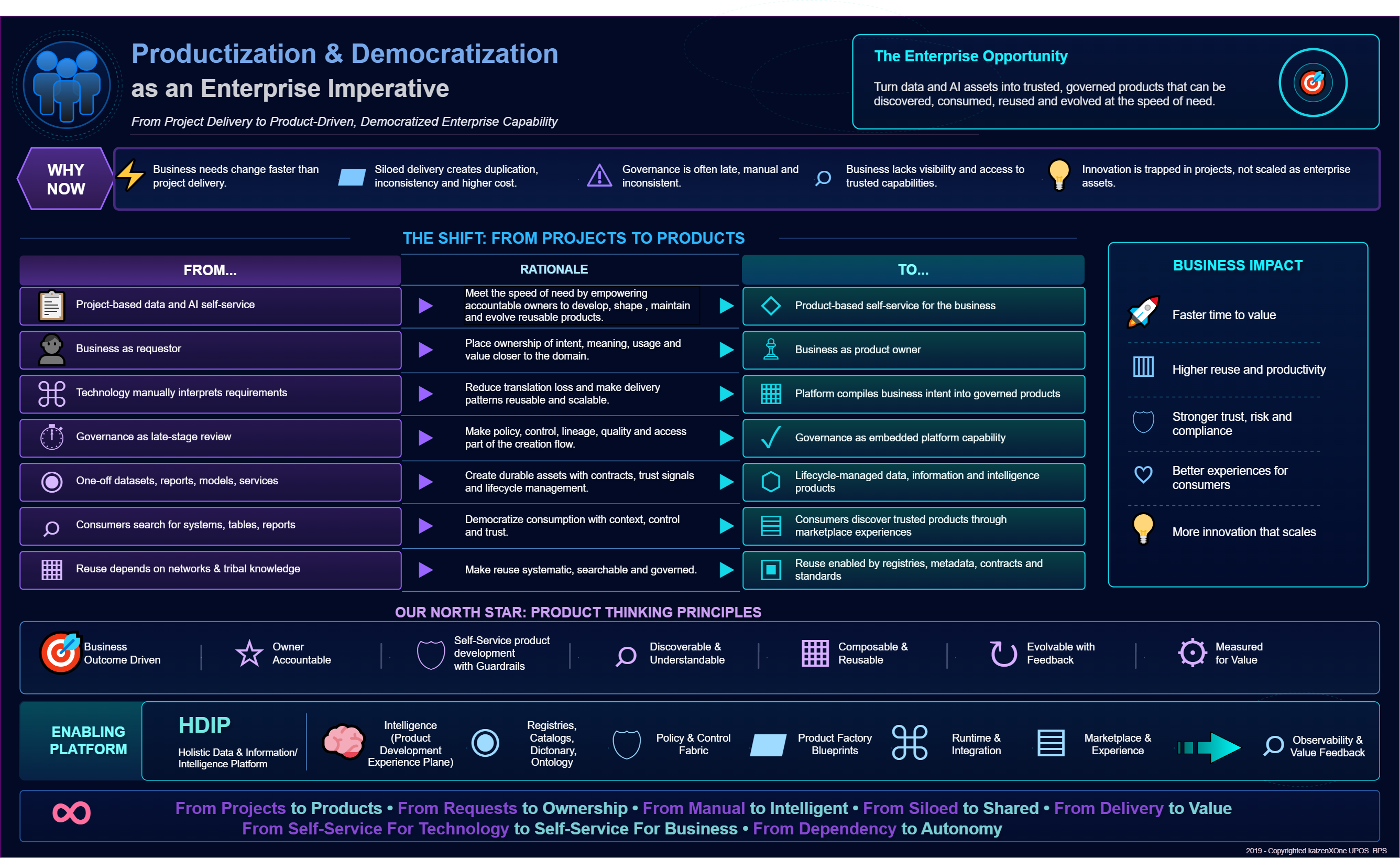
UPOS shifts the unit of value from projects to products: products become first-class, governed, publishable offerings with clear ownership, contracts/ports for consumption, lifecycle state, and measurable outcomes.
UPOS enables product-native self-service for product creators (not just technology-native self-service for engineers).
Take for example HDIP Logical architecture which is built on UPOS. Below illustrates the Productization and Democratization imperitive
ProductVerse and PVEP
UPOS assumes a product economy is not a list-it is a graph.
ProductVerse (PV)
ProductVerse is the network/graph of products and their relationships (inputs, dependencies, compositions, substitutes/complements).
It enables recursive product economies where products are consumed as inputs to create new products.
ProductVerse Experience Plane (PVEP)
PVEP is the umbrella experience plane for the product economy. It includes:
- Marketplace experiences (browse-first discovery, acquisition, entitlements, portfolio views),
- CEP consumption experiences (experiences consuming product ports),
- Intent-first / concierge discovery experiences that may span multiple marketplaces,
- Navigation of the ProductVerse (finding dependencies, alternatives, compositions).
A critical implication:
- A Consumption Intent Record (CIR) can be created at the point of intent capture by the PCON or a PCON-delegate (e.g., concierge/agent).
- Marketplaces may infer/confirm a derived CIR in browse-first mode, but CIR is not exclusively “owned” by any single marketplace.
The Symbiant economy
UPOS is an enabler for a new economic actor: the Symbiant.
A Symbiant is a single-entity micro-enterprise (human + machine intelligence) capable of taking end-to-end accountability for a product-from ideation to marketplace and continuous evolution-without requiring a large cross-functional team.
In UPOS, the “team” is encoded into:
- standardized descriptors and governance artifacts,
- factory intelligence that compiles intent into provisioned reality,
- and self-service lifecycle experiences.
High-level UPOS flow
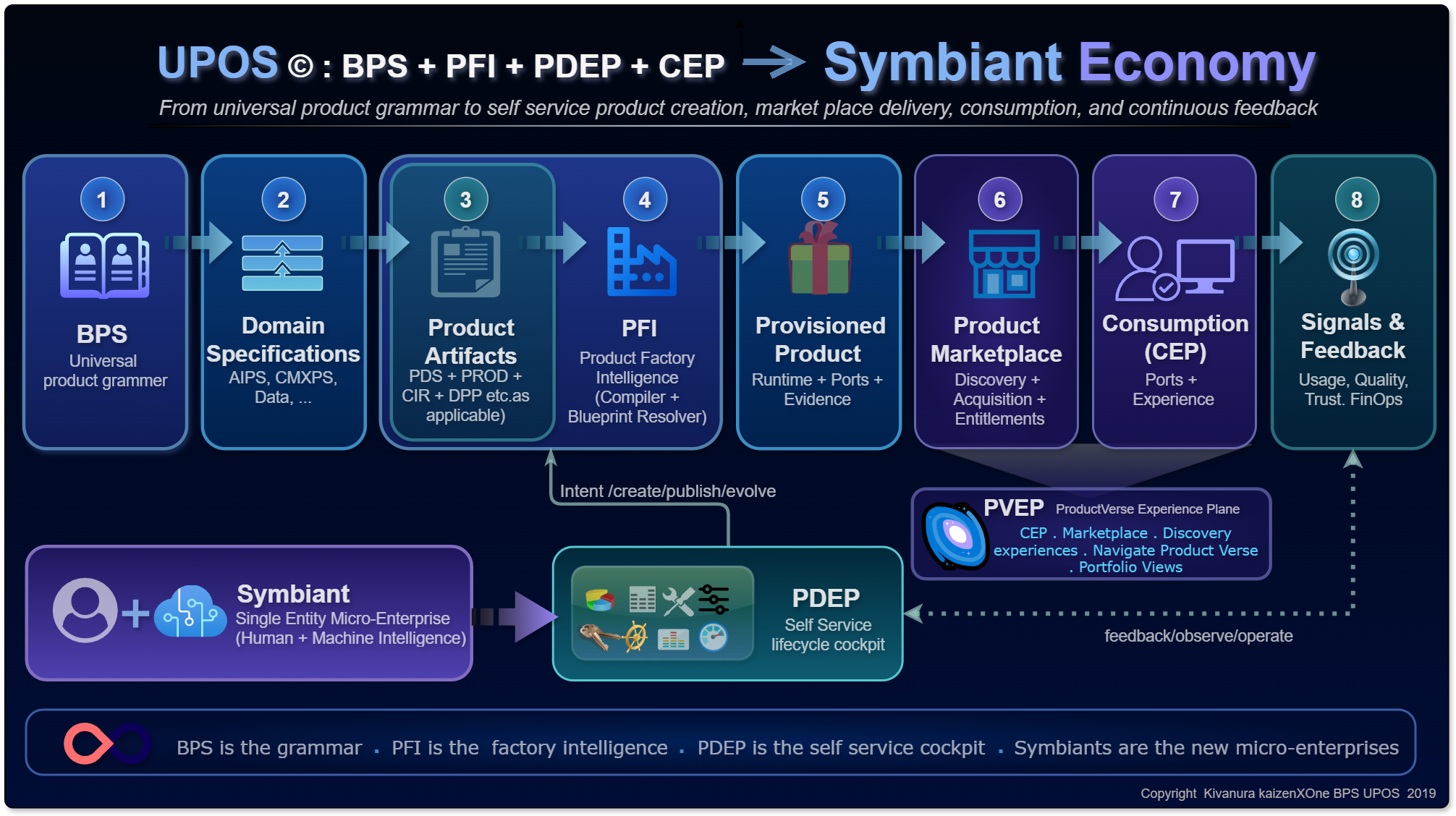
The diagram below shows the UPOS conceptual flow for executives.
For a minimalistic presentational view equivalent to the above:
Important semantic note: signals and feedback inform stewardship decisions (via PDEP) and lead to new product versions. UPOS does not imply that telemetry automatically mutates descriptors.
Canonical capability blocks (executive view)
1) BPS - Universal product grammar
BPS provides a shared language for describing products across domains so that they can be governed, compared, discovered, and composed.
Exec takeaway: BPS makes products legible and interoperable.
2) Domain specifications (AIPS, CMXPS, AnyProductPS, …)
Domain specifications act like domain “type systems”-they define what “counts” as a valid product in a domain and what artifacts are required.
Examples:
- AI Products → AIPS (AIPROD/AIPDS + trust/evidence layer)
- Comic Products → CMXPS (CMXPROD/CMXPDS + trust layer)
- Any future product kind →
<AnyProduct>PS(domain profiles + obligations)
Exec takeaway: Domain specs make productization computable and enforceable.
3) PDEP - the democratization layer (creator cockpit)
PDEP is the product-native self-service cockpit for product creators:
- author intent in product language,
- perform stewardship decisions,
- issue lifecycle commands (create/publish/evolve/deprecate/retire),
- observe signals and steer evolution.
PDEP is not for authoring technical artifacts.
Exec takeaway: Creators steer; the factory compiles.
4) PFI - Product Factory Intelligence (intent compiler)
PFI is the compiler/factory that turns product intent into a provisioned, publishable product by generating artifacts and realizing the product:
- generates PIR (Product Intent Record), policy bundle, and domain descriptors (PROD / PDS / DPP),
- resolves blueprints/capabilities,
- provisions runtime and governed ports,
- configures evidence hooks and observability,
- prepares publication readiness.
Exec takeaway: PFI replaces ad hoc project execution with repeatable compilation.
Naming hygiene: UPOS reserves PIR for creation intent (PFI side) and CIR for consumption intent (PVEP side).
5) Provisioned product (runtime + ports + evidence)
A provisioned product is the instantiation of the compiled outcome:
- runtime resources,
- governed input/output ports,
- policy enforcement,
- continuous evidence generation.
Exec takeaway: Products become operable units, not “projects we shipped once.”
6) ProductVerse Experience Plane (PVEP)
PVEP is the umbrella experience plane for discovery and consumption in a product economy:
- marketplace experiences (browse-first discovery, acquisition, entitlements, portfolio views),
- CEP consumption experiences (dashboards, notebooks, embedded UIs, system/agent interfaces),
- intent-first discovery/concierge experiences spanning multiple marketplaces,
- navigation of ProductVerse relationships (inputs, dependencies, alternatives, compositions).
Exec takeaway: PVEP is how the ProductVerse becomes usable.
7) Signals & feedback (usage, quality, trust, FinOps)
Signals close the loop:
- adoption/usage,
- service health and quality,
- trust/risk indicators,
- operational cost and ROI.
These signals inform:
- prioritization and evolution decisions,
- governance interventions,
- version evolution,
- deprecation/retirement decisions.
Exec takeaway: UPOS makes product value and risk measurable by default.
How UPOS relates to HDIP (and other domain architectures)
-
UPOS defines the generic meta-architecture for productization ecosystems.
-
HDIP is a domain specialization of UPOS for Data & AI, refining:
- domain semantics,
- domain governance kernels,
- lifecycle obligations,
- implementation patterns and platform capabilities.
Rule of thumb:
UPOS supplies the abstract planes and blocks; HDIP selects and concretizes them for Data & AI realities.
Why executives should care
UPOS enables:
- speed (less queueing behind engineering),
- reuse (standard ports + ProductVerse discoverability),
- governance by design (policy + evidence baked into lifecycle),
- measurable value (usage/cost/trust signals),
- a scalable Symbiant economy (micro-enterprises that can create and steward products end-to-end).
To summarize
UPOS is the universal operating system for productization-turning product intent into governed, ProductVerse-ready products through self-service stewardship (PDEP), factory intelligence (PFI), and ProductVerse experiences (PVEP)-so that Symbiants can own end-to-end outcomes without a large delivery organization.