PDEP — Product Development Experience Plane
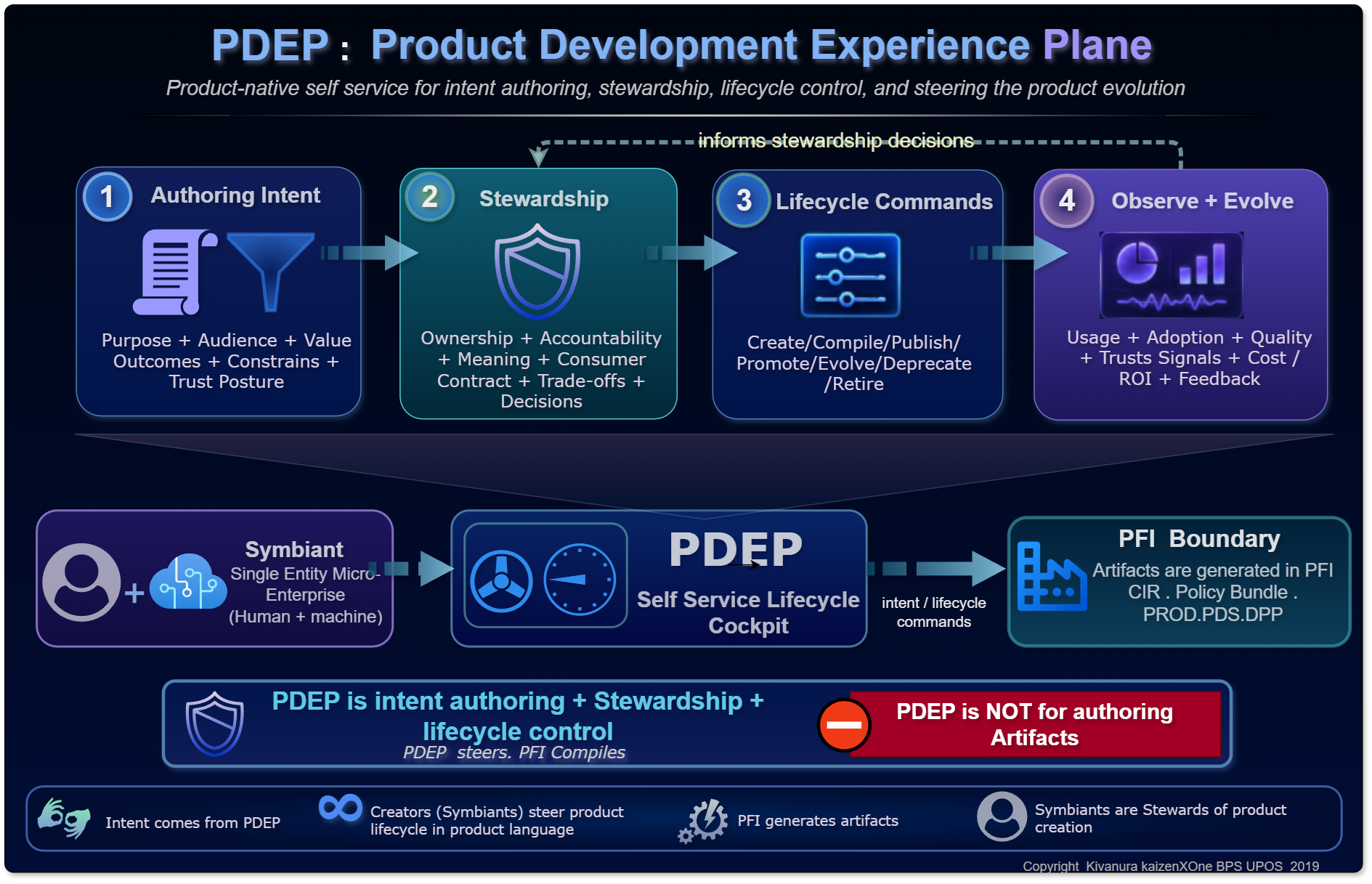
PDEP (Product Development Experience Plane) is the product-native self-service cockpit in UPOS.
PDEP is where a product creator (including a Symbiant) expresses Product Intent, steers stewardship decisions, and issues lifecycle commands (create/compile, publish, evolve, deprecate, retire).
PDEP is not where creators author technical artifacts such as PIR, PROD, PDS, DPP, or policy bundles.
PDEP is intent + stewardship + lifecycle control.
PFI is compilation + artifact generation + realization.
Executive framing
Traditional enterprises require product teams to hand off intent to engineering organizations, who translate that intent into implementation artifacts and delivery work.
UPOS shifts this model by making productization self-service for product creators:
- the creator steers through PDEP (product language),
- the factory compiles through PFI (artifact chain + realization),
- and PVEP enables discovery, acquisition, entitlements, and consumption experiences across the ProductVerse.
PDEP is the democratization layer for creators.
What PDEP is responsible for
PDEP owns the creator-facing responsibilities:
1) Intent authoring (product-native)
PDEP captures Product Intent in business/product terms:
- purpose and audience
- value outcomes and success criteria
- constraints and obligations (e.g., residency, retention, purpose limits)
- trust posture (risk appetite, assurance expectations)
- dependencies (upstream products/assets where applicable)
2) Stewardship (accountability)
PDEP is where the creator acts as Creator–Steward:
- confirming ownership and mandate
- reviewing product meaning and consumer contract (at the right abstraction level)
- choosing lifecycle actions and trade-offs (time, quality, cost, risk)
- accepting responsibility for publish decisions and deprecation/retirement decisions
3) Lifecycle commands (control plane actions)
PDEP issues explicit commands such as:
- Create / Compile (initiate first version build)
- Publish (make a version available through PVEP)
- Promote (dev → test → prod, where applicable)
- Evolve (new version derived from current version)
- Pause / Rollback (where supported by domain/platform)
- Deprecate / Retire (portfolio lifecycle management)
4) Observation and evolution steering
PDEP surfaces signals and supports steering decisions:
- adoption and usage patterns
- quality and health indicators
- trust/risk indicators (domain-dependent)
- FinOps signals (cost, efficiency, ROI)
- incidents, drift, and corrective actions
Signals inform decisions; they do not automatically mutate the product.
What PDEP is not responsible for
To preserve true democratization (and avoid pushing engineering complexity onto creators), PDEP does not require the creator to author or manipulate:
- PIR (Product Intent Record) (creation intent record generated in PFI)
- Policy Bundles
- PROD / PDS / DPP artifacts
- blueprint selection details
- runtime topology, pipelines, infra manifests
- monitoring configs, alert routes, runbooks (except at policy/intent level)
- PVEP listing/entitlement wiring mechanics
Those are generated and wired by PFI.
The PDEP ↔ PFI contract (the most important boundary)
PDEP provides (to PFI)
- Intent (product-native)
- constraints and trust posture
- lifecycle command (create/publish/evolve/etc.)
- context (target environment, audience scope, required timelines)
PFI returns (to PDEP)
- generated artifacts (PIR → Policy Bundle → PROD/PDS/DPP)
- compilation status and gate results
- realized/provisioned product readiness state
- publish readiness confirmation
- evidence and observability summaries
- derived recommendations (optional), e.g., blueprint choice rationale
Key principle: PDEP is the steering wheel; PFI is the engine and factory floor.
PDEP as product-native self-service (not engineering self-service)
A common misunderstanding is “self-service = developers shipping faster.”
UPOS makes a different claim:
- Engineering self-service (technology-native) accelerates engineers through CI/CD, infra automation, and tooling.
- PDEP self-service (product-native) democratizes productization by enabling creators to steer end-to-end lifecycle without needing a large delivery organization.
UPOS self-service is for product creators (Symbiants), not only for engineers.
Typical PDEP user journey (high-level)
- Declare intent (purpose, audience, outcomes, constraints, trust posture).
- Request creation (command: create/compile new version).
- Review product preview (meaning + contract + obligations, not implementation details).
- Publish (command: publish through PVEP).
- Operate and observe (signals, quality, trust, cost).
- Evolve (command: derive a new version based on feedback).
- Deprecate/retire when appropriate.
Relationship to other UPOS planes
PDEP ↔ PVEP
PDEP initiates publish/deprecate/retire actions; PVEP exposes discovery, acquisition, entitlements, portfolio views, and consumption experiences (including CEP).
PDEP ↔ Signals & Feedback
Signals flow into PDEP for steering and accountability. Decisions taken in PDEP trigger version evolution commands that PFI compiles.
(Note: PVEP also manages consumption-side intent (CIR) for intent-first discovery; this is distinct from creation-side intent handled in PDEP/PFI.)
Summary
PDEP is the creator cockpit of UPOS:
- Intent authoring (product-native)
- Stewardship (ownership and accountability)
- Lifecycle commands (create/publish/evolve/deprecate/retire)
- Observation and evolution steering (signals-informed decisions)
PDEP does not ask creators to author technical product artifacts.
Those are generated by PFI, which compiles intent into a realized, publishable product made available through PVEP.