Marketplace Experience Zone
1. Purpose
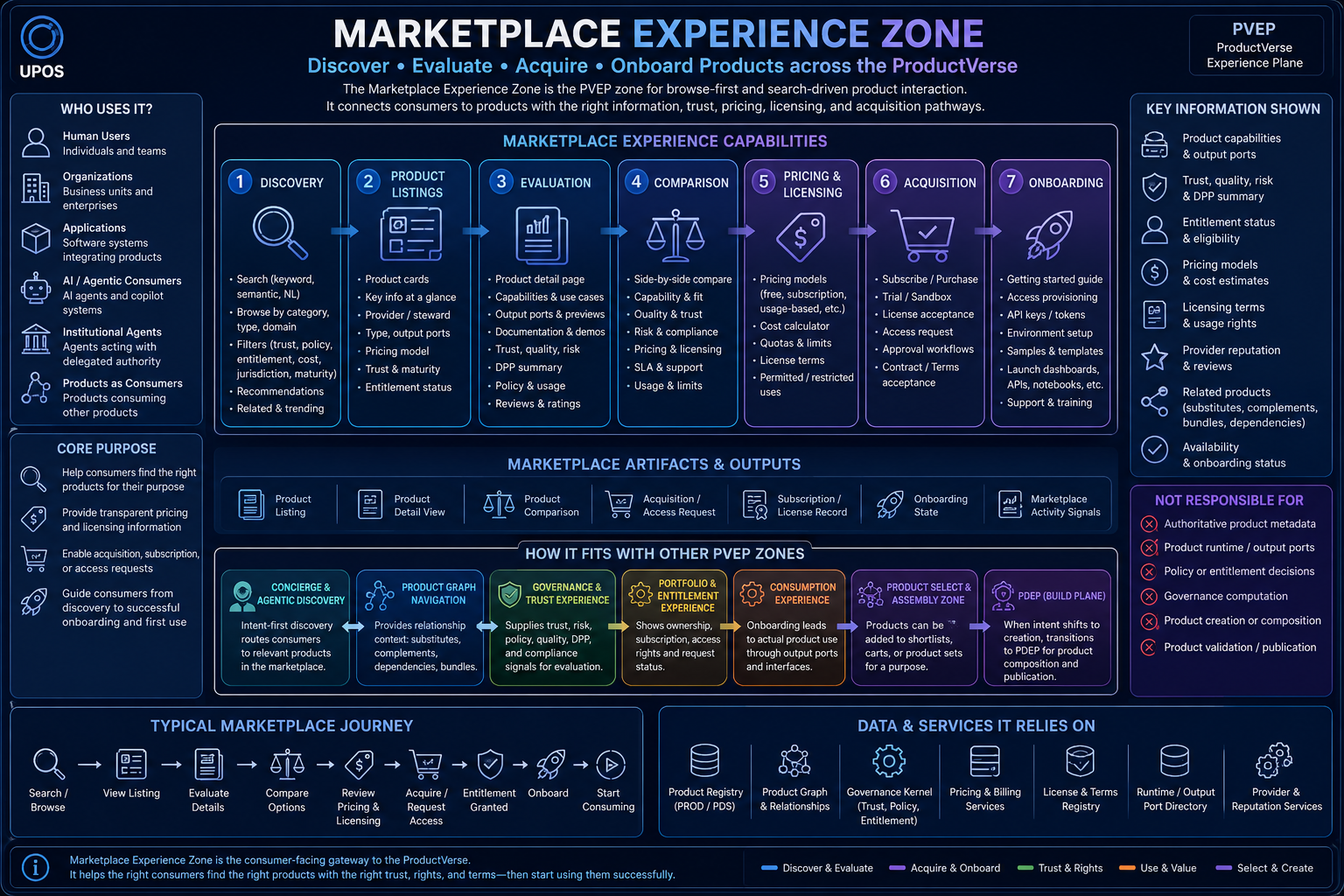
The Marketplace Experience Zone is the PVEP zone through which consumers discover, evaluate, acquire, subscribe to, request access to, and onboard products across the ProductVerse.
It is the most recognizable product-facing zone because it resembles familiar marketplaces, catalogs, app stores, data marketplaces, model marketplaces, content marketplaces, and enterprise product portals. However, in UPOS, the marketplace is not the whole ProductVerse and not the whole ProductVerse Experience Plane.
The Marketplace Experience Zone is one consumer-oriented zone within PVEP. It provides structured marketplace experiences over productized value, while relying on other UPOS capabilities for product metadata, entitlement, governance, trust, runtime access, lifecycle management, and product creation.
2. Definition
The Marketplace Experience Zone is the PVEP capability zone that enables browse-first and search-driven interaction with products through product listings, product detail pages, evaluation views, pricing and licensing information, acquisition flows, access requests, and onboarding experiences.
It supports consumers in answering questions such as:
- What products exist?
- Which products are relevant to my intent?
- Which products am I allowed to use?
- Which products are trustworthy?
- What does this product cost?
- What license or usage terms apply?
- How do I acquire, subscribe to, or request access?
- How do I start using the product after acquisition?
- What other products are related, substitutable, or complementary?
3. Scope
The Marketplace Experience Zone covers:
- product discovery,
- product listings,
- search and filtering,
- product detail pages,
- product comparison,
- product evaluation,
- pricing presentation,
- licensing and usage terms,
- subscription and acquisition flows,
- access request initiation,
- trial or sandbox onboarding,
- product onboarding guidance,
- provider and owner profiles,
- ratings, reviews, and reputation signals,
- product recommendations,
- marketplace ranking,
- trust and governance signal presentation,
- related product suggestions,
- marketplace analytics and activity signals.
The Marketplace Experience Zone does not own:
- authoritative product metadata creation,
- product runtime,
- product output ports,
- product building,
- product composition,
- product validation,
- product versioning,
- product publication,
- policy decisions,
- entitlement authority,
- governance computation,
- trust signal generation.
Those responsibilities belong to other UPOS planes, kernels, registries, or services.
4. Position within PVEP
The Marketplace Experience Zone is one of the seven PVEP experience zones.
ProductVerse Experience Plane (PVEP)
├─ Marketplace Experience Zone
├─ Consumption Experience Zone
├─ Concierge & Agentic Discovery Zone
├─ Product Graph Navigation Zone
├─ Portfolio & Entitlement Experience Zone
├─ Product Select & Assembly Zone
└─ Governance & Trust Experience Zone
It interacts closely with all other zones:
| Related PVEP Zone | Relationship |
|---|---|
| Concierge & Agentic Discovery Zone | May route intent-first recommendations into marketplace product listings or detail pages. |
| Product Graph Navigation Zone | Provides relationship context such as substitutes, complements, dependencies, and bundles. |
| Governance & Trust Experience Zone | Supplies trust, risk, quality, policy, evidence, and DPP signals for evaluation. |
| Portfolio & Entitlement Experience Zone | Shows whether the consumer owns, subscribes to, or is entitled to use a product. |
| Consumption Experience Zone | Provides the post-acquisition pathway into actual product use. |
| Product Select & Assembly Zone | Allows products discovered in the marketplace to be shortlisted, grouped, or assembled into product sets. |
| PDEP Boundary | If marketplace interaction becomes product-creation intent, the flow transitions to PDEP. |
5. Marketplace as a ProductVerse View
A marketplace is a commercial, organizational, or exchange-oriented projection of the ProductVerse.
It is not the ProductVerse itself.
The ProductVerse includes many possible topologies and experiences, including product graphs, product webs, product meshes, product fabrics, ecosystems, chains, portfolios, runtime ports, trust structures, and governance relationships.
The Marketplace Experience Zone exposes a subset of this universe through marketplace-native constructs such as:
- listings,
- categories,
- rankings,
- provider pages,
- pricing pages,
- subscription options,
- acquisition flows,
- onboarding steps,
- product recommendations.
This means a product in the marketplace may also be:
- a node in a Product Graph,
- part of a Product Mesh,
- governed by a Product Fabric,
- a dependency in a Product Chain,
- a trusted object with a Digital Product Passport,
- a component of a product set,
- a runtime service with output ports,
- an input to another product.
The Marketplace Experience Zone should therefore avoid flat catalog thinking. Marketplace listings should provide entry points into graph, trust, entitlement, consumption, and selection experiences.
6. Core Responsibilities
6.1 Product Discovery
Marketplace discovery helps consumers find products through browse-first, search-first, filter-first, recommendation-first, or category-based experiences.
Discovery capabilities may include:
- keyword search,
- semantic search,
- natural-language search,
- category browsing,
- provider browsing,
- product type browsing,
- product domain browsing,
- tag and taxonomy browsing,
- policy-aware filtering,
- entitlement-aware filtering,
- trust-aware filtering,
- jurisdiction-aware filtering,
- cost-aware filtering,
- maturity-aware filtering,
- popularity-based discovery,
- usage-pattern-based discovery,
- substitute and complement suggestions.
Discovery should support both human and agentic consumers.
For agentic discovery, marketplace capabilities should expose machine-readable product metadata, search APIs, ranking APIs, and policy-aware discovery endpoints.
6.2 Product Listings
A Product Listing is the marketplace-facing representation of a product.
It is optimized for discovery, evaluation, acquisition, and onboarding. It should not be confused with the full semantic product descriptor, deployment specification, or Digital Product Passport.
A Product Listing may include:
- product name,
- product summary,
- product category,
- product kind,
- provider or owner,
- producer or steward,
- version,
- availability,
- supported use cases,
- output ports,
- consumption modes,
- pricing model,
- licensing model,
- trust indicators,
- quality indicators,
- risk indicators,
- policy constraints,
- entitlement status,
- acquisition options,
- onboarding status,
- related products,
- ratings and reviews,
- support information,
- documentation links.
The listing is usually a marketplace projection over deeper authoritative records such as:
- PROD descriptor,
- PDS descriptor,
- DPP record,
- product registry record,
- entitlement record,
- pricing record,
- licensing record,
- quality record,
- policy record,
- runtime endpoint record.
6.3 Product Evaluation
Product evaluation helps consumers determine whether a product is suitable for their purpose.
Evaluation capabilities may include:
- product detail pages,
- product comparison views,
- product capability summaries,
- supported use cases,
- output port previews,
- sample data or sample outputs,
- API examples,
- screenshots or demos,
- product documentation,
- product maturity indicators,
- quality metrics,
- trust signals,
- risk indicators,
- compliance status,
- lineage summaries,
- provenance summaries,
- DPP summary,
- allowed-use statements,
- prohibited-use statements,
- entitlement eligibility,
- cost estimates,
- provider reputation,
- ratings and reviews,
- usage statistics,
- adoption signals,
- support and SLA information.
Evaluation should be contextual. A product may be suitable for one consumer, purpose, jurisdiction, or entitlement state, but unsuitable for another.
The Marketplace Experience Zone should therefore support purpose-aware evaluation where possible.
6.4 Product Comparison
Product comparison allows consumers to evaluate alternatives side by side.
Comparison dimensions may include:
- capability,
- product type,
- domain fit,
- supported output ports,
- freshness,
- latency,
- quality,
- maturity,
- risk tier,
- compliance posture,
- allowed usage,
- jurisdictional restrictions,
- pricing,
- licensing,
- SLA,
- support model,
- provider reputation,
- adoption,
- interoperability,
- dependencies,
- substitutes and complements.
Comparison should not be limited to commercial features. In UPOS, trust, governance, entitlement, and fit-for-purpose constraints are first-class comparison dimensions.
6.5 Acquisition
Acquisition is the process through which a consumer obtains the right to use, access, subscribe to, license, trial, or otherwise consume a product.
Acquisition flows may include:
- free access activation,
- subscription,
- purchase,
- license acceptance,
- trial activation,
- sandbox request,
- internal access request,
- approval workflow initiation,
- procurement request,
- entitlement request,
- usage-plan selection,
- contract acceptance,
- terms-of-use acknowledgement.
In enterprise settings, acquisition may not involve payment. It may involve authorization, governance approval, data access approval, manager approval, policy check, or entitlement provisioning.
In public commercial settings, acquisition may involve pricing, checkout, subscription, invoicing, billing, or contract acceptance.
The Marketplace Experience Zone initiates acquisition. It does not own all authoritative decisions involved in acquisition.
6.6 Onboarding
Onboarding helps a consumer move from acquisition or entitlement to successful product use.
Onboarding may include:
- getting started guide,
- setup instructions,
- access provisioning status,
- API key or token request,
- environment selection,
- output port connection instructions,
- sample queries,
- SDK instructions,
- dashboard launch,
- reader launch,
- sandbox launch,
- notebook template,
- integration checklist,
- usage constraint acknowledgement,
- support contact,
- training material,
- troubleshooting guidance.
Onboarding should connect the marketplace to the Consumption Experience Zone.
The marketplace may help a user acquire a product, but the Consumption Experience Zone provides the actual product usage experience.
6.7 Pricing
Pricing information helps consumers understand the economic model of product usage.
Pricing models may include:
- free,
- freemium,
- one-time purchase,
- subscription,
- tiered subscription,
- usage-based pricing,
- metered pricing,
- per-seat pricing,
- per-call pricing,
- per-query pricing,
- per-transaction pricing,
- per-download pricing,
- revenue sharing,
- internal chargeback,
- showback,
- cost allocation,
- bundled pricing,
- negotiated pricing,
- enterprise agreement pricing.
Pricing should be presented with enough context for consumers to understand expected cost and cost drivers.
Pricing views may include:
- base price,
- usage limits,
- overage pricing,
- quota thresholds,
- billing frequency,
- included features,
- included output ports,
- included support level,
- trial limits,
- cancellation terms,
- renewal terms,
- cost estimate calculator,
- historic usage cost,
- projected usage cost.
In internal enterprise marketplaces, pricing may appear as showback, chargeback, FinOps allocation, or consumption cost rather than direct payment.
6.8 Licensing
Licensing defines the rights, restrictions, and obligations associated with product use.
Licensing information may include:
- license type,
- permitted users,
- permitted purposes,
- permitted geographies,
- permitted environments,
- redistribution rights,
- derivative product rights,
- commercial use rights,
- internal use restrictions,
- external sharing restrictions,
- attribution requirements,
- retention obligations,
- audit obligations,
- termination conditions,
- renewal terms,
- revocation conditions,
- regulatory limitations,
- intellectual property restrictions,
- model usage restrictions,
- data usage restrictions,
- content usage restrictions.
Licensing should be understandable to consumers, but it should be grounded in authoritative license records and policy services.
The Marketplace Experience Zone may present licensing terms, but the Governance Kernel and entitlement services may determine whether a specific consumer may use the product for a specific purpose.
7. Key Marketplace Artifacts
7.1 Product Listing
A marketplace-facing representation of a product optimized for discovery, evaluation, and acquisition.
7.2 Product Detail View
A richer consumer-facing view containing product description, capabilities, usage guidance, trust posture, pricing, licensing, entitlement status, output ports, and onboarding links.
7.3 Product Comparison View
A side-by-side view of multiple products across capability, cost, trust, policy, maturity, quality, usage, and entitlement dimensions.
7.4 Marketplace Search Result
A ranked product result returned from search, browse, recommendation, or filter interactions.
7.5 Product Recommendation
A suggested product based on consumer intent, context, similarity, complementarity, popularity, policy fit, entitlement, or prior usage.
7.6 Acquisition Request
A request to purchase, subscribe to, license, trial, or otherwise acquire access to a product.
7.7 Access Request
A request for permission or entitlement to use a product.
7.8 Subscription Record
A record indicating that a subject, team, organization, or agent has subscribed to a product.
7.9 License Acceptance Record
A record indicating that a consumer has accepted product usage terms or licensing conditions.
7.10 Onboarding State
A record or state model showing the consumer’s progress toward successful product use.
7.11 Marketplace Activity Signal
An event generated through marketplace behavior, such as product view, search, comparison, acquisition, abandonment, or onboarding completion.
8. Marketplace Data Inputs
The Marketplace Experience Zone depends on multiple underlying sources of truth.
| Input | Description | Likely Authority |
|---|---|---|
| Product metadata | Product name, type, description, provider, capabilities. | Product Registry / PROD Services |
| Product listing metadata | Marketplace-facing product representation. | Marketplace Services |
| Product relationships | Substitutes, complements, dependencies, bundles. | Product Graph / Relationship Registry |
| Trust signals | Trust, maturity, quality, risk, DPP status. | Governance Kernel / Trust Services |
| Entitlement state | Whether a consumer can access the product. | Entitlement Services / Governance Kernel |
| Pricing data | Cost, tiers, usage rates, billing rules. | Pricing / Billing Services |
| Licensing data | Rights, restrictions, obligations. | License Registry / Policy Services |
| Usage data | Adoption, popularity, usage frequency. | Runtime / Observability Services |
| Provider data | Product owner, steward, support model, reputation. | Provider Registry / Product Registry |
| Runtime availability | Whether output ports or environments are available. | Runtime / Operations Services |
| Reviews and ratings | Consumer feedback, satisfaction, qualitative assessment. | Marketplace / Feedback Services |
9. Marketplace Events and Signals
Marketplace interactions should emit structured signals.
Examples include:
- product searched,
- product result displayed,
- product listing viewed,
- product detail viewed,
- product compared,
- product recommended,
- product shortlisted,
- product added to product set,
- product removed from product set,
- pricing viewed,
- licensing viewed,
- DPP viewed from listing,
- entitlement checked,
- access requested,
- acquisition started,
- acquisition completed,
- acquisition abandoned,
- subscription created,
- trial started,
- onboarding started,
- onboarding completed,
- product rated,
- review submitted,
- support requested.
These signals may feed:
- marketplace ranking,
- recommendation models,
- product improvement loops,
- provider analytics,
- governance analytics,
- portfolio analytics,
- FinOps,
- consumer support,
- product lifecycle evolution.
Marketplace signals should be governed by privacy, consent, policy, and purpose-limitation rules.
10. Relationship to Governance & Trust
The Marketplace Experience Zone must be trust-aware by design.
Consumers should be able to see relevant governance and trust information at the point of evaluation and acquisition.
Examples include:
- Digital Product Passport summary,
- trust score,
- product maturity,
- certification status,
- AI risk tier,
- data quality score,
- model quality score,
- compliance posture,
- lineage summary,
- provenance summary,
- policy restrictions,
- allowed uses,
- prohibited uses,
- entitlement eligibility,
- outstanding exceptions,
- audit or evidence status.
The marketplace should not manually invent trust indicators. It should render trust and governance state derived from the Governance Kernel and related authoritative services.
The key principle is:
Marketplace trust signals must be kernel-derived, explainable, and actionable.
11. Relationship to Portfolio & Entitlement
The Marketplace Experience Zone helps consumers understand whether they can access a product, but it does not own entitlement authority.
Marketplace views may show:
- already subscribed,
- already owned,
- entitled,
- eligible,
- request required,
- approval pending,
- denied,
- restricted,
- unavailable,
- expired,
- trial available,
- license acceptance required.
When the consumer acts on this status, the flow may transition to the Portfolio & Entitlement Experience Zone or directly to entitlement services.
Examples:
Marketplace listing
  → View entitlement status
  → Request access
  → Governance Kernel / Entitlement Services
  → Entitlement decision
  → Portfolio & Entitlement view
  → Consumption Experience
12. Relationship to Product Graph Navigation
Marketplace experiences should not isolate products from their relationships.
The Marketplace Experience Zone may display relationship-based suggestions such as:
- similar products,
- substitute products,
- complementary products,
- commonly bundled products,
- upstream dependencies,
- downstream consumers,
- provider-related products,
- products used in the same workflows,
- products in the same domain constellation,
- products with similar trust posture,
- products with lower cost or lower risk.
For deeper relationship exploration, the marketplace may link into the Product Graph Navigation Zone.
Example:
Product Detail Page
  → Related Products
  → View Product Graph
  → Explore dependencies, substitutes, complements, and bundles
13. Relationship to Product Select & Assembly
Marketplace discovery often feeds product selection.
Consumers may add marketplace products to:
- shortlist,
- cart,
- collection,
- candidate product set,
- procurement list,
- evaluation set,
- product-set intent,
- PDEP transition candidate.
This flow belongs to the Product Select & Assembly Zone.
The Marketplace Experience Zone may provide the action, but the product-set concept is owned by Product Select & Assembly.
Example:
Marketplace Search
  → Product Listing
  → Add to Product Set
  → Product Select & Assembly Zone
  → Evaluate set
  → Consume as set OR transition to PDEP
14. Relationship to Consumption Experience
After a product is acquired or entitlement is granted, the consumer must be able to use the product.
The marketplace may provide launch points such as:
- open dashboard,
- open reader,
- launch notebook,
- connect API,
- run sample query,
- download file,
- start sandbox,
- open model playground,
- invoke agent tool,
- view documentation.
The actual usage experience belongs to the Consumption Experience Zone.
Example:
Acquire Product
  → Onboarding
  → Launch Consumption Experience
  → Product Output Port
  → Usage and Feedback Signals
15. Relationship to Concierge & Agentic Discovery
The Marketplace Experience Zone supports browse-first and search-first discovery. The Concierge & Agentic Discovery Zone supports intent-first discovery.
These zones should work together.
Example:
User: "Find a compliant AI Product for payment anomaly detection"
  → Concierge captures intent
  → Policy-aware recommendation
  → Marketplace product detail pages
  → Comparison and evaluation
  → Acquisition or product selection
The marketplace may also embed concierge features, such as:
- guided search,
- conversational filters,
- AI product assistant,
- product matching wizard,
- recommendation explanation,
- policy-aware discovery helper.
16. Human and Agentic Marketplace Interfaces
The Marketplace Experience Zone should support both human and machine interaction.
16.1 Human Interfaces
Human interfaces may include:
- product catalog,
- marketplace portal,
- app store,
- product cards,
- product detail pages,
- comparison tables,
- onboarding pages,
- pricing pages,
- licensing views,
- reviews and ratings,
- provider pages.
16.2 Agentic Interfaces
Agentic interfaces may include:
- product search API,
- product recommendation API,
- product listing API,
- product detail API,
- pricing API,
- licensing API,
- entitlement-check API,
- DPP retrieval API,
- related-products API,
- acquisition request API,
- onboarding status API.
Agentic interfaces should be policy-aware and entitlement-aware.
17. Pricing and Licensing Design Guidance
Pricing and licensing should be treated as first-class marketplace concerns.
17.1 Pricing Guidance
Pricing views should be:
- transparent,
- contextual,
- usage-aware,
- comparable,
- explainable,
- linked to billing or chargeback,
- connected to quotas and limits,
- clear about trial conditions,
- clear about renewal and cancellation.
17.2 Licensing Guidance
Licensing views should be:
- understandable,
- purpose-aware,
- jurisdiction-aware,
- explicit about restrictions,
- explicit about obligations,
- linked to policy and entitlement decisions,
- machine-readable where possible,
- human-readable where necessary.
17.3 Pricing and Licensing Together
Pricing and licensing should not be separated from usage rights.
A low-cost product may still be unsuitable if licensing restrictions prevent the intended use. A technically suitable product may be unavailable if entitlement or policy constraints block access.
Therefore, marketplace evaluation should combine:
Capability fit
+ Trust fit
+ Policy fit
+ Entitlement fit
+ Pricing fit
+ Licensing fit
+ Runtime fit
18. Marketplace Metrics
Marketplace performance should be observable.
Useful metrics include:
- search success rate,
- zero-result search rate,
- click-through rate,
- product detail conversion,
- comparison usage,
- acquisition conversion,
- access request conversion,
- onboarding completion,
- time to entitlement,
- time to first consumption,
- abandoned acquisition rate,
- most viewed products,
- most compared products,
- most requested products,
- most denied products,
- recommendation acceptance,
- trial-to-subscription conversion,
- consumer satisfaction,
- review quality,
- trust signal usage,
- DPP view rate,
- pricing view rate,
- licensing view rate.
These metrics support marketplace improvement, product lifecycle decisions, provider feedback, governance analysis, and ProductVerse intelligence.
19. Security, Privacy, and Policy Considerations
Marketplace experiences must be secure and policy-aware.
Key considerations include:
- authenticated and anonymous browsing modes,
- visibility rules for restricted products,
- entitlement-aware product listing,
- policy-aware search results,
- prevention of sensitive metadata leakage,
- secure acquisition flows,
- consent-aware recommendations,
- privacy-preserving marketplace analytics,
- access request auditability,
- license acceptance auditability,
- agent authority validation,
- rate limiting for marketplace APIs,
- protection against ranking manipulation,
- clear treatment of reviews and ratings,
- compliance with purpose limitation.
Marketplace search and recommendations should not expose products, metadata, pricing, trust details, or relationships that the consumer is not permitted to see.
20. Anti-Patterns
20.1 Marketplace as the Whole PVEP
The marketplace should not be treated as the full ProductVerse Experience Plane. PVEP is broader and includes consumption, graph navigation, entitlement, trust, concierge, and product selection experiences.
20.2 Flat Product Catalog
A marketplace that lists products without relationships, trust, entitlement, usage, or governance context fails to represent the ProductVerse.
20.3 Trust as Marketing
Trust indicators should not be manually curated marketing badges. They should be derived from authoritative governance, evidence, quality, risk, or DPP signals.
20.4 Entitlement-Blind Discovery
Showing products without considering access rights, policy constraints, or eligibility can create frustration and compliance risk.
20.5 Pricing Without Usage Context
Pricing presented without usage limits, licensing restrictions, quotas, or cost drivers may mislead consumers.
20.6 Licensing Hidden in Fine Print
Licensing and permitted-use constraints should be visible at the point of evaluation and acquisition, not buried after acquisition.
20.7 Marketplace Building Products
The marketplace should not become the product composition or product-building plane. Product creation belongs to PDEP.
21. Example Marketplace Journey
A typical marketplace journey may look like this:
Consumer
  → Searches marketplace
  → Filters by product type, trust, entitlement, cost, and domain
  → Opens product listing
  → Reviews product detail page
  → Reviews trust and DPP summary
  → Compares with substitutes
  → Reviews pricing and licensing
  → Requests access or subscribes
  → Receives entitlement decision
  → Completes onboarding
  → Launches consumption experience
If the consumer selects multiple products for a future solution:
Consumer
  → Adds products to Product Set
  → Reviews product-set fit
  → Checks trust and entitlement posture
  → Uses product set for evaluation
  → Transitions to PDEP if the intent becomes product creation
22. Summary
The Marketplace Experience Zone is the PVEP zone for product discovery, evaluation, acquisition, onboarding, pricing, licensing, and product listings.
It enables consumers to find, understand, compare, acquire, and begin using products across the ProductVerse.
It is marketplace-aware but not marketplace-limited. It connects to other PVEP zones for trust, entitlement, graph navigation, consumption, agentic discovery, and product selection.
The essential principles are:
- A marketplace is one projection of the ProductVerse, not the whole ProductVerse.
- Marketplace listings should be connected to trust, entitlement, pricing, licensing, and relationship context.
- Product acquisition should lead naturally into onboarding and consumption.
- Trust signals must be derived from the Governance Kernel.
- Entitlement decisions must come from authoritative entitlement and policy services.
- Product selection may happen in PVEP, but product building belongs to PDEP.
In short:
The Marketplace Experience Zone helps consumers find, evaluate, acquire, and start using products, while the wider PVEP ensures those products are trusted, entitled, connected, consumable, and selectable across the ProductVerse.