ProductVerse Experience Plane (PVEP) Architecture
1. Purpose
The ProductVerse Experience Plane (PVEP) is the UPOS architectural plane that provides consumer-oriented experiences across the ProductVerse.
PVEP enables humans, organizations, applications, AI agents, institutional agents, and products-as-consumers to discover, evaluate, acquire, consume, navigate, trust, and select products across a universe of productized entities and relationships.
PVEP is not a single application, marketplace, portal, or catalog. It is an architectural plane composed of experience zones, interaction patterns, supporting services, and integration points that make the ProductVerse visible, navigable, trustworthy, and actionable.
2. Architectural Positioning in UPOS
Within UPOS, PVEP sits above the ProductVerse and interacts with several supporting planes and kernels.
                         Humans / Organizations / Agents
                                      │
                                      ▼
              ┌────────────────────────────────────────────┐
              │ ProductVerse Experience Plane (PVEP)       │
              │ Discover · Evaluate · Acquire · Consume    │
              │ Navigate · Trust · Select · Transition     │
              └────────────────────────────────────────────┘
                                      │
          ┌───────────────────────────┼───────────────────────────┐
          ▼                           ▼                           ▼
┌───────────────────┐       ┌───────────────────┐       ┌───────────────────┐
│ ProductVerse      │       │ Governance Kernel │       │ PDEP              │
│ Product topology, │       │ Policy, trust,    │       │ Product creation, │
│ graph, marketplace│       │ risk, entitlement,│       │ composition,      │
│ , relationships   │       │ assurance         │       │ publication       │
└───────────────────┘       └───────────────────┘       └───────────────────┘
          │                           │                           │
          ▼                           ▼                           ▼
┌────────────────────────────────────────────────────────────────────┐
│ Product Factory Intelligence / Registry / Runtime Capabilities     │
└────────────────────────────────────────────────────────────────────┘
PVEP is the experiential surface. It does not replace the ProductVerse, PDEP, Product Foundation & Intelligence capabilities, registries, product runtimes, or the Governance Kernel. Instead, it coordinates experience-level interaction with those underlying capabilities.
3. Core Architectural Role
PVEP has five primary architectural responsibilities.
3.1 Experience Mediation
PVEP mediates between consumers and the ProductVerse.
It translates product metadata, product relationships, entitlement state, trust posture, governance constraints, and runtime access patterns into experiences that consumers and agents can understand and act upon.
3.2 Intent Capture
PVEP captures consumer intent in structured form.
This may include:
- consumption intent,
- discovery intent,
- evaluation intent,
- access intent,
- selection intent,
- product-set intent,
- composition or creation intent that requires handoff to PDEP.
The primary artifact for this is the Consumption Intent Record (CIR). Related or more specialized artifacts may include product-set intent records, access request records, product evaluation records, or transition records into PDEP.
3.3 Product Discovery and Navigation
PVEP enables products to be found, compared, understood, and navigated across multiple ProductVerse topologies.
It supports:
- marketplace discovery,
- search,
- recommendation,
- graph navigation,
- substitute and complement discovery,
- lineage and dependency exploration,
- provider and ecosystem exploration,
- portfolio and entitlement views.
3.4 Trust and Governance Interpretation
PVEP renders Governance Kernel outputs in consumer- and agent-usable form.
It exposes:
- entitlement state,
- policy posture,
- permitted and prohibited uses,
- trust signals,
- maturity indicators,
- quality signals,
- risk tier,
- compliance state,
- lineage and provenance,
- Digital Product Passport views,
- evidence and assurance summaries.
PVEP does not compute authoritative governance decisions itself. The Governance Kernel remains the decision, policy, evidence, and assurance authority.
3.5 Transition Management
PVEP detects when the consumer’s intent changes from consumption, evaluation, or selection into product creation.
When this happens, PVEP hands the flow to PDEP, the Product Development and Execution Plane.
The key rule is:
PVEP selects and shapes intent. PDEP builds and publishes products.
4. Architectural Boundaries
PVEP must maintain clear architectural boundaries to avoid becoming a catch-all layer.
4.1 PVEP Is Not PDEP
PVEP may support:
- product discovery,
- product comparison,
- product selection,
- product-set assembly,
- intent capture,
- access request,
- consumption experience,
- trust review,
- graph navigation.
PVEP must not own:
- product authoring,
- product composition,
- product semantic design,
- product artifact generation,
- PDS / PROD / DPP generation,
- deployment blueprint creation,
- product validation,
- product versioning,
- product publication.
These belong to PDEP and related foundation capabilities.
4.2 PVEP Is Not the Governance Kernel
PVEP may display, explain, and request governance decisions.
PVEP must not become the source of truth for:
- policy decisions,
- risk computation,
- entitlement authority,
- compliance state,
- audit evidence,
- assurance records,
- quality certification,
- regulatory determinations.
These belong to the Governance Kernel and its underlying registries, policy engines, evidence stores, and assurance capabilities.
4.3 PVEP Is Not the Product Runtime
PVEP may provide consumption experiences over products.
PVEP must not become the product runtime itself unless the product is explicitly an experience product.
Normally, product runtime capabilities expose product ports, services, APIs, dashboards, content, data, models, or agentic interfaces. PVEP experiences consume those ports and render them for the consumer.
4.4 PVEP Is Not Merely a Marketplace
A marketplace is one important expression of PVEP, but PVEP is broader.
PVEP also includes:
- consumption experiences,
- concierge and agentic discovery,
- graph navigation,
- portfolio and entitlement views,
- product select and assembly experiences,
- governance and trust experiences.
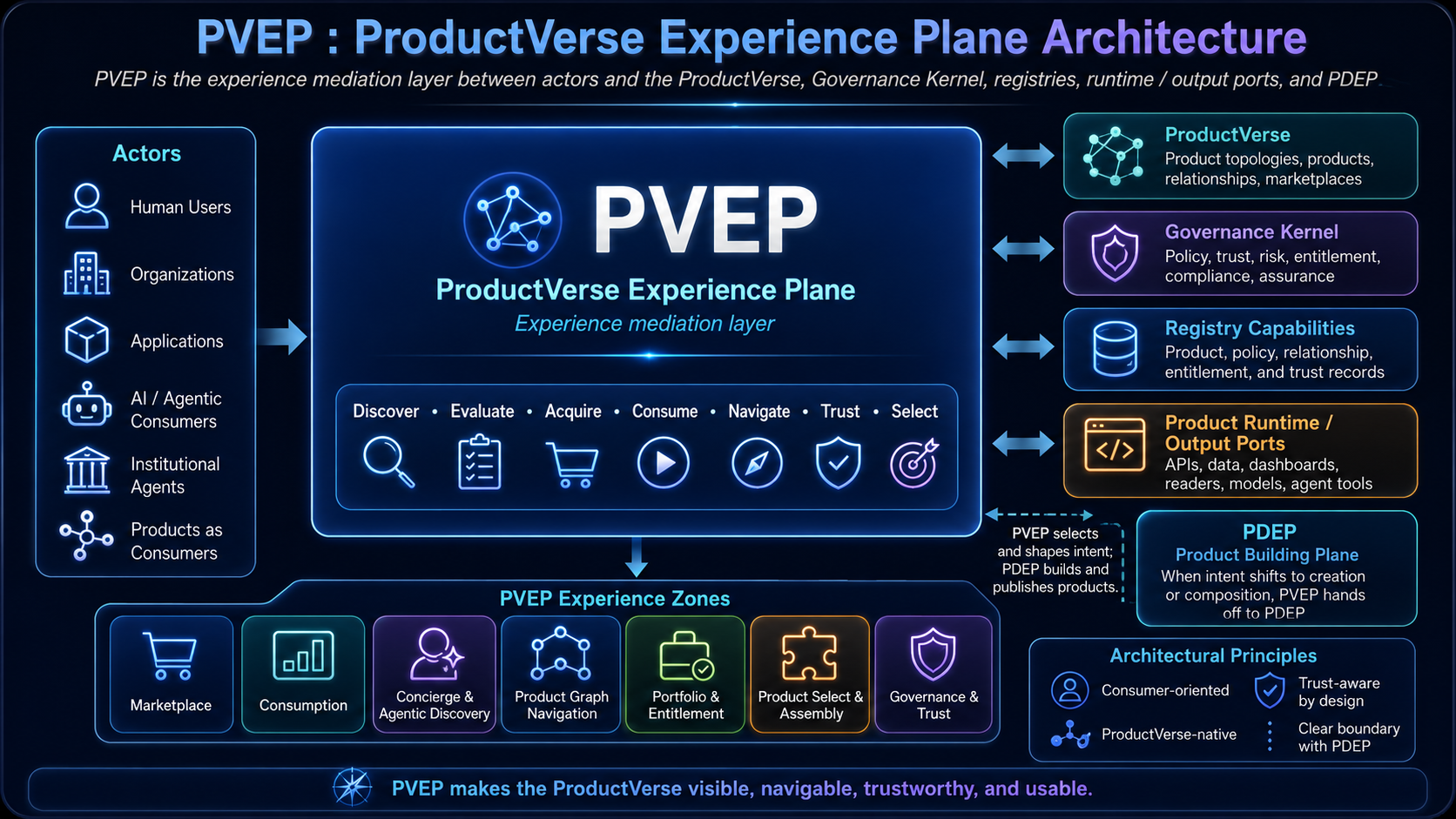
5. PVEP Experience Zone Architecture
PVEP is organized into seven experience zones.
ProductVerse Experience Plane (PVEP)
├─ Marketplace Experience Zone
├─ Consumption Experience Zone
│  └─ Consumer Experience Plane (CEP)
├─ Concierge & Agentic Discovery Zone
├─ Product Graph Navigation Zone
├─ Portfolio & Entitlement Experience Zone
├─ Product Select & Assembly Zone
└─ Governance & Trust Experience Zone
Each zone represents a coherent mode of interaction with the ProductVerse.
6. Marketplace Experience Zone
The Marketplace Experience Zone supports browse-first discovery, evaluation, acquisition, onboarding, commercial interaction, and product listing experiences.
Responsibilities
- Present marketplace listings.
- Support product search and filtering.
- Enable comparison across products.
- Show product detail pages.
- Present pricing, licensing, and subscription options.
- Support acquisition, trial, onboarding, and access initiation.
- Display provider profiles, ratings, reviews, and marketplace rankings.
- Surface trust and governance indicators during evaluation.
Key Inputs
- Product listings.
- Product descriptors.
- Product metadata.
- Provider metadata.
- Pricing and licensing data.
- Trust signals.
- Entitlement eligibility.
- Usage terms.
- Digital Product Passport summaries.
Key Outputs
- Product views.
- Product comparisons.
- Purchase or subscription requests.
- Access requests.
- Marketplace activity signals.
- Product evaluation signals.
- Potential Consumption Intent Records.
Boundary
The Marketplace Experience Zone helps consumers discover and acquire products. It does not own consumption, runtime behavior, governance decisions, or product creation.
7. Consumption Experience Zone
The Consumption Experience Zone supports direct use of products through appropriate consumer-facing interfaces.
It is the architectural home for the earlier Consumer Experience Plane (CEP) as a specialized sub-plane inside PVEP.
Responsibilities
- Render product output ports in usable form.
- Support dashboards, readers, notebooks, API consoles, workbenches, viewers, embedded interfaces, and agent tools.
- Enable product usage by humans, applications, and agents.
- Capture usage, feedback, and value signals.
- Surface relevant policy, trust, cost, and entitlement context during consumption.
Key Inputs
- Product output ports.
- Runtime endpoints.
- Entitlement state.
- Usage constraints.
- Trust signals.
- Product documentation.
- User and agent context.
- Consumption intent.
Key Outputs
- Consumption sessions.
- Usage records.
- Consumption Feedback Records.
- Value signals.
- Error and quality observations.
- Runtime interaction logs.
- Requests for support, access expansion, or product improvement.
Boundary
Consumption experiences consume product ports. They do not redefine the product, generate product artifacts, or publish new products.
8. Concierge & Agentic Discovery Zone
The Concierge & Agentic Discovery Zone supports intent-first discovery and guided navigation across the ProductVerse.
Responsibilities
- Capture natural-language or structured intent.
- Translate intent into product search and recommendation queries.
- Recommend candidate products or product sets.
- Filter recommendations by policy, entitlement, risk, trust, cost, and context.
- Support human, AI-agent, and institutional-agent discovery patterns.
- Create and refine Consumption Intent Records.
- Guide consumers toward marketplace, graph, portfolio, consumption, or PDEP transition experiences.
Key Inputs
- User intent.
- Organizational context.
- Role and entitlement context.
- Product metadata.
- Product relationships.
- Trust signals.
- Policy constraints.
- Usage history.
- Recommendation models or rules.
Key Outputs
- Consumption Intent Records.
- Recommended products.
- Recommended product sets.
- Refined discovery queries.
- Guided decision paths.
- Handoff to marketplace, graph navigation, product select and assembly, consumption, or PDEP.
Boundary
This zone recommends and guides. It does not make final governance decisions unless delegated by the Governance Kernel, and it does not create governed products.
9. Product Graph Navigation Zone
The Product Graph Navigation Zone allows consumers and agents to explore relationships across the ProductVerse.
Responsibilities
- Visualize product relationships.
- Show upstream and downstream dependencies.
- Reveal lineage, provenance, and value flows.
- Identify substitutes and complements.
- Explore product bundles, constellations, chains, ecosystems, and fabrics.
- Show relationships between products, policies, agents, providers, marketplaces, and DPPs.
- Support impact analysis and dependency exploration.
Key Inputs
- Product graph data.
- Product relationship registry.
- Lineage and provenance records.
- Dependency metadata.
- Entitlement relationships.
- Provider relationships.
- Policy relationships.
- Trust and DPP relationships.
Key Outputs
- Product relationship views.
- Dependency maps.
- Lineage views.
- Substitute and complement recommendations.
- Impact analysis.
- Product topology projections.
- Candidate products for selection or consumption.
Boundary
Product graph navigation helps users understand product relationships. It does not itself create, validate, or publish product relationships as authoritative records unless integrated with governed registry workflows.
10. Portfolio & Entitlement Experience Zone
The Portfolio & Entitlement Experience Zone helps consumers understand what products they own, can access, are subscribed to, are denied from, or are obligated to manage.
Responsibilities
- Present individual, team, organization, and agent product portfolios.
- Display current entitlements and access rights.
- Show subscriptions, licenses, trials, and ownership state.
- Track pending, approved, denied, and expiring access.
- Surface usage limits, quotas, costs, chargeback, and FinOps information.
- Enable access request, renewal, revocation, and entitlement review workflows.
- Show products used by agents, applications, or downstream products.
Key Inputs
- Identity and subject context.
- Entitlement records.
- Access policies.
- License and subscription records.
- Usage metering.
- Billing and chargeback data.
- Product inventory.
- Organizational structures.
- Agent identities.
Key Outputs
- Portfolio views.
- Entitlement views.
- Access requests.
- Renewal or revocation requests.
- Usage and cost dashboards.
- Portfolio governance signals.
- Subject-product relationship records.
Boundary
This zone manages the consumer’s relationship with products. It does not become the authoritative IAM or policy engine; it relies on the Governance Kernel and entitlement services.
11. Product Select & Assembly Zone
The Product Select & Assembly Zone supports consumer-side selection, grouping, shortlisting, comparison, and preparation of product sets.
This zone is intentionally not the product-building zone.
Responsibilities
- Allow consumers to select products for a purpose.
- Create shortlists, carts, collections, or product sets.
- Compare candidate product sets.
- Group products around a business or operational intent.
- Capture constraints, assumptions, use cases, and desired outcomes.
- Check preliminary entitlement and trust posture.
- Prepare a handoff to PDEP if the intent becomes product creation.
Key Inputs
- Candidate products.
- Consumption intent.
- Product relationship data.
- Entitlement posture.
- Trust signals.
- Cost and usage constraints.
- Consumer context.
- Business purpose.
Key Outputs
- Product set intent.
- Product shortlist.
- Product cart or collection.
- Candidate solution set.
- Preliminary feasibility view.
- PDEP transition package, when creation intent emerges.
Boundary
PVEP supports product selection and assembly intent. PDEP owns governed product composition and product building.
The rule is:
PVEP may assemble a candidate product set. PDEP composes products into governed, reusable, publishable products.
12. Governance & Trust Experience Zone
The Governance & Trust Experience Zone exposes governance, trust, risk, policy, evidence, and assurance state to consumers and agents.
Responsibilities
- Display Digital Product Passport information.
- Present trust badges, maturity indicators, and certification state.
- Explain policy posture and usage constraints.
- Show entitlement explainability.
- Surface data quality, model quality, or product quality indicators.
- Display AI risk tier or other product-kind-specific risk state.
- Present lineage, provenance, and evidence summaries.
- Show exception, approval, and compliance status.
- Provide stewardship, ownership, and accountability information.
Key Inputs
- Governance Kernel outputs.
- Policy decisions.
- Entitlement decisions.
- Trust signals.
- Risk computations.
- Quality metrics.
- DPP artifacts.
- Evidence records.
- Compliance state.
- Lineage and provenance data.
Key Outputs
- Trust views.
- DPP views.
- Policy explanations.
- Risk explanations.
- Usage constraint displays.
- Consumer-facing governance guidance.
- Access or exception requests.
- Trust-based decision support.
Boundary
This zone explains and renders governance state. It does not become the governance authority. The Governance Kernel remains responsible for computation, policy evaluation, enforcement, evidence, and audit.
13. Supporting Architectural Capabilities
PVEP depends on several supporting capabilities.
13.1 Product Metadata and Descriptor Services
Provide product descriptors, semantic descriptions, product summaries, product-type information, provider details, and marketplace-facing product information.
13.2 Product Relationship and Graph Services
Provide product relationship data, dependency links, lineage, provenance, bundles, substitutes, complements, and topology projections.
13.3 Search, Recommendation, and Ranking Services
Support keyword search, semantic search, natural-language discovery, personalized recommendation, product ranking, substitute discovery, and policy-aware matching.
13.4 Identity, Subject, and Context Services
Provide information about the human, organization, application, AI agent, institutional agent, or product acting as consumer.
13.5 Entitlement and Access Services
Provide product access state, entitlement checks, approval workflows, usage limits, license posture, and subject-product relationship state.
13.6 Governance Kernel Interfaces
Expose governance decisions, policy explainability, risk state, trust posture, evidence state, DPP views, quality metrics, and compliance posture.
13.7 Product Runtime and Output Port Interfaces
Allow PVEP consumption experiences to interact with product output ports such as APIs, SQL endpoints, streams, dashboards, readers, inference services, files, or embedded interfaces.
13.8 Event, Signal, and Feedback Services
Capture PVEP events such as discovery, evaluation, acquisition, consumption, feedback, selection, trust review, and PDEP transition.
13.9 PDEP Transition Services
Package consumer intent, selected products, constraints, context, trust posture, and preliminary feasibility into a handoff suitable for product creation in PDEP.
14. Principal Data and Artifact Flows
14.1 Discovery Flow
Consumer / Agent
  → PVEP Discovery Interface
  → Search / Recommendation / Product Metadata Services
  → Marketplace, Graph, Trust, Entitlement Views
  → Candidate Products
14.2 Intent-First Discovery Flow
Consumer / Agent
  → Concierge & Agentic Discovery Zone
  → Consumption Intent Record
  → Policy-aware Product Matching
  → Recommended Products or Product Sets
  → Marketplace / Graph / Selection / Consumption Experience
14.3 Acquisition and Entitlement Flow
Consumer
  → Marketplace Experience Zone
  → Product Evaluation
  → Acquire / Subscribe / Request Access
  → Governance Kernel / Entitlement Services
  → Entitlement Record
  → Portfolio & Entitlement Experience Zone
14.4 Consumption Flow
Entitled Consumer
  → Consumption Experience Zone
  → Product Output Port
  → Product Runtime
  → Usage / Feedback / Value Signals
  → CFR and Observability Signals
14.5 Product Set Selection Flow
Consumer / Agent
  → Product Select & Assembly Zone
  → Selected Products / Product Set Intent
  → Preliminary Entitlement and Trust Check
  → Consume as Set OR Transition to PDEP
14.6 Transition to PDEP Flow
Consumer Intent Shifts to Creation
  → PVEP Product Select & Assembly Zone
  → PDEP Transition Package
  → PDEP Product Authoring / Composition
  → PFI / Governance Kernel / Registries
  → Published Product Back into ProductVerse
14.7 Governance and Trust Flow
Consumer / Agent
  → Governance & Trust Experience Zone
  → Governance Kernel
  → Policy / Trust / Risk / Evidence / DPP State
  → Consumer-facing Trust Interpretation
15. PVEP Architectural Artifacts
PVEP creates, displays, or consumes several important artifacts.
| Artifact | Role in PVEP | Source of Authority |
|---|---|---|
| Consumption Intent Record (CIR) | Captures consumer purpose, context, constraints, and desired outcome. | PVEP, often through concierge or marketplace experiences |
| Consumption Feedback Record (CFR) | Captures feedback, usage experience, value signals, and improvement suggestions. | PVEP consumption experiences |
| Product Listing | Marketplace-facing representation of a product. | Marketplace / product descriptor services |
| Product Detail View | Consumer-readable view of product capabilities, usage, trust, and access. | Product descriptor services and Governance Kernel |
| Product Relationship View | Navigation view over product relationships and topology. | Product graph / relationship services |
| Entitlement Record | Represents subject-product access rights. | Entitlement services / Governance Kernel |
| Product Set Intent | Captures selected products and intended use. | Product Select & Assembly Zone |
| PDEP Transition Package | Carries selected products, intent, context, and constraints into PDEP. | PVEP and PDEP transition services |
| Trust Signal | Consumer-facing governance, assurance, quality, or risk signal. | Governance Kernel |
| DPP View | Experience rendering of a Digital Product Passport. | DPP services / Governance Kernel |
16. Human and Agent Interaction Architecture
PVEP must support both human and agentic interaction patterns.
16.1 Human Interaction
Human users may interact through:
- marketplace portals,
- catalog interfaces,
- dashboards,
- notebooks,
- readers,
- graph explorers,
- entitlement workbenches,
- trust viewers,
- product set builders,
- embedded experiences.
16.2 Agentic Interaction
Agents may interact through:
- APIs,
- machine-readable product descriptors,
- structured search endpoints,
- recommendation endpoints,
- policy-aware discovery services,
- product graph APIs,
- DPP retrieval endpoints,
- entitlement-check APIs,
- product runtime ports.
16.3 Institutional Agent Interaction
Institutional agents may act with delegated authority and require additional controls such as:
- authority profiles,
- scope constraints,
- audit trails,
- policy-bound action limits,
- supervisor relationships,
- recurring review,
- accountable institutional identity.
PVEP should support these interaction modes without forcing all experiences into human-only UI patterns.
17. Governance Kernel Integration
PVEP integrates with the Governance Kernel through authoritative governance interfaces.
The Governance Kernel provides:
- policy evaluation,
- entitlement decisions,
- risk tier computation,
- trust posture,
- permitted usage,
- prohibited usage,
- evidence status,
- compliance status,
- maturity state,
- lineage and provenance signals,
- auditability,
- exceptions and approvals.
PVEP presents this information in usable form.
Governance Kernel
  ├─ Computes decisions
  ├─ Evaluates policy
  ├─ Records evidence
  ├─ Maintains assurance state
  └─ Emits governance signals
          │
          ▼
PVEP Governance & Trust Experience Zone
  ├─ Explains decisions
  ├─ Displays trust state
  ├─ Guides consumers
  ├─ Captures requests
  └─ Supports accountable usage
The key principle is:
PVEP renders governance state; it does not become the governance authority.
18. PDEP Boundary and Transition Architecture
The boundary between PVEP and PDEP is one of the most important architectural distinctions in UPOS.
PVEP is consumer-oriented. PDEP is product-builder-oriented.
18.1 PVEP Responsibilities Before Transition
PVEP may capture:
- consumer identity and context,
- purpose,
- selected products,
- desired outcome,
- constraints,
- entitlement posture,
- trust posture,
- usage assumptions,
- business or operational intent.
18.2 PDEP Responsibilities After Transition
PDEP owns:
- product intent authoring,
- product stewardship,
- product composition,
- semantic design,
- lifecycle commands,
- validation,
- artifact generation,
- publication,
- evolution.
18.3 Transition Package
A transition from PVEP to PDEP may include:
- CIR,
- selected product set,
- product-set intent,
- purpose and outcome statement,
- constraints,
- entitlement state,
- trust posture,
- preliminary feasibility assessment,
- source product references,
- consumer-to-creator role transition context.
The transition can be summarized as:
PVEP
  Selects products and captures intent
      │
      ▼
PDEP
  Authors, composes, validates, versions, and publishes products
19. Event and Signal Architecture
PVEP should emit structured events and signals that improve ProductVerse intelligence.
Examples include:
- product viewed,
- product compared,
- product recommended,
- product shortlisted,
- product selected,
- product acquired,
- access requested,
- entitlement granted,
- entitlement denied,
- product consumed,
- trust signal viewed,
- DPP viewed,
- policy constraint encountered,
- product set created,
- PDEP transition initiated,
- feedback submitted,
- product abandoned,
- substitute selected.
These signals may feed:
- recommendation systems,
- marketplace rankings,
- product improvement loops,
- governance analytics,
- trust analytics,
- producer dashboards,
- portfolio optimization,
- FinOps,
- product lifecycle evolution.
PVEP signals should respect privacy, policy, consent, and purpose limitation.
20. Security and Access Considerations
PVEP must be secure by design.
Important considerations include:
- authenticated and anonymous access modes,
- subject-aware product discovery,
- entitlement-aware result filtering,
- policy-aware recommendation,
- secure access request flows,
- agent identity and delegated authority validation,
- prevention of unauthorized product metadata leakage,
- least-privilege product consumption,
- auditability of acquisition and consumption,
- privacy of intent records,
- secure handling of product-set intent and PDEP transition packages.
PVEP should avoid showing a consumer products, metadata, trust details, or relationship data that the consumer is not permitted to see.
21. Observability and Feedback
PVEP should be observable as an experience plane.
Observability should include:
- search success,
- recommendation quality,
- product discovery conversion,
- access request conversion,
- time to entitlement,
- consumption activation,
- usage frequency,
- trust signal usage,
- product abandonment,
- failed consumption attempts,
- policy-blocked usage,
- PDEP transition rate,
- consumer satisfaction,
- value feedback,
- cost and quota signals.
This observability supports both ProductVerse intelligence and product lifecycle improvement.
22. Design Principles
PVEP architecture should follow these design principles.
22.1 Consumer-Oriented
Design PVEP around consumer intent, context, rights, obligations, and outcomes.
22.2 ProductVerse-Native
Represent products as part of a connected ProductVerse, not as isolated catalog entries.
22.3 Trust-Aware by Design
Expose trust, policy, quality, risk, lineage, provenance, and entitlement context at the point of decision and use.
22.4 Agent-Compatible
Support both human and machine interaction patterns through UI, API, structured descriptors, and event interfaces.
22.5 Boundary-Clean
Do not collapse PVEP into PDEP, the Governance Kernel, product runtime, or marketplace.
22.6 Intent-Driven
Capture and structure consumer intent so that discovery, evaluation, access, consumption, selection, and transition are context-aware.
22.7 Transition-Aware
Detect when consumer intent becomes creation intent and hand off to PDEP cleanly.
22.8 Feedback-Generating
Treat consumer interactions as signals that improve discovery, trust, governance, marketplace ranking, and product evolution.
23. Summary
PVEP is the consumer-oriented architectural plane that makes the ProductVerse experiential.
It enables consumers and agents to:
- discover products,
- evaluate products,
- acquire or request access,
- consume products,
- navigate product relationships,
- understand portfolios and entitlements,
- select and assemble product sets,
- understand trust and governance posture,
- transition to PDEP when product creation intent emerges.
PVEP is organized into seven zones:
- Marketplace Experience Zone
- Consumption Experience Zone
- Concierge & Agentic Discovery Zone
- Product Graph Navigation Zone
- Portfolio & Entitlement Experience Zone
- Product Select & Assembly Zone
- Governance & Trust Experience Zone
PVEP depends on ProductVerse metadata, registry capabilities, product runtimes, search and recommendation services, entitlement services, and the Governance Kernel.
Its most important architectural boundary is with PDEP:
PVEP is where consumers experience, select, and act on products. PDEP is where products are authored, composed, validated, versioned, and published.