Governance Kernel Architecture
1. Purpose
The Governance Kernel Architecture defines how the UPOS Governance Kernel is structured, how it interacts with the ProductVerse, and how it provides authoritative governance state to PVEP, PDEP, Product Fabric, marketplaces, product graphs, runtime services, registries, and Digital Product Passport services.
The Governance Kernel is not a portal, committee, static policy catalog, or badge-rendering mechanism.
It is the computational decision and assurance core for the ProductVerse.
Its purpose is to provide a consistent architecture for evaluating and emitting governance state across:
- products,
- product versions,
- product output ports,
- actors and agents,
- purposes and intents,
- entitlements,
- licenses,
- policies,
- risks,
- trust evidence,
- product relationships,
- lifecycle events,
- runtime contexts,
- marketplace interactions,
- product composition flows.
The architecture ensures that governance is applied consistently across the ProductVerse rather than being reinterpreted separately by each experience, marketplace, runtime, or product-building workflow.
2. Architectural Definition
The Governance Kernel is the UPOS architectural component that:
- receives governance-relevant context,
- evaluates policies, entitlements, risks, trust, evidence, obligations, and constraints,
- computes governance decisions and assurance state,
- records decisions and evidence for auditability,
- emits governance state to consuming planes and services.
The kernel may be implemented as a set of services, engines, registries, APIs, event processors, decision logs, and assurance pipelines.
Conceptually, the architecture is:
Governance Inputs
    ↓
Governance Kernel
    ├─ Context Resolver
    ├─ Policy Evaluation Engine
    ├─ Entitlement Decision Engine
    ├─ Risk Evaluation Engine
    ├─ Trust & Evidence Engine
    ├─ DPP Evaluation Engine
    ├─ Obligation & Constraint Engine
    ├─ Lifecycle Governance Engine
    ├─ Explanation Engine
    ├─ Audit & Evidence Ledger
    └─ Governance Signal Emitter
    ↓
Governance State
    ↓
PVEP / PDEP / Product Fabric / Marketplace / Product Graph / Runtime
The kernel is architectural, not necessarily a single deployable component. It may be implemented through multiple services while preserving one coherent governance model.
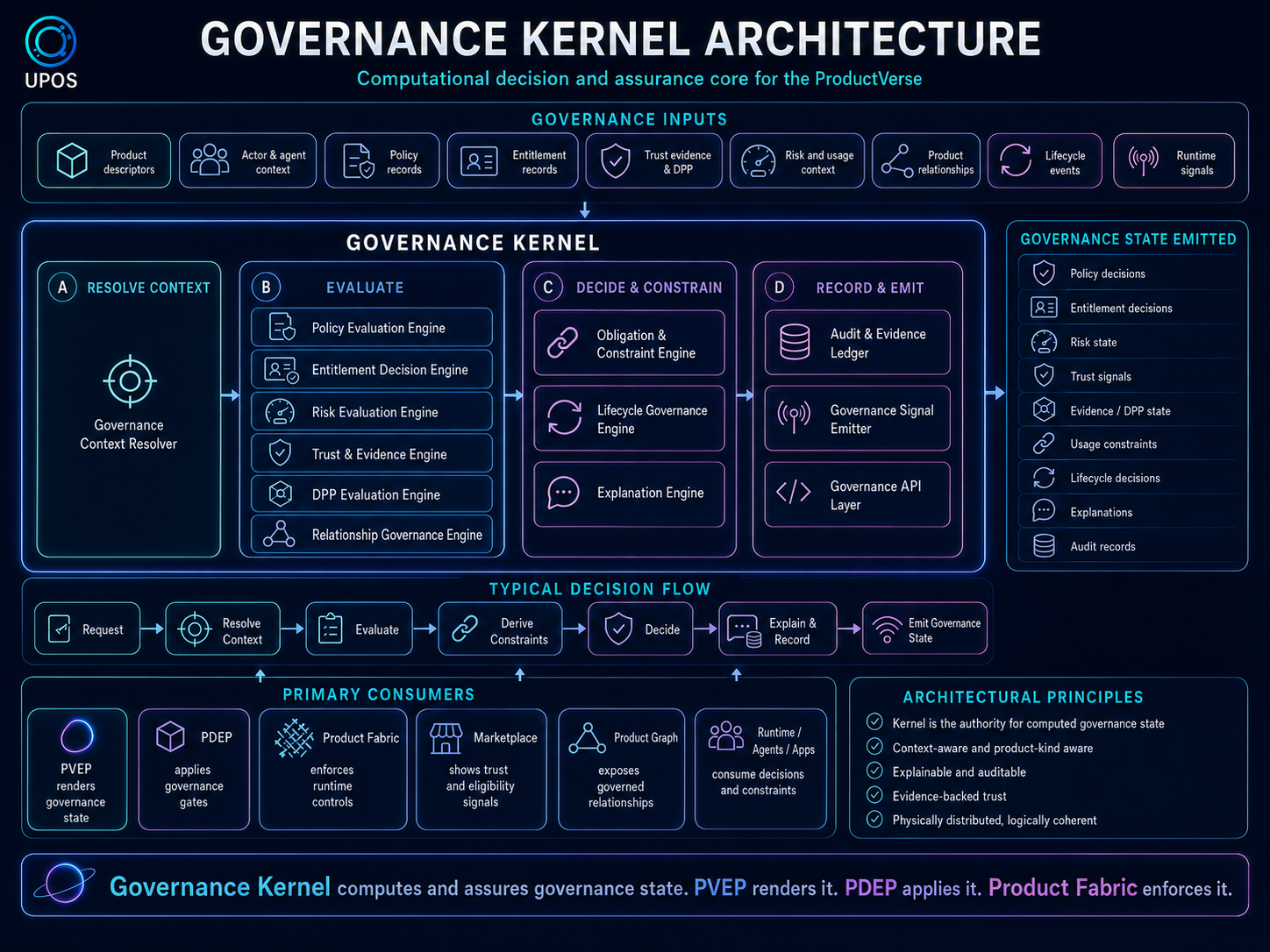
3. Architectural Position in UPOS
The Governance Kernel sits at UPOS level and serves multiple planes and ProductVerse capabilities.
                         ProductVerse
                              │
                              ▼
                    Product Registries
                    Policy Registries
                    Evidence Stores
                    Entitlement Services
                    Product Graph
                    Runtime Signals
                              │
                              ▼
                   ┌─────────────────────┐
                   │ Governance Kernel   │
                   │ Decision + Assurance│
                   └─────────────────────┘
                              │
        ┌─────────────────────┼─────────────────────┐
        ▼                     ▼                     ▼
      PVEP                  PDEP              Product Fabric
 Experience            Product Build       Runtime / Identity /
 Interpretation        & Lifecycle         Interoperability /
                                             Enforcement
        │                     │                     │
        ▼                     ▼                     ▼
 Marketplace          Product Publication    Product Runtime
 Trust Views          Composition Control    Access Control
 Entitlement UX       Validation Gates       Policy Enforcement
The Governance Kernel does not replace PVEP, PDEP, Product Fabric, Product Registry, or Marketplace capabilities.
It provides the authoritative governance state these capabilities consume.
4. Core Architectural Responsibilities
The Governance Kernel has eight core architectural responsibilities.
4.1 Context Resolution
The kernel must understand the context of a governance question.
A governance decision is rarely about a product alone. It depends on the combination of:
- actor,
- agent type,
- product,
- product kind,
- product version,
- output port,
- purpose,
- intent,
- environment,
- jurisdiction,
- entitlement,
- policy,
- risk,
- trust evidence,
- lifecycle state,
- relationship context.
Example:
Can Actor A use Product B
through Output Port C
for Purpose D
in Environment E
under Jurisdiction F?
The Context Resolver assembles this context from authoritative sources.
4.2 Policy Evaluation
The kernel evaluates policies, rules, obligations, and restrictions that apply to the context.
Policy evaluation may determine:
- permitted uses,
- prohibited uses,
- conditional uses,
- required approvals,
- jurisdiction restrictions,
- retention requirements,
- redistribution limits,
- human oversight requirements,
- evidence requirements,
- lifecycle transition gates.
4.3 Entitlement Decisioning
The kernel evaluates whether a subject has the right to access or use a product.
Entitlement decisions may consider:
- identity,
- role,
- organization,
- group,
- subscription,
- license,
- approval,
- delegated authority,
- output-port-specific permission,
- purpose-specific permission,
- expiry,
- usage limits,
- environment restrictions.
4.4 Risk Evaluation
The kernel evaluates risk associated with a product, actor, purpose, relationship, output port, or lifecycle event.
Risk evaluation may consider:
- product risk,
- AI risk tier,
- data sensitivity,
- physical safety risk,
- operational criticality,
- regulatory risk,
- jurisdiction risk,
- actor risk,
- agent autonomy,
- downstream impact,
- relationship risk,
- composition risk.
4.5 Trust and Evidence Evaluation
The kernel evaluates whether product claims are evidence-backed and whether a product is trustworthy for a given use.
Trust evaluation may consider:
- Digital Product Passport state,
- evidence records,
- certifications,
- audit results,
- quality signals,
- lineage,
- provenance,
- test results,
- evaluation reports,
- maturity scores,
- incident history,
- exception status.
4.6 Obligation and Constraint Derivation
The kernel does not only decide allow or deny. It also derives conditions that must be obeyed.
Examples:
- mask sensitive fields,
- allow only read access,
- restrict to internal use,
- require human review,
- prohibit export,
- require attribution,
- require audit logging,
- enforce retention period,
- require DPP display,
- require additional approval,
- restrict to specific environment.
4.7 Lifecycle Governance
The kernel evaluates product lifecycle events.
It may decide whether a product can be:
- created,
- composed,
- validated,
- published,
- listed,
- promoted,
- deprecated,
- retired,
- archived,
- restored,
- versioned,
- exposed through new output ports.
Lifecycle governance is especially important for PDEP.
4.8 Explanation, Audit, and Signal Emission
The kernel should produce explainable and auditable outputs.
It should record:
- what was evaluated,
- which inputs were used,
- which policies applied,
- what decision was made,
- what constraints were derived,
- what evidence supported the decision,
- who or what requested the decision,
- when the decision occurred,
- what version of product, policy, or evidence was used.
It should emit governance signals to consuming systems and experiences.
5. Logical Architecture Components
The Governance Kernel can be described as a set of logical components.
Governance Kernel
├─ Governance Context Resolver
├─ Policy Evaluation Engine
├─ Entitlement Decision Engine
├─ Risk Evaluation Engine
├─ Trust & Evidence Engine
├─ DPP Evaluation Engine
├─ Obligation & Constraint Engine
├─ Lifecycle Governance Engine
├─ Relationship Governance Engine
├─ Explanation Engine
├─ Audit & Evidence Ledger
├─ Exception Management Interface
├─ Governance Signal Emitter
└─ Governance API Layer
Each component is described below.
6. Governance Context Resolver
6.1 Purpose
The Governance Context Resolver assembles the context needed to evaluate a governance question.
It converts a partial request into a complete decision context.
6.2 Inputs
Inputs may include:
- actor identity,
- agent type,
- delegated authority,
- product identifier,
- product version,
- product kind,
- output port,
- requested purpose,
- declared intent,
- environment,
- jurisdiction,
- runtime context,
- selected products,
- relationship context,
- lifecycle event.
6.3 Resolved Context
The resolver may enrich the request with:
- actor roles,
- organizational affiliation,
- entitlement state,
- product metadata,
- product sensitivity,
- product owner,
- lifecycle state,
- applicable policies,
- applicable licenses,
- applicable risk models,
- evidence requirements,
- DPP state,
- jurisdictional constraints,
- runtime constraints,
- dependency relationships.
6.4 Example
Input:
User U requests access to Product P.

Resolved context:
User U is in Organization O.
Product P is a restricted Data Product.
Requested purpose is internal analytics.
Output port is SQL.
Jurisdiction is EU.
Policy A and License B apply.
DPP is valid.
Manager approval is required for export.
7. Policy Evaluation Engine
7.1 Purpose
The Policy Evaluation Engine evaluates policies, rules, controls, obligations, and prohibitions against the resolved context.
7.2 Policy Types
Policy types may include:
- access policy,
- usage policy,
- purpose policy,
- jurisdiction policy,
- data residency policy,
- retention policy,
- privacy policy,
- AI safety policy,
- model risk policy,
- physical safety policy,
- licensing policy,
- export policy,
- publication policy,
- lifecycle policy,
- evidence policy,
- product composition policy.
7.3 Decision Outcomes
Policy evaluation may produce:
- allow,
- deny,
- conditional allow,
- review required,
- exception required,
- escalation required,
- restricted use,
- masked use,
- read-only use,
- human oversight required,
- evidence required.
7.4 Design Principle
Policies should be computable and versioned.
The kernel should be able to explain which policies applied and why.
8. Entitlement Decision Engine
8.1 Purpose
The Entitlement Decision Engine evaluates whether a subject may access a product or output port.
A subject may be:
- human user,
- organization,
- team,
- application,
- machine agent,
- AI agent,
- institutional agent,
- product-as-consumer.
8.2 Entitlement Dimensions
Entitlements may be evaluated across:
- subject,
- product,
- product version,
- output port,
- purpose,
- environment,
- time period,
- usage quota,
- license scope,
- delegated authority,
- approval status.
8.3 Example Decisions
Allowed:
Team A may consume Product B through dashboard output port.

Conditional:
AI Agent C may invoke Product D only for monitoring and only with audit logging.

Denied:
Application E may not export Product F outside approved jurisdiction.

Approval required:
User G may access Product H after steward approval.
9. Risk Evaluation Engine
9.1 Purpose
The Risk Evaluation Engine evaluates risk posture for products, actors, relationships, intents, output ports, and lifecycle actions.
9.2 Risk Inputs
Risk inputs may include:
- product kind,
- product criticality,
- sensitivity,
- AI risk tier,
- autonomy level,
- actor authority,
- jurisdiction,
- downstream dependency,
- operational impact,
- financial impact,
- safety impact,
- compliance impact,
- trust evidence state,
- unresolved exceptions,
- incident history.
9.3 Risk Outputs
Risk outputs may include:
- risk tier,
- risk score,
- escalation requirement,
- human review requirement,
- prohibited use,
- additional evidence requirement,
- lifecycle gate requirement,
- monitoring requirement.
9.4 Example
AI Product X is allowed for advisory use
but requires human review for automated decisioning
because the effective risk tier exceeds the approved threshold.
10. Trust & Evidence Engine
10.1 Purpose
The Trust & Evidence Engine evaluates whether a product, actor, relationship, or lifecycle event has sufficient evidence to support its claims and permitted uses.
10.2 Evidence Types
Evidence may include:
- DPP evidence,
- certification records,
- audit records,
- test results,
- quality checks,
- model evaluation results,
- safety inspections,
- lineage records,
- provenance records,
- incident records,
- approval records,
- attestation records,
- policy compliance records.
10.3 Trust Outputs
Trust outputs may include:
- trust posture,
- maturity state,
- evidence sufficiency,
- evidence gap,
- expired evidence,
- certification state,
- quality posture,
- assurance status,
- DPP validity,
- exception state.
10.4 Principle
Trust should be evidence-backed.
The kernel should not emit trust state without reference to supporting evidence or provenance.
11. DPP Evaluation Engine
11.1 Purpose
The DPP Evaluation Engine evaluates Digital Product Passport state.
DPPs provide product identity, claims, evidence, provenance, certifications, trust posture, and assurance information.
11.2 DPP Checks
The engine may check:
- DPP presence,
- DPP completeness,
- DPP validity,
- DPP version,
- claim-evidence binding,
- evidence freshness,
- required sections,
- product identity binding,
- risk state,
- certification state,
- usage constraints,
- lifecycle alignment.
11.3 Outputs
DPP evaluation may emit:
- DPP valid,
- DPP incomplete,
- DPP expired,
- DPP evidence missing,
- DPP claim unsupported,
- DPP requires review,
- DPP suitable for marketplace display,
- DPP suitable for product publication,
- DPP suitable for specified use.
12. Obligation & Constraint Engine
12.1 Purpose
The Obligation & Constraint Engine derives obligations and constraints from policy, entitlement, risk, license, trust, and evidence decisions.
12.2 Examples of Constraints
Examples include:
- internal use only,
- no external sharing,
- no automated decisioning,
- human review required,
- data masking required,
- row-level filtering required,
- field-level redaction required,
- export prohibited,
- retention period enforced,
- audit logging required,
- attribution required,
- use only in approved environment,
- use only by approved agent,
- use only until expiry date.
12.3 Why This Matters
Governance is not binary.
Many decisions are conditional. The kernel must express those conditions in a form that PVEP can explain, PDEP can validate, and Product Fabric can enforce.
13. Lifecycle Governance Engine
13.1 Purpose
The Lifecycle Governance Engine evaluates product lifecycle transitions.
13.2 Lifecycle Events
Lifecycle events may include:
- create,
- compose,
- validate,
- approve,
- publish,
- list,
- promote,
- deploy,
- deprecate,
- retire,
- archive,
- restore,
- revoke,
- renew,
- re-certify.
13.3 Lifecycle Questions
The engine may answer:
- Is the product ready to publish?
- Is evidence sufficient?
- Is the DPP complete?
- Are required owners assigned?
- Are policies satisfied?
- Are output ports approved?
- Are dependencies allowed?
- Is risk acceptable?
- Are lifecycle approvals complete?
- Can this product be retired without unacceptable downstream impact?
13.4 Relationship to PDEP
PDEP is the primary consumer of lifecycle governance.
PDEP builds and evolves products. The Governance Kernel validates whether lifecycle transitions are allowed.
14. Relationship Governance Engine
14.1 Purpose
The Relationship Governance Engine evaluates governance implications of product relationships.
This is critical because the ProductVerse is recursive and relational.
14.2 Relationship Types
It may evaluate:
- product-to-product consumption,
- dependency,
- composition,
- substitution,
- complement,
- bundle membership,
- lineage,
- provenance,
- marketplace listing,
- policy relationship,
- entitlement relationship,
- agent relationship,
- runtime relationship.
14.3 Example Questions
May Product A consume Product B?
May Product A be composed with Product B?
Does Product A inherit restrictions from Product B?
Does this dependency increase risk?
Does this composition require new evidence?
Does this product chain violate a policy constraint?
14.4 Relationship to Product Graph
The Product Graph may expose governance-aware relationships, but the Governance Kernel determines authoritative governance state for those relationships.
15. Explanation Engine
15.1 Purpose
The Explanation Engine produces human- and machine-usable explanations for governance decisions.
15.2 Explanation Contents
An explanation may include:
- decision result,
- applicable policies,
- applied entitlements,
- relevant evidence,
- risk factors,
- constraints,
- missing requirements,
- approval requirements,
- exception conditions,
- expiration details,
- appeal or remediation path.
15.3 Example
Decision:
Conditional allow.

Reason:
You may use this product for internal analytics because your team has an active entitlement.
External sharing is prohibited because the product license restricts redistribution.
Export requires separate approval under the jurisdiction policy.
15.4 Principle
Explanations should be appropriate to the audience.
A consumer may need a simple explanation. An auditor may need detailed traceability. An agent may need machine-readable rationale.
16. Audit & Evidence Ledger
16.1 Purpose
The Audit & Evidence Ledger records governance decisions, inputs, outputs, evidence references, and decision traces.
16.2 What It Records
It may record:
- decision request,
- actor,
- product,
- output port,
- purpose,
- environment,
- policies evaluated,
- evidence considered,
- decision outcome,
- constraints derived,
- explanation,
- timestamp,
- policy version,
- product version,
- DPP version,
- exception state,
- decision authority.
16.3 Why It Matters
Auditability is necessary for:
- accountability,
- compliance,
- incident investigation,
- assurance,
- model risk management,
- product lifecycle review,
- consumer dispute resolution,
- regulatory reporting.
The ledger does not need to be blockchain-based. The term ledger here means a durable, queryable, trustworthy decision record.
17. Exception Management Interface
17.1 Purpose
The Exception Management Interface handles governed deviations from normal policy.
Exceptions may be needed when a product, actor, purpose, or lifecycle event does not fully satisfy normal governance requirements but may be allowed under specific conditions.
17.2 Exception Attributes
An exception should capture:
- requested deviation,
- affected product,
- affected actor,
- purpose,
- policy being overridden,
- risk rationale,
- approving authority,
- mitigation controls,
- expiry date,
- review date,
- evidence requirements,
- revocation conditions.
17.3 Principle
Exceptions must be explicit, time-bound, evidence-backed, and auditable.
18. Governance Signal Emitter
18.1 Purpose
The Governance Signal Emitter publishes governance state to other UPOS components and experiences.
18.2 Signals
Signals may include:
- entitlement granted,
- entitlement denied,
- policy violation detected,
- trust posture changed,
- DPP expired,
- evidence missing,
- risk tier changed,
- product approved for publication,
- product blocked from publication,
- exception created,
- exception expired,
- lifecycle transition approved,
- lifecycle transition denied,
- restricted usage detected.
18.3 Consumers
Signals may be consumed by:
- PVEP,
- PDEP,
- Product Fabric,
- Product Graph,
- marketplaces,
- product registries,
- runtime enforcement services,
- observability services,
- producer dashboards,
- audit systems,
- agent services.
19. Governance API Layer
19.1 Purpose
The Governance API Layer exposes kernel capabilities to other UPOS systems.
19.2 API Categories
APIs may include:
- decision API,
- entitlement API,
- policy explanation API,
- trust signal API,
- DPP status API,
- evidence status API,
- lifecycle gate API,
- relationship governance API,
- exception API,
- audit query API,
- governance signal subscription API.
19.3 API Design Principle
APIs should be both:
- machine-readable for systems and agents,
- explainable for human-facing experiences.
20. Governance Decision Flow
A typical governance decision flow may look like this:
Request
  → Context Resolution
  → Policy Evaluation
  → Entitlement Evaluation
  → Risk Evaluation
  → Trust & Evidence Evaluation
  → Obligation / Constraint Derivation
  → Decision
  → Explanation
  → Audit Record
  → Governance Signal
Example:
Consumer requests use of Product X for Purpose Y.

Kernel:
  resolves actor, product, output port, purpose, jurisdiction, policies, entitlement, evidence,
  evaluates permission,
  derives constraints,
  emits conditional allow,
  records decision,
  sends state to PVEP and Product Fabric.
21. Architecture Patterns
21.1 Synchronous Decisioning
Used when a decision is required immediately.
Examples:
- access check,
- entitlement check,
- output port invocation,
- marketplace acquisition eligibility,
- runtime policy enforcement.
Caller → Governance Decision API → Decision → Caller
21.2 Asynchronous Assurance
Used when the kernel continuously evaluates trust, evidence, risk, lifecycle, and compliance state.
Examples:
- DPP freshness check,
- evidence expiry monitoring,
- risk posture update,
- policy drift detection,
- lifecycle readiness monitoring.
Event / Schedule → Governance Evaluation → Signal Emitted
21.3 Lifecycle Gate Evaluation
Used by PDEP during product creation and lifecycle transitions.
Examples:
- publish approval,
- product composition validation,
- output port approval,
- retirement gate.
PDEP → Lifecycle Gate API → Governance Decision → Continue / Block / Review
21.4 Runtime Enforcement Support
Used by Product Fabric and runtime services.
Examples:
- API access,
- data masking,
- output filtering,
- agent invocation control,
- environment routing,
- jurisdiction restrictions.
Runtime → Policy / Entitlement Check → Enforcement Action
21.5 Experience Rendering Support
Used by PVEP and marketplaces.
Examples:
- trust badge display,
- access explanation,
- permitted-use statement,
- DPP state,
- exception warning.
PVEP → Governance State API → Human-readable / Agent-readable Governance View
22. Data and State Model
The Governance Kernel operates over several categories of state.
| State category | Examples |
|---|---|
| Product state | Product kind, version, lifecycle, output ports, owner, sensitivity. |
| Actor state | Identity, role, organization, authority, agent type, delegated mandate. |
| Policy state | Applicable rules, obligations, prohibitions, controls. |
| Entitlement state | Access grants, license scope, approvals, subscriptions, expiry. |
| Risk state | Risk tier, operational risk, compliance risk, safety risk, downstream risk. |
| Trust state | DPP, evidence, quality, maturity, certification, audit posture. |
| Relationship state | Product dependencies, composition, lineage, provenance, runtime links. |
| Purpose state | Declared use, inferred use, audience, environment, automation level. |
| Lifecycle state | Draft, validated, published, deprecated, retired, archived. |
| Exception state | Active, expired, revoked, pending, remediation required. |
These states must be version-aware where appropriate.
Governance decisions should be reproducible or explainable using the relevant state at the time of decision.
23. Kernel Consumers
The Governance Kernel serves many UPOS consumers.
23.1 PVEP
PVEP consumes governance state to render:
- access status,
- trust signals,
- DPP views,
- policy explanations,
- permitted-use guidance,
- exception warnings,
- risk posture,
- quality posture.
23.2 PDEP
PDEP consumes governance state to validate:
- product authoring authority,
- product composition,
- input product eligibility,
- lifecycle gates,
- publication readiness,
- DPP completeness,
- output port approval,
- retirement readiness.
23.3 Product Fabric
Product Fabric consumes governance state to enforce:
- identity and access,
- entitlement,
- runtime policy,
- masking and filtering,
- jurisdiction routing,
- interoperability constraints,
- output-port restrictions,
- agent invocation controls.
23.4 Marketplace
Marketplace experiences consume governance state to show:
- acquisition eligibility,
- subscription eligibility,
- pricing or license constraints,
- trust posture,
- DPP summary,
- access requirements,
- approval requirements.
23.5 Product Graph
Product Graph consumes governance state to show:
- policy edges,
- entitlement edges,
- trust edges,
- evidence edges,
- risk overlays,
- governed relationships,
- restricted dependencies.
23.6 Agents and Applications
Agents and applications consume governance state to determine:
- what products they may discover,
- what products they may invoke,
- what actions are allowed,
- what constraints apply,
- whether human confirmation is required,
- what audit trail is needed.
24. Security and Control Considerations
The Governance Kernel is security-sensitive.
Important concerns include:
- access control to governance APIs,
- protection of policy logic,
- protection of evidence records,
- secure audit logs,
- version control for policies,
- tamper resistance for decision records,
- separation of duties,
- privileged access monitoring,
- secure exception handling,
- prevention of policy bypass,
- prevention of metadata leakage,
- safe handling of agent authority,
- secure integration with runtime enforcement,
- resilience and availability for critical decisions.
The kernel should be designed so that governance cannot be silently bypassed by marketplace, PVEP, PDEP, product runtime, or agent services.
25. Observability
The Governance Kernel should be observable.
Useful metrics include:
- number of decisions,
- allow / deny / conditional decision rates,
- approval-required rate,
- exception rate,
- policy violation rate,
- entitlement failure rate,
- evidence gap rate,
- DPP expiration rate,
- risk escalation rate,
- lifecycle gate failure rate,
- decision latency,
- explanation availability,
- audit record completeness,
- policy evaluation errors,
- stale policy usage,
- stale evidence usage,
- governance signal delivery failure,
- runtime enforcement failures.
These metrics help ensure the kernel itself remains trustworthy.
26. Deployment Considerations
The Governance Kernel may be implemented through a distributed architecture.
Possible deployment patterns include:
- centralized logical governance kernel with distributed enforcement,
- domain-local policy engines with shared global governance model,
- federated governance kernels coordinated through shared standards,
- event-driven assurance pipelines,
- synchronous decision APIs for runtime checks,
- asynchronous signal streams for trust and evidence state,
- registry-backed policy and evidence services.
The key requirement is conceptual consistency:
Governance may be physically distributed, but the governance model must remain coherent.
27. Architecture Principles
27.1 One Governance Model
Different systems may consume governance state, but the governance model should be coherent across UPOS.
27.2 Kernel as Authority
The Governance Kernel is the authority for computed governance state, not PVEP, marketplace UI, or product runtime.
27.3 Policy and Evidence Separation
Policies define obligations. Evidence supports claims. The kernel evaluates both.
27.4 Context-Aware Decisions
A decision without actor, purpose, product, and context is incomplete.
27.5 Explainable and Auditable
Every important decision should be explainable and auditable.
27.6 Product-Kind Agnostic, Product-Kind Aware
The kernel should support all product kinds while recognizing that different kinds require different governance rules.
27.7 Agent-Aware by Design
The kernel must distinguish human, machine, AI, institutional, and product-as-consumer actors.
27.8 Runtime-Enforceable
Governance decisions should be expressible in forms that Product Fabric and runtime systems can enforce.
27.9 Experience-Renderable
Governance state should be expressible in forms that PVEP can render meaningfully to humans and agents.
28. Anti-Patterns
28.1 Governance Logic Scattered Across UIs
If each UI interprets governance independently, governance becomes inconsistent and unauditable.
28.2 Static Policy Without Runtime Decisioning
Static policy documents cannot govern dynamic product use, agent actions, composition, or runtime access.
28.3 Trust Signals Without Evidence
Trust indicators must be derived from evidence, not manually decorated.
28.4 Access Control Without Purpose
Identity and role alone are insufficient. Purpose, product, output port, environment, and jurisdiction matter.
28.5 PDEP Without Governance Gates
Product creation and publication without governance validation produces untrusted products.
28.6 Product Fabric Without Kernel State
Runtime enforcement without authoritative governance state leads to inconsistent controls.
28.7 Agent Blindness
Treating machine, AI, institutional, and product-as-consumer actors as ordinary users hides material governance differences.
28.8 Unlogged Decisions
Governance decisions without audit records undermine accountability.
29. Summary
The Governance Kernel Architecture defines the computational decision and assurance core of UPOS.
It is composed of logical capabilities such as:
- Governance Context Resolver,
- Policy Evaluation Engine,
- Entitlement Decision Engine,
- Risk Evaluation Engine,
- Trust & Evidence Engine,
- DPP Evaluation Engine,
- Obligation & Constraint Engine,
- Lifecycle Governance Engine,
- Relationship Governance Engine,
- Explanation Engine,
- Audit & Evidence Ledger,
- Exception Management Interface,
- Governance Signal Emitter,
- Governance API Layer.
The kernel consumes product, actor, policy, entitlement, risk, evidence, relationship, lifecycle, and runtime context.
It emits authoritative governance state to PVEP, PDEP, Product Fabric, marketplaces, product graphs, runtime services, agents, and audit systems.
In short:
The Governance Kernel computes, assures, explains, records, and emits governance state so that the ProductVerse can remain trustworthy, policy-aware, entitlement-aware, risk-aware, and accountable at scale.