ProductVerse Overview
1. Purpose
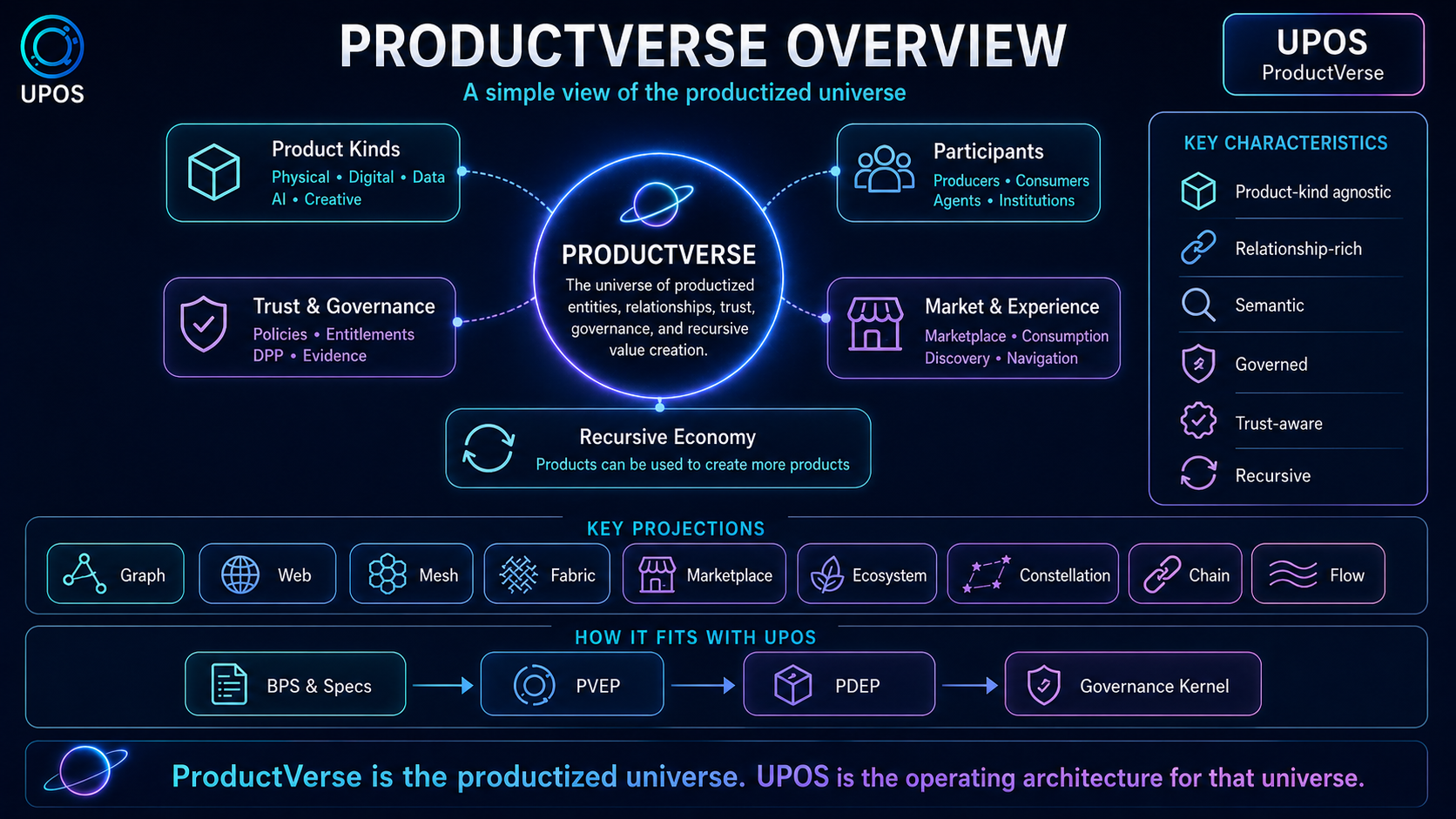
The ProductVerse is the UPOS concept for the expanding universe of productized entities, relationships, experiences, actors, markets, governance structures, trust mechanisms, and value-creation patterns.
It provides the conceptual foundation for understanding products not as isolated units, listings, assets, services, or outputs, but as participants in a wider productized reality.
In UPOS, a product may be physical, digital, informational, computational, creative, operational, institutional, or hybrid. A product may also consume other products, depend on other products, expose output ports, participate in marketplaces, carry trust evidence, belong to product chains, form part of product ecosystems, or act as an input to further product creation.
The ProductVerse exists to give UPOS a product-kind-agnostic way to reason about this expanding world of productized value.
2. Definition
ProductVerse is the total universe of productized entities, actors, relationships, markets, experiences, governance structures, trust artifacts, dependencies, and value-creation patterns.
It includes:
- products,
- product versions,
- product descriptors,
- product output ports,
- product experiences,
- product relationships,
- producers,
- consumers,
- human agents,
- machine agents,
- institutional agents,
- marketplaces,
- product chains,
- product flows,
- product ecosystems,
- governance policies,
- entitlement structures,
- trust artifacts,
- Digital Product Passports,
- evidence records,
- product registries,
- runtime environments,
- product creation pathways.
The ProductVerse is not a single platform, marketplace, catalog, graph, registry, or user interface.
It is the broader productized domain that UPOS seeks to describe, govern, experience, and operationalize.
3. Why ProductVerse?
Modern economies increasingly productize more than traditional goods and services.
In a post-industrial and post-digital world, many things can become productized:
- data products,
- AI products,
- software products,
- APIs,
- dashboards,
- reports,
- content products,
- creative assets,
- digital twins,
- policies,
- evidence packages,
- governance artifacts,
- simulation models,
- operational capabilities,
- agent services,
- physical infrastructure,
- space systems,
- habitat systems,
- energy systems,
- logistics systems,
- educational experiences,
- trust services,
- compliance capabilities.
As productization expands, the product economy becomes too large and complex to understand through a flat catalog or a single marketplace.
Products form relationships.
Products depend on other products.
Products consume other products.
Products substitute and complement each other.
Products belong to chains, flows, ecosystems, and constellations.
Products carry governance, trust, policy, and entitlement context.
Products may be consumed by humans, applications, agents, institutions, or other products.
Products may be reused as inputs to create further products.
The term ProductVerse captures this broader condition:
A universe in which productized entities become the primary units of value, coordination, trust, exchange, reuse, and recursive creation.
4. ProductVerse and UPOS
UPOS, the Universal Product Operating System, is the abstract reference meta-architecture for product-kind-agnostic product economies.
The ProductVerse is the domain that UPOS operates over.
UPOS
├─ Describes the ProductVerse
├─ Provides planes for product creation and experience
├─ Defines governance and trust mechanisms
├─ Supports product lifecycle patterns
├─ Enables product discovery, consumption, composition, and reuse
└─ Provides a product-kind-agnostic operating model
The relationship can be summarized as:
| Concept | Role |
|---|---|
| ProductVerse | The universe of productized entities and relationships. |
| UPOS | The reference operating architecture for the ProductVerse. |
| BPS | The base specification grammar for describing products. |
| Domain Specifications | Specialized product specifications such as AIPS, CMXPS, or data-product specifications. |
| PVEP | The experience plane through which consumers interact with the ProductVerse. |
| PDEP | The development and execution plane through which products are authored, composed, validated, versioned, and published. |
| Governance Kernel | The decision and assurance kernel for policy, trust, entitlement, risk, compliance, and evidence. |
5. ProductVerse as Productized Reality
The ProductVerse is not only a digital catalog. It is a conceptual model of productized reality.
A productized entity is something that can be described, discovered, trusted, governed, consumed, exchanged, reused, or composed as a product.
This may include:
| Productized entity | Example |
|---|---|
| Physical product | Rocket engine, habitat module, oxygen generator |
| Digital product | API, application, digital twin, dashboard |
| Data product | Customer risk indicators, telemetry feed, environmental data |
| AI product | Anomaly detection model, planning agent, risk classifier |
| Creative product | Comic product, asset bundle, film scene, character pack |
| Governance product | Policy package, control framework, compliance checklist |
| Evidence product | Audit evidence pack, model evaluation report, certification record |
| Experience product | Reader, simulator, onboarding journey, training module |
| Infrastructure product | Compute environment, storage service, network capability |
| Agent product | Software agent, AI agent, institutional agent service |
| Trust product | Digital Product Passport, certification, assurance bundle |
The ProductVerse allows all of these to be reasoned about through a shared architectural lens without forcing them into the same implementation model.
6. Product as Node, Product as Participant
In traditional product thinking, a product is often treated as a standalone unit.
In ProductVerse thinking, a product is both:
- a node in a wider productized structure, and
- a participant in product relationships, flows, chains, ecosystems, and governance contexts.
A product may be:
- listed in a marketplace,
- consumed through an output port,
- owned by a domain,
- governed by a policy,
- trusted through a Digital Product Passport,
- dependent on other products,
- used as an input by other products,
- substituted by another product,
- complemented by another product,
- composed into a higher-order product,
- monitored through observability,
- licensed for a specific purpose,
- constrained by entitlement,
- evaluated through quality and maturity signals,
- reused in future product creation.
This means that a product is not merely an item. It is an active participant in a productized economy.
7. Recursive Product Economy
One of the defining properties of the ProductVerse is recursion.
Products may be consumed as inputs to create further products.
Product A
  → consumed by Product B
      → composed into Product C
          → listed in Marketplace
              → consumed by Product D
This recursive structure appears across domains.
Examples:
Sensor Product
  → Environmental Data Product
      → Habitat Risk Model Product
          → Crew Safety Recommendation Product
              → Mission Control Dashboard Product
Image Asset Product
  → Comic Page Product
      → Comic Product
          → Comic Product Bundle
              → Marketplace Listing
Training Data Product
  → AI Model Product
      → Decision Support Product
          → Governance Evidence Product
This recursive product economy is central to UPOS.
It is the reason UPOS separates:
- product discovery from product creation,
- product consumption from product composition,
- product experience from product development,
- product governance from user interface decoration,
- product relationships from flat listings.
8. ProductVerse Actors
The ProductVerse includes many actors.
8.1 Producers
Producers create, maintain, publish, evolve, and retire products.
A producer may be:
- an individual,
- a team,
- a business domain,
- a company,
- a platform,
- an AI-assisted creator,
- an institutional agent,
- a decentralized community.
8.2 Consumers
Consumers discover, evaluate, acquire, use, and provide feedback on products.
A consumer may be:
- a human user,
- a business team,
- an organization,
- an application,
- a machine agent,
- an AI agent,
- an institutional agent,
- another product.
8.3 Stewards
Stewards are accountable for product quality, meaning, trust, lifecycle, compliance, and evolution.
They may oversee:
- product semantics,
- product documentation,
- trust posture,
- quality posture,
- lifecycle status,
- consumer feedback,
- product improvement,
- governance obligations.
8.4 Governance Actors
Governance actors define, compute, enforce, monitor, or review product obligations.
They may include:
- policy owners,
- risk functions,
- compliance teams,
- regulators,
- audit functions,
- governance agents,
- assurance systems,
- Governance Kernel services.
8.5 Agents
In UPOS, an agent is any entity that can act on behalf of itself or another subject within a defined context.
Agents may be:
- human agents,
- software agents,
- machine agents,
- AI agents,
- institutional agents,
- product agents.
The term agentic should not be treated as synonymous with AI. Agentic means pertaining to agency or agent-like behavior. AI agents are one subclass of agentic actors.
9. ProductVerse Relationships
The ProductVerse is relationship-rich.
Important relationship classes include:
- input relationships,
- output relationships,
- dependency relationships,
- composition relationships,
- substitution relationships,
- complement relationships,
- bundle relationships,
- provider relationships,
- ownership relationships,
- stewardship relationships,
- entitlement relationships,
- policy relationships,
- trust relationships,
- marketplace relationships,
- runtime relationships,
- lineage relationships,
- provenance relationships,
- agent relationships,
- consumer relationships.
These relationships are not decorative. They are core to how products are discovered, trusted, governed, composed, consumed, and evolved.
10. ProductVerse Projections
Because the ProductVerse is large and multi-dimensional, it cannot be understood through one view.
UPOS therefore defines multiple ProductVerse projections.
A projection is a purpose-specific way of viewing or reasoning about the ProductVerse.
Examples include:
| Projection | Purpose |
|---|---|
| Product Graph | Formal node-edge representation of products and relationships. |
| Product Web | Meaningful linked discovery and semantic navigation of products. |
| Product Mesh | Federated ownership, stewardship, and domain accountability. |
| Product Fabric | Interoperability, governance, trust, identity, and integration substrate. |
| Product Marketplace | Exchange, acquisition, pricing, licensing, subscription, and access. |
| Product Ecosystem | Co-evolving socio-technical-economic system around products and actors. |
| Product Constellation | Purpose, mission, domain, or portfolio-oriented product cluster. |
| Product Chain | Ordered dependency, production, or value sequence. |
| Product Flow | Dynamic movement of value, data, materials, rights, energy, decisions, or feedback. |
These projections are defined in detail in productverse-projections.md.
The key principle is:
ProductVerse is the universe. Projections are contextual lenses for understanding it.
11. Mesh and Web in ProductVerse
Two ProductVerse projections require special distinction: Product Mesh and Product Web.
They are often easy to confuse because both imply connectedness. However, they foreground different concerns.
| Term | What it foregrounds | Primary concern |
|---|---|---|
| Mesh | Topology, decentralization, distribution, ownership, operational scalability | How responsibility and operation are distributed |
| Web | Meaning, relationships, links, discoverability, semantics, knowledge navigation | How things become meaningfully connected and discoverable |
In UPOS:
Product Mesh = federated ownership and stewardship of products
Product Web  = semantic discovery and navigation of product relationships
This distinction is important.
A product economy may have a strong Product Mesh but a weak Product Web. That would mean products are distributed and owned by domains, but hard to understand, discover, or semantically navigate.
Conversely, a product economy may have a strong Product Web but a weak Product Mesh. That would mean products are well linked and discoverable, but ownership, stewardship, and accountability may be unclear.
A mature ProductVerse needs both:
- Product Mesh for scalable product ownership.
- Product Web for meaningful product discovery and interpretation.
12. ProductVerse and PVEP
The ProductVerse Experience Plane (PVEP) is the experience plane through which consumers, organizations, applications, agents, and products-as-consumers interact with the ProductVerse.
PVEP enables participants to:
- discover products,
- evaluate products,
- acquire products,
- request access,
- consume products,
- navigate product relationships,
- understand trust and governance posture,
- manage portfolios and entitlements,
- select product sets,
- transition to PDEP when creation intent emerges.
PVEP does not expose the ProductVerse as one monolithic view.
Instead, PVEP should provide contextual experiences based on actor intent.
For example:
| Consumer intent | PVEP experience |
|---|---|
| “Find a product for this purpose.” | Concierge & Agent-Mediated Discovery Zone |
| “Show me available products.” | Marketplace Experience Zone |
| “Use this product.” | Consumption Experience Zone |
| “What is this product related to?” | Product Graph Navigation Zone |
| “What can I access?” | Portfolio & Entitlement Experience Zone |
| “Can I trust this product?” | Governance & Trust Experience Zone |
| “Select these products for a purpose.” | Product Select & Assembly Zone |
PVEP is therefore the consumer-facing experiential surface of the ProductVerse.
13. ProductVerse and PDEP
The Product Development and Execution Plane (PDEP) is the UPOS plane responsible for product authoring, composition, validation, lifecycle control, versioning, deployment preparation, and publication.
The ProductVerse provides the domain of products and relationships. PDEP provides the controlled mechanism for creating and evolving governed products.
The distinction is:
PVEP explores, evaluates, consumes, and selects products.
PDEP authors, composes, validates, versions, and publishes products.
ProductVerse exploration may reveal creation opportunities.
Examples:
- a Product Graph reveals a missing dependency,
- a Product Web reveals meaningful adjacency,
- a Product Constellation suggests a candidate product set,
- a Product Chain reveals a missing product in a value sequence,
- a Product Flow reveals an observability gap,
- a Product Marketplace reveals unmet demand,
- a Product Ecosystem reveals a new domain opportunity.
When intent becomes product creation, composition, validation, versioning, or publication, the flow transitions into PDEP.
14. ProductVerse and the Governance Kernel
The Governance Kernel is the UPOS decision and assurance kernel for policy, entitlement, risk, trust, compliance, evidence, and accountability.
The ProductVerse is governance-rich.
Products may be governed by:
- policies,
- controls,
- obligations,
- licenses,
- regulations,
- entitlement models,
- risk tiers,
- trust frameworks,
- quality requirements,
- evidence requirements,
- maturity expectations,
- provenance constraints,
- permitted-use rules,
- prohibited-use rules.
The Governance Kernel provides authoritative governance state.
ProductVerse experiences and projections may expose that state, but they should not invent it.
The principle is:
Governance state must be kernel-derived, not experience-decorated.
For example:
- a Product Marketplace may display trust signals,
- a Product Web may link to DPPs,
- a Product Graph may show policy edges,
- a Product Flow may show governed movement,
- a Product Fabric may enforce interoperability constraints,
- a Product Chain may support traceability.
But the Governance Kernel remains the authority for governance computation, evidence, and decisioning.
15. ProductVerse and Trust
Trust is central to the ProductVerse.
In a small product economy, trust may be implicit or reputation-based. In a large product economy, especially one involving AI, automation, physical infrastructure, planetary operations, or regulated environments, trust must be explicit, computable, inspectable, and evidence-backed.
Trust may be represented through:
- Digital Product Passports,
- product maturity scores,
- quality signals,
- lineage,
- provenance,
- certifications,
- audit evidence,
- policy compliance,
- risk tier,
- evaluation results,
- safety evidence,
- ownership and stewardship clarity,
- usage history,
- incident history,
- consumer feedback.
Trust is not only a marketplace concern. It affects discovery, consumption, composition, interoperability, governance, and lifecycle decisions.
A ProductVerse without trust becomes a noisy universe of claims. A ProductVerse with computable trust becomes a navigable economy of accountable products.
16. ProductVerse and Scale
The ProductVerse concept is designed for scale.
It can apply to:
- a small internal product catalog,
- an enterprise data and AI platform,
- a creative marketplace,
- a digital product ecosystem,
- a smart-city product economy,
- a space mission product economy,
- a lunar or Martian settlement,
- a cross-planetary product economy,
- a human-AI institutional economy.
At small scale, ProductVerse concepts may appear as simple product listings, relationships, and consumption experiences.
At large scale, ProductVerse concepts become necessary for survival-level coordination:
- which habitat systems depend on which energy products,
- which AI products control physical operations,
- which products are trusted for safety-critical use,
- which policies govern product consumption,
- which products can be substituted during failure,
- which products are owned by which domains,
- which product flows carry energy, oxygen, materials, data, or decisions,
- which marketplaces can provision critical capabilities,
- which governance evidence supports continued operation.
The ProductVerse is therefore not merely a commercial concept. It is an architecture for productized coordination at scale.
17. Design Principles
17.1 Product-Kind Agnostic
The ProductVerse must support many product kinds without privileging one type, such as data products, AI products, software products, or physical products.
17.2 Relationship-First
Products should be understood through their relationships, not only their standalone descriptions.
17.3 Meaning-Aware
Product discovery should support meaning, context, semantics, and interpretation, not only keyword search or category browsing.
17.4 Governance-Aware
Policy, entitlement, trust, risk, and compliance should be part of ProductVerse reasoning, not external afterthoughts.
17.5 Experience-Aware
Products become usable through experiences. PVEP provides the experience plane through which consumers interact with the ProductVerse.
17.6 Creation-Aware
The ProductVerse is recursive. Products may be used as inputs to create further products through PDEP.
17.7 Projection-Aware
No single view is sufficient. Consumers and agents should be able to use the ProductVerse projection that matches their intent.
17.8 Agent-Compatible
The ProductVerse must support human users, applications, machine agents, AI agents, institutional agents, and products-as-consumers.
17.9 Trust-Centric
Trust should be computable, evidence-backed, and inspectable through product descriptors, DPPs, governance signals, and provenance.
18. Anti-Patterns
18.1 Flat Catalog Thinking
Treating the ProductVerse as a list of products hides relationships, dependencies, trust, governance, flows, and ecosystems.
18.2 Marketplace-Centric Thinking
Treating the marketplace as the whole ProductVerse ignores consumption, graph navigation, product creation, governance, and product relationships.
18.3 Data-Product Bias
Defining ProductVerse only through data products weakens its product-kind-agnostic purpose.
18.4 AI-Product Bias
Defining ProductVerse only through AI products ignores physical, digital, creative, governance, infrastructure, and content products.
18.5 Mesh/Web Confusion
Using mesh and web interchangeably weakens the model. Mesh foregrounds distributed ownership. Web foregrounds semantic navigation.
18.6 Trust as Decoration
Trust signals should not be manually applied as marketing badges. They should be derived from governance, evidence, quality, risk, and DPP mechanisms.
18.7 Product Creation in the Experience Plane
PVEP may help consumers select products and express intent, but governed product creation belongs to PDEP.
18.8 Single-Projection Bias
Assuming every user needs the same graph, marketplace, or topology creates poor experiences and weakens ProductVerse usability.
19. Summary
The ProductVerse is the UPOS construct for the expanding universe of productized entities, actors, relationships, markets, experiences, governance structures, trust artifacts, dependencies, and value-creation patterns.
It exists because modern product economies are no longer flat collections of products. They are relationship-rich, recursive, governed, trusted, dynamic, and multi-actor systems.
The ProductVerse is:
- product-kind agnostic,
- relationship-rich,
- semantic,
- governed,
- trust-aware,
- market-aware,
- experience-aware,
- recursive,
- scalable,
- agent-compatible.
It is experienced through PVEP, built and evolved through PDEP, governed through the Governance Kernel, described through product specifications, and interpreted through contextual projections.
In short:
ProductVerse is the productized universe. UPOS is the operating architecture for that universe.