Governance Kernel Overview
1. Purpose
The Governance Kernel is the UPOS decision and assurance kernel responsible for computing, evaluating, recording, and emitting authoritative governance state across the ProductVerse.
It provides the productized economy with a consistent mechanism for answering governance questions such as:
- Who is allowed to use this product?
- For what purpose may this product be used?
- What policy obligations apply?
- What trust evidence supports this product?
- What risks are associated with this product?
- What constraints apply to this product’s output ports?
- What entitlements exist for a consumer, agent, organization, or product?
- What governance state should be shown in PVEP?
- What governance checks must be applied during PDEP?
- What evidence must be retained for audit, assurance, or regulatory review?
The Governance Kernel exists because a large ProductVerse cannot rely on manual governance, static checklists, informal trust, or UI-level decoration.
In UPOS, governance must be:
- computable,
- explainable,
- evidence-backed,
- policy-driven,
- intent-aware,
- product-kind-aware,
- actor-aware,
- entitlement-aware,
- risk-aware,
- auditable,
- and continuously observable.
2. Definition
The Governance Kernel is the UPOS computational governance core that evaluates policies, entitlements, risks, trust signals, obligations, evidence, and permitted-use conditions for products, actors, intents, product relationships, output ports, and product lifecycle actions.
It is called a kernel because it provides a foundational decision and assurance function beneath multiple UPOS planes and experiences.
It is not a user interface, committee, static policy repository, approval workflow, or marketplace badge system.
The Governance Kernel is the authoritative layer that determines, records, and emits governance state so that other UPOS planes can act consistently.
The core definition is:
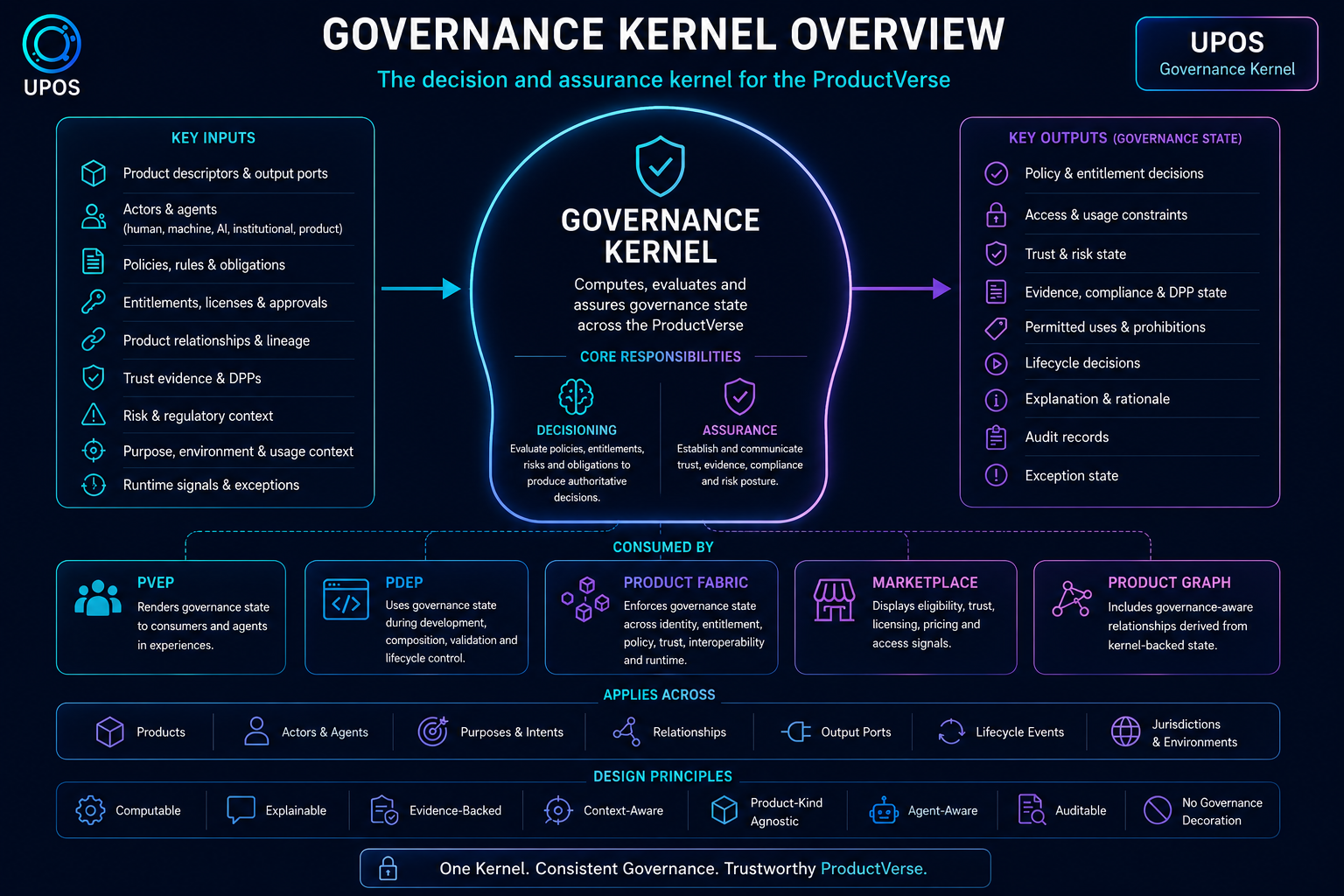
The Governance Kernel computes and assures governance state across the ProductVerse. PVEP renders that state. PDEP applies that state during product creation and lifecycle control. Product Fabric enforces that state across runtime, identity, interoperability, and trust mechanisms.
3. Why a Governance Kernel?
As product economies scale, governance becomes more complex.
A product may be:
- consumed by humans,
- invoked by applications,
- used by AI agents,
- acted upon by institutional agents,
- consumed by another product,
- listed in a marketplace,
- composed into a higher-order product,
- governed by multiple policies,
- licensed for specific purposes,
- restricted by jurisdiction,
- supported by evidence,
- associated with risk,
- dependent on other products,
- exposed through multiple output ports.
A static governance model cannot handle this complexity.
The Governance Kernel exists to provide a consistent computational basis for governance across:
- product discovery,
- product evaluation,
- product acquisition,
- product entitlement,
- product consumption,
- product selection,
- product composition,
- product publication,
- product lifecycle evolution,
- product retirement,
- audit and assurance.
Without a Governance Kernel, each experience or platform component would create its own interpretation of policy, trust, risk, and entitlement.
That would lead to inconsistent decisions, weak auditability, fragmented controls, and misleading trust signals.
4. Scope
The Governance Kernel covers governance decisioning and assurance across the ProductVerse.
It may evaluate and emit state related to:
- policies,
- controls,
- obligations,
- permitted uses,
- prohibited uses,
- entitlements,
- access decisions,
- purpose limitations,
- risk posture,
- trust posture,
- product maturity,
- quality posture,
- evidence state,
- DPP state,
- compliance status,
- lineage and provenance,
- actor authority,
- agent authority,
- product relationship risk,
- product output port restrictions,
- lifecycle approvals,
- exception status,
- audit requirements.
The Governance Kernel does not own:
- product authoring,
- product composition,
- product development workflows,
- product experience design,
- marketplace UI,
- consumer dashboards,
- product runtime implementation,
- human committee deliberation,
- product storage or serving by default.
Those capabilities may use the Governance Kernel, but they are not the kernel itself.
5. Position within UPOS
The Governance Kernel is a UPOS-level construct. It sits beneath and beside the main UPOS planes, providing authoritative governance state to each.
ProductVerse
    │
    ▼
Governance Kernel
    ├─ Policy decisions
    ├─ Entitlement decisions
    ├─ Risk state
    ├─ Trust state
    ├─ Evidence state
    ├─ Compliance state
    ├─ Permitted-use state
    └─ Assurance state
Its relationship to the major UPOS constructs can be summarized as follows:
| UPOS construct | Relationship to Governance Kernel |
|---|---|
| ProductVerse | The kernel evaluates governance state across products, actors, relationships, flows, chains, marketplaces, and ecosystems. |
| PVEP | PVEP renders kernel-derived governance state to consumers and agents. |
| PDEP | PDEP applies kernel decisions during product authoring, composition, validation, versioning, and publication. |
| Product Fabric | Product Fabric enforces kernel-derived governance through identity, entitlement, policy, trust, interoperability, and runtime mechanisms. |
| Product Marketplace | Marketplace experiences display kernel-derived trust, eligibility, licensing, and access signals. |
| Product Graph | Product Graph may include policy, entitlement, trust, evidence, and risk relationships derived from kernel-backed sources. |
| DPP | Digital Product Passports expose product trust and evidence state that may be validated, referenced, or emitted by the kernel. |
| Product Registries | Registries provide product, policy, entitlement, evidence, and relationship records used by the kernel. |
6. Governance Kernel as Decision and Assurance Core
The Governance Kernel has two major responsibilities:
- Decisioning
- Assurance
6.1 Decisioning
Decisioning is the process of evaluating whether an action, usage, relationship, entitlement, lifecycle transition, or product state is permitted, denied, restricted, conditional, or requires review.
Examples:
- May this consumer access this product?
- May this AI agent invoke this output port?
- May this product be used for this purpose?
- May this product be composed with another product?
- May this data leave a jurisdiction?
- May this model be used in automated decisioning?
- May this product be published to a marketplace?
- May this product be retired?
- May this output be shared externally?
Decision outputs may include:
- allow,
- deny,
- conditional allow,
- approval required,
- exception required,
- masked access,
- restricted access,
- read-only access,
- purpose-limited access,
- time-limited access,
- jurisdiction-limited access,
- escalation required.
6.2 Assurance
Assurance is the process of establishing, recording, and communicating whether a product, actor, relationship, or action is trustworthy, compliant, evidence-backed, and fit for use.
Examples:
- Is the product evidence-backed?
- Is the Digital Product Passport valid?
- Is the product quality posture acceptable?
- Is the product maturity sufficient?
- Is the product risk tier acceptable?
- Is lineage complete?
- Are required controls satisfied?
- Are required reviews current?
- Are exceptions open or expired?
- Is the product permitted for this class of use?
Assurance outputs may include:
- trust signal,
- risk state,
- maturity state,
- compliance state,
- evidence state,
- DPP state,
- quality state,
- control status,
- audit posture,
- certification status,
- exception state.
7. Core Governance Questions
The Governance Kernel helps UPOS answer several classes of questions.
7.1 Access Questions
Who can access this product?
Which output ports can they use?
Under what conditions?
For how long?
With what constraints?
7.2 Purpose Questions
Can this product be used for this purpose?
Is the purpose permitted, restricted, or prohibited?
Does this purpose require approval?
7.3 Actor Questions
Who is acting?
Is the actor a human, organization, application, machine agent, AI agent, institutional agent, or product?
What authority does the actor have?
Is delegated authority valid?
7.4 Product Questions
What kind of product is this?
What governance obligations apply to this product kind?
What is its trust, risk, maturity, and quality posture?
7.5 Relationship Questions
May this product depend on that product?
May this product consume that output port?
Is this composition allowed?
Does this relationship create additional risk?
7.6 Lifecycle Questions
May this product be published?
May this product be promoted?
May this product be deprecated?
May this product be retired?
What evidence is required for lifecycle transition?
7.7 Evidence Questions
What evidence supports this product?
Is the evidence current?
Is the evidence sufficient?
What claims does the evidence support?
What claims remain unsupported?
8. Governance Kernel Inputs
The Governance Kernel relies on authoritative inputs.
| Input | Description |
|---|---|
| Product descriptors | Product identity, kind, owner, version, output ports, usage model, domain, lifecycle state. |
| Policy records | Rules, obligations, restrictions, controls, permitted uses, prohibited uses. |
| Actor context | Identity, role, organization, delegated authority, agent type, purpose, location, environment. |
| Entitlement records | Access grants, subscriptions, licenses, approvals, restrictions, expiry, scope. |
| Product relationships | Dependencies, inputs, outputs, composition, lineage, substitutes, complements, bundles. |
| Trust evidence | DPPs, certifications, attestations, audits, evaluation results, quality records. |
| Risk records | Risk tier, product risk, actor risk, purpose risk, relationship risk, jurisdiction risk. |
| Usage context | Intended purpose, environment, output port, consumption mode, audience, automation level. |
| Runtime signals | Availability, incidents, error rates, policy violations, usage patterns, anomaly signals. |
| Regulatory context | Jurisdiction, legal obligations, industry rules, institutional requirements. |
| Exception records | Approved deviations, temporary waivers, remediation plans, expiry dates. |
These inputs may come from registries, policy engines, identity systems, entitlement services, DPP services, observability systems, lifecycle systems, or product metadata services.
9. Governance Kernel Outputs
The Governance Kernel emits authoritative governance state.
| Output | Description |
|---|---|
| Policy decision | Allow, deny, conditional allow, approval required, exception required. |
| Entitlement decision | Whether a subject may access a product or output port under specified conditions. |
| Trust signal | Consumer- and agent-usable representation of product trust posture. |
| Risk state | Risk classification or risk posture for product, actor, purpose, or relationship. |
| Compliance state | Whether required obligations and controls are satisfied. |
| Evidence state | Whether required evidence exists, is current, and supports product claims. |
| DPP state | Validity, completeness, status, and trust posture of Digital Product Passport. |
| Usage constraint | Conditions, restrictions, obligations, permitted uses, prohibited uses. |
| Lifecycle decision | Whether a product may be published, promoted, deprecated, or retired. |
| Explanation | Reasoning or trace for a governance decision or trust state. |
| Audit record | Evidence that a decision was evaluated, with inputs, outputs, time, and authority. |
| Exception state | Whether an exception exists, is valid, expired, or requires review. |
These outputs should be machine-readable where possible and human-explainable where necessary.
10. Governance State
The Governance Kernel emits governance state.
Governance state is the authoritative condition of a product, actor, action, relationship, or lifecycle event with respect to policies, rights, obligations, risks, trust, evidence, and compliance.
Examples of governance state include:
Consumer X is allowed to use Product Y
for Purpose Z
through Output Port P
in Environment E
until Date D
subject to Constraints C.
Product A has high trust posture
because required evidence records are present,
DPP is valid,
quality checks are current,
and no critical exceptions are open.
Product B may not be composed with Product C
because the intended purpose violates a licensing constraint.
AI Product D requires human review
because its effective risk tier exceeds the threshold for automated use.
Governance state should be:
- contextual,
- explainable,
- evidence-backed,
- time-aware,
- version-aware,
- actor-aware,
- purpose-aware,
- auditable.
11. Product-Kind Awareness
UPOS is product-kind agnostic, but governance is often product-kind specific.
Different product kinds require different governance considerations.
| Product kind | Example governance considerations |
|---|---|
| Data Product | sensitivity, residency, retention, quality, lineage, permitted use, privacy. |
| AI Product | risk tier, safety, evaluation, explainability, autonomy, authority, model behavior, human oversight. |
| Software Product | vulnerabilities, dependencies, licensing, runtime security, API access, availability. |
| Physical Product | safety, certification, maintenance, operational limits, environmental constraints. |
| Creative Product | rights, licensing, ownership, derivative use, attribution, distribution permissions. |
| Policy Product | authority, applicability, version, jurisdiction, conflict resolution, lifecycle state. |
| Evidence Product | provenance, validity, scope, auditability, freshness, claim support. |
| Agent Product | delegated authority, scope, autonomy, audit trail, supervisor assignment, revocation. |
The Governance Kernel must support product-kind-specific policies while maintaining a common governance model.
12. Actor and Agent Awareness
The Governance Kernel must distinguish between different actor types.
Actors may include:
- human users,
- organizations,
- teams,
- applications,
- machine agents,
- AI agents,
- institutional agents,
- products-as-consumers,
- governance actors,
- stewards,
- producers.
The term agentic should not be treated as synonymous with AI.
In UPOS:
Agentic means pertaining to agents or agency. AI agents are one subclass of agentic actors.
The Governance Kernel must therefore evaluate:
- who or what is acting,
- whether the actor has authority,
- whether authority is delegated,
- whether the action is within scope,
- whether human approval is required,
- whether agent activity is auditable,
- whether the actor may act for the stated purpose.
This is especially important for institutional agents and products-as-consumers.
13. Intent and Purpose Awareness
Governance decisions are not only about identity and product.
They also depend on intent and purpose.
A consumer may be allowed to use a product for one purpose but not another.
Example:
Allowed:
Use Product A for internal analytics.

Restricted:
Use Product A for external customer communication.

Prohibited:
Use Product A for automated high-impact decisioning.
The Governance Kernel should be able to evaluate:
- declared purpose,
- inferred purpose,
- consumer intent,
- output port,
- environment,
- audience,
- automation level,
- jurisdiction,
- downstream use,
- derivative use,
- redistribution use.
This makes governance more precise than simple role-based access.
14. Relationship Awareness
Governance is not limited to single products.
The Governance Kernel must reason about relationships.
For example:
- Product A may consume Product B.
- Product C may be composed from Products A and B.
- Product D may expose an output port to Product E.
- Product F may be a substitute for Product G.
- Product H may inherit risk from Product I.
- Product J may be governed by Policy K.
- Product L may carry evidence from DPP M.
- Agent N may invoke Product O on behalf of Organization P.
Relationship-aware governance enables:
- composition control,
- dependency risk analysis,
- lineage assurance,
- trust propagation,
- policy impact analysis,
- entitlement inheritance,
- product-to-product access control,
- downstream usage control.
This is critical in a recursive product economy.
15. Governance Kernel and Product Fabric
The Product Fabric is the interoperability, governance, trust, identity, registry, policy, and integration substrate that allows independently produced products to work together safely and coherently.
The Governance Kernel provides decisioning and assurance logic used by the Product Fabric.
Governance Kernel
  → policy decisions
  → entitlement decisions
  → trust state
  → risk state
  → permitted-use state
  → evidence state

Product Fabric
  → enforces and operationalizes those decisions across identity, access, runtime, registries, and interoperability mechanisms
In short:
The Governance Kernel decides and assures. The Product Fabric connects and enforces.
16. Governance Kernel and PVEP
The ProductVerse Experience Plane (PVEP) renders governance state in consumer- and agent-usable form.
PVEP may show:
- entitlement status,
- trust badges,
- DPP summaries,
- policy explanations,
- permitted-use statements,
- risk tier,
- quality posture,
- evidence status,
- compliance status,
- access rationale,
- exception state,
- lifecycle state.
However, PVEP should not manually invent governance state.
The principle is:
PVEP renders governance state. The Governance Kernel computes and assures it.
Example:
Governance Kernel:
Consumer may use Product X for Purpose Y with Constraint Z.

PVEP:
Displays “You may use this product for internal analytics only. External sharing requires approval.”
This distinction prevents governance from becoming UI decoration.
17. Governance Kernel and PDEP
The Product Development and Execution Plane (PDEP) uses the Governance Kernel during product creation, composition, validation, lifecycle control, and publication.
PDEP may ask the Governance Kernel:
- May this product be created?
- Is the product owner authorized?
- Are the selected input products allowed?
- Is this product composition permitted?
- Are required policies satisfied?
- Is evidence sufficient for publication?
- Is DPP generation complete?
- Is the risk tier acceptable?
- Are lifecycle transition requirements met?
- May this product be published to a marketplace?
- May this product be deprecated or retired?
The principle is:
PDEP builds governed products. The Governance Kernel validates governance conditions for that build.
18. Governance Kernel and Product Marketplace
Marketplaces depend on governance signals.
The Marketplace Experience Zone may display:
- product eligibility,
- entitlement status,
- pricing eligibility,
- licensing constraints,
- trust posture,
- DPP summary,
- permitted uses,
- risk level,
- quality posture,
- approval requirements.
But the marketplace should not be the governance authority.
The principle is:
Marketplace experiences display governance signals. The Governance Kernel provides the authoritative governance state.
19. Governance Kernel and Product Graph
The Product Graph may include governance-aware relationships.
Examples:
Product A
  governed by
Policy B

Consumer C
  entitled to use
Product D

Product E
  evidenced by
DPP F

Product G
  restricted by
License H

Product I
  inherits risk from
Product J
These graph relationships should be grounded in authoritative kernel-backed state.
The Product Graph can help users navigate governance relationships, but the Governance Kernel remains the authority for evaluation, decisioning, and assurance.
20. Governance Kernel and DPP
Digital Product Passports are product trust artifacts that expose product identity, claims, evidence, certifications, provenance, compliance status, and assurance information.
The Governance Kernel may:
- validate DPP completeness,
- evaluate DPP freshness,
- check evidence sufficiency,
- bind DPP state to product usage decisions,
- emit DPP-derived trust signals,
- require DPP presence for publication,
- require DPP review for high-risk use,
- expose DPP state to PVEP,
- record DPP-related audit decisions.
The principle is:
DPPs carry product trust evidence. The Governance Kernel evaluates and operationalizes that evidence.
21. Design Principles
21.1 Computable Governance
Governance rules should be represented in a form that systems can evaluate.
21.2 Explainable Decisions
Governance decisions should provide understandable rationale.
21.3 Evidence-Backed Trust
Trust signals should be grounded in evidence, not manual labels.
21.4 Context-Aware Evaluation
Governance depends on actor, product, purpose, relationship, environment, jurisdiction, and lifecycle state.
21.5 Product-Kind Awareness
Different product kinds require different governance rules, but the governance model should remain coherent.
21.6 Agent-Aware Control
Governance must evaluate human, machine, AI, institutional, and product-as-consumer actors.
21.7 Separation of Concerns
The Governance Kernel computes and assures governance state. PVEP renders it. PDEP uses it. Product Fabric enforces it.
21.8 Auditability
Governance decisions should be recorded with enough context to support assurance, investigation, and accountability.
21.9 No Governance Decoration
Governance signals should not be decorative UI elements. They must derive from authoritative governance state.
22. Anti-Patterns
22.1 Governance as Committee Only
Human committees may exist, but the ProductVerse requires computational governance support.
22.2 Governance as Static Documentation
Static policy documents alone cannot govern dynamic product usage, composition, and agentic behavior.
22.3 Governance as UI Badge
Trust badges without evidence-backed kernel state are weak and potentially misleading.
22.4 Governance Fragmentation
Each marketplace, product experience, or runtime should not invent its own governance logic.
22.5 Identity-Only Access Control
Knowing who the user is is insufficient. Governance must consider purpose, product, output port, policy, trust, risk, and context.
22.6 Product-Kind Blindness
Applying the same governance rules to data products, AI products, physical products, creative products, and agent products ignores material differences.
22.7 Agent Blindness
Treating all actors as human users ignores applications, AI agents, machine agents, institutional agents, and products-as-consumers.
22.8 Evidence-Free Trust
A product should not be considered trusted without supporting evidence, provenance, quality signals, or assurance records.
22.9 PDEP Bypass
Products should not bypass governance validation during creation, composition, publication, or lifecycle transition.
23. Summary
The Governance Kernel is the UPOS decision and assurance kernel for the ProductVerse.
It computes, evaluates, records, and emits authoritative governance state across products, actors, intents, relationships, output ports, lifecycle actions, policies, entitlements, risks, trust signals, evidence, and permitted-use conditions.
It exists because a large-scale ProductVerse requires governance that is computable, explainable, evidence-backed, product-kind-aware, actor-aware, intent-aware, relationship-aware, auditable, and continuously observable.
Its essential boundary is:
Governance Kernel computes and assures governance state.
PVEP renders governance state.
PDEP applies governance state during product creation and lifecycle control.
Product Fabric enforces governance state across runtime and interoperability mechanisms.
In short:
The Governance Kernel is the computational governance core that makes the ProductVerse trustworthy, policy-aware, entitlement-aware, risk-aware, and accountable.