PVEP Reference Model
1. Purpose
The PVEP Reference Model provides a consolidated conceptual model of the ProductVerse Experience Plane (PVEP).
PVEP is the UPOS experience mediation plane through which ProductVerse participants discover, evaluate, acquire, consume, navigate, trust, select, assemble candidate product sets, request access, provide feedback, and transition to PDEP when product creation intent emerges.
This reference model consolidates the main PVEP concepts introduced across the PVEP documentation:
- PVEP zones,
- actors and personas,
- products and product relationships,
- artifacts,
- journeys,
- governance integration,
- Product Fabric interaction,
- PDEP boundary,
- ProductVerse flows.
The key principle is:
PVEP is the governed experience mediation layer between actors and the ProductVerse. It renders product, governance, entitlement, trust, marketplace, graph, consumption, and selection experiences without becoming the product-building plane.
2. Reference Model Scope
The PVEP Reference Model defines the conceptual structure of PVEP.
It covers:
- actors who use PVEP,
- experience zones inside PVEP,
- ProductVerse entities surfaced through PVEP,
- PVEP-facing artifacts,
- relationships among artifacts and entities,
- governance state rendered by PVEP,
- common experience flows,
- handoffs to PDEP,
- runtime interaction with Product Fabric,
- feedback and learning loops.
It does not define:
- physical UI implementation,
- specific frontend technology,
- API protocol,
- database schema,
- product registry implementation,
- marketplace commercial model,
- PDEP implementation,
- Governance Kernel internals,
- Product Fabric runtime architecture.
Those may be defined in implementation-specific architectures or domain-specific specializations.
3. PVEP in UPOS
PVEP sits between actors and the broader ProductVerse.
Actors / Participants
        ↓
ProductVerse Experience Plane
        ↓
ProductVerse Products, Marketplaces, Graphs, Output Ports, Registries, Governance State
PVEP is connected to:
- ProductVerse — the universe of productized entities, relationships, actors, and value flows.
- Governance Kernel — computes policy, entitlement, trust, risk, evidence, DPP, lifecycle, and relationship governance state.
- Product Fabric — enforces runtime access, output-port usage, identity, interoperability, and governance constraints.
- PDEP — creates, composes, validates, versions, publishes, and evolves governed products.
- Marketplace services — support listing, pricing, acquisition, subscription, licensing, and onboarding.
- Product Graph — exposes product relationships, dependencies, substitutes, complements, chains, flows, and governance overlays.
- Product registries — hold product identity, descriptors, metadata, output ports, lifecycle state, and relationships.
The central UPOS boundary is:
PVEP renders product experience.
Governance Kernel computes governance state.
Product Fabric enforces runtime state.
PDEP creates governed products.
4. PVEP Core Definition
PVEP, or ProductVerse Experience Plane, is the UPOS plane responsible for mediating human, organizational, application, agent, and product-as-consumer experiences across the ProductVerse.
PVEP enables actors to:
- discover products,
- evaluate product fit,
- inspect product trust,
- understand governance constraints,
- request access,
- acquire or subscribe,
- consume output ports,
- navigate product relationships,
- manage portfolios and entitlements,
- select products into Product Sets,
- prepare PDEP handoff,
- provide feedback.
PVEP is not only a marketplace, catalog, dashboard, or portal. It is an integrated experience plane for governed interaction with the ProductVerse.
5. Reference Model Overview
At a high level, the PVEP conceptual model contains the following elements:
PVEP Reference Model
├─ Actors and Personas
├─ Experience Zones
├─ ProductVerse Entities
├─ PVEP Artifacts
├─ Governance State
├─ Product Relationships
├─ Journeys and Flows
├─ Runtime Interaction
├─ PDEP Handoff
└─ Feedback and Observability
These elements are described in the sections below.
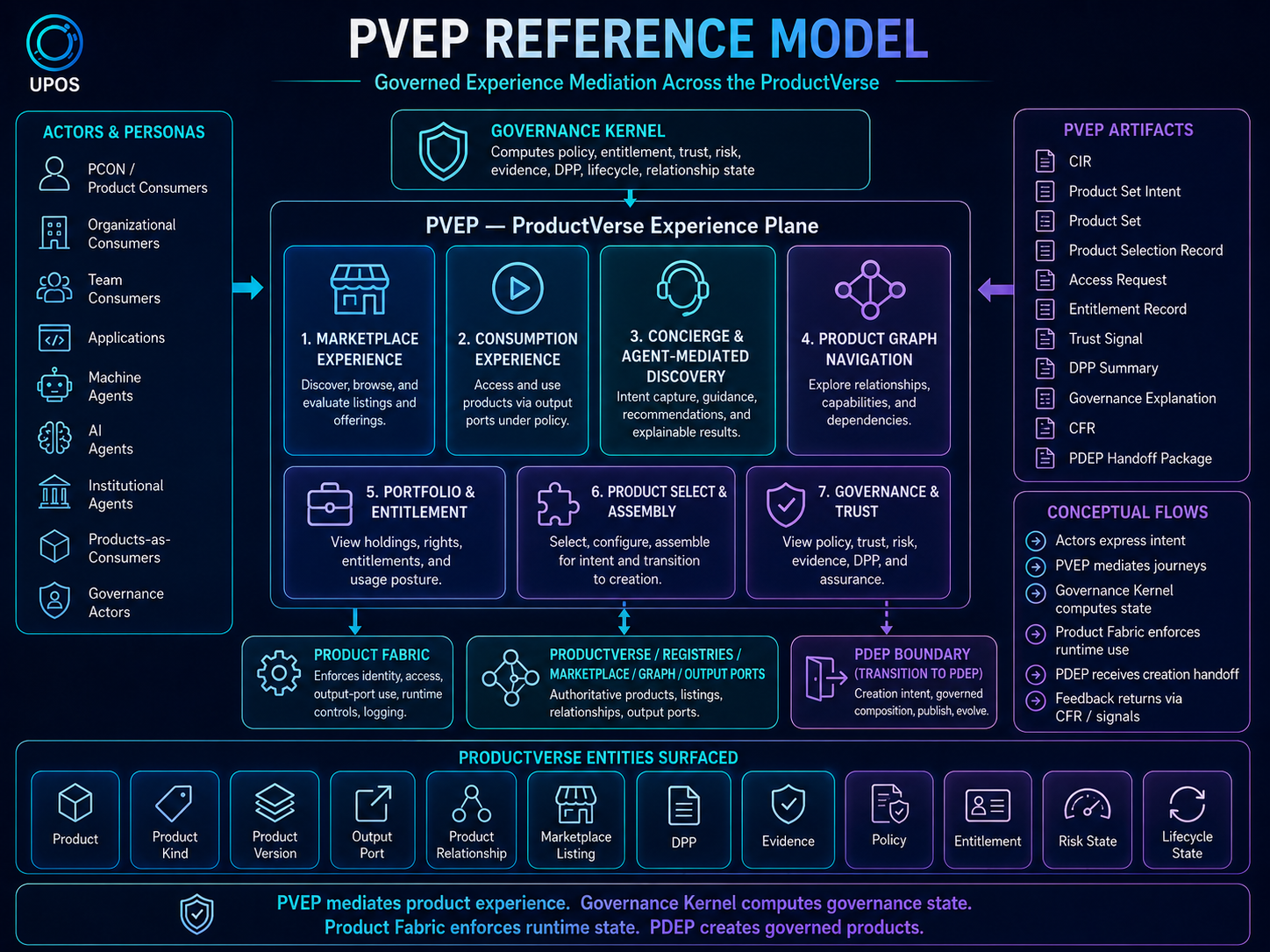
6. Actors and Personas
PVEP supports multiple actor classes and personas.
PVEP Actors
├─ PCON / Product Consumers
├─ Organizational Consumers
├─ Team Consumers
├─ Application Consumers
├─ Machine Agents
├─ AI Agents
├─ Institutional Agents
├─ Products-as-Consumers
├─ Producers entering PDEP
├─ Product Stewards
├─ Governance Actors
├─ Auditors and Assurance Actors
└─ Marketplace Operators
6.1 PCON
PCON, or Product Consumer, is the main product-kind-agnostic consumer persona.
PCON may discover, evaluate, acquire, consume, trust-check, select, and provide feedback on products.
PCON may consume products of any kind, including:
- Data Products,
- AI Products,
- Software Products,
- Physical Products,
- Creative Products,
- Evidence Products,
- Governance Products,
- Infrastructure Products,
- Agent Products.
6.2 Organizational Consumer
An Organizational Consumer represents a collective entity that acquires, governs, licenses, consumes, or manages product access.
Examples:
- enterprise unit,
- public agency,
- mission authority,
- creative studio,
- research institution,
- operational team.
6.3 Agentic Consumer
An Agentic Consumer is any agent-like actor that discovers, evaluates, recommends, selects, invokes, or acts upon products.
In UPOS, agentic does not mean AI by default.
Agentic consumers may include:
- human agents,
- machine agents,
- AI agents,
- institutional agents,
- products-as-consumers.
6.4 Institutional Agent
An Institutional Agent acts with formally delegated authority from an organization, institution, governance body, or mandate.
It requires explicit authority, scope, expiry, auditability, and revocation controls.
6.5 Product-as-Consumer
A Product-as-Consumer is a product that consumes, invokes, depends on, derives from, or composes with another product.
Examples:
AI Product consumes Data Product.
Dashboard Product consumes Analytics Product.
Comic Product consumes Image Asset Product.
Evidence Product references Policy Product.
Rocket Telemetry Product consumes Sensor Product.
6.6 Producer Entering PDEP
A producer may begin in PVEP as a consumer or selector, then transition into PDEP when creation intent emerges.
Example:
Consumer selects products in PVEP.
Consumer decides to create a new governed product.
PVEP prepares handoff.
PDEP performs product creation.
7. PVEP Experience Zones
PVEP is organized into experience zones.
PVEP Experience Zones
├─ Marketplace Experience Zone
├─ Consumption Experience Zone
├─ Concierge & Agent-Mediated Discovery Zone
├─ Product Graph Navigation Zone
├─ Portfolio & Entitlement Experience Zone
├─ Product Select & Assembly Zone
└─ Governance & Trust Experience Zone
Each zone has a distinct purpose, but journeys may cross multiple zones.
8. Marketplace Experience Zone
The Marketplace Experience Zone supports browse-first and search-driven product interaction.
It enables actors to:
- discover marketplace listings,
- evaluate product details,
- compare offerings,
- inspect pricing,
- review licensing,
- request trials,
- subscribe or acquire,
- start onboarding,
- view DPP summaries,
- understand permitted-use context.
Key entities:
- Marketplace Listing,
- Product Offer,
- Subscription,
- License,
- Pricing Model,
- Product Detail View,
- Acquisition Path,
- Onboarding State.
Boundary:
Marketplace displays product offer and acquisition pathways.
Governance Kernel provides governance state.
Product Registry provides product identity.
Product Fabric enforces runtime use.
9. Consumption Experience Zone
The Consumption Experience Zone supports actual use of existing product output ports.
It enables actors to:
- open dashboards,
- invoke APIs,
- query SQL endpoints,
- read content,
- use model endpoints,
- consume streams,
- launch workflows,
- interact with physical or digital interfaces.
Key entities:
- Output Port,
- Consumption Session,
- Runtime Access,
- Usage Constraint,
- Product Fabric Enforcement,
- Consumption Feedback Record.
Boundary:
PVEP mediates consumption experience.
Product Fabric enforces runtime governance.
Consumption uses existing products; it does not create new products.
10. Concierge & Agent-Mediated Discovery Zone
The Concierge & Agent-Mediated Discovery Zone supports intent-first discovery assisted by human, machine, AI, or institutional agents.
It enables:
- intent capture,
- clarification,
- product matching,
- filtering,
- recommendation,
- explanation,
- next-action guidance.
Key entities:
- Consumption Intent Record,
- Agent Recommendation Record,
- Discovery Intent,
- Product Suitability Assessment,
- Governance Explanation,
- Product Recommendation.
Boundary:
PVEP guides discovery.
Agents assist within delegated scope.
Governance Kernel evaluates authority and suitability.
PDEP is used only when creation intent emerges.
11. Product Graph Navigation Zone
The Product Graph Navigation Zone enables contextual exploration of product relationships.
It supports navigation through:
- dependencies,
- inputs,
- outputs,
- substitutes,
- complements,
- bundles,
- chains,
- flows,
- provenance,
- lineage,
- trust relationships,
- entitlement relationships,
- governance overlays.
Key entities:
- Product Graph View,
- Product Node,
- Product Edge,
- Relationship Type,
- Governance Overlay,
- Graph Projection,
- Path,
- Cluster.
Boundary:
Product Graph shows relationships.
PVEP renders scoped graph views.
Governance Kernel controls visibility and governance overlays.
Product registries remain authoritative for relationship data.
12. Portfolio & Entitlement Experience Zone
The Portfolio & Entitlement Experience Zone helps actors understand what products they have, what they can use, and under what conditions.
It supports:
- personal portfolios,
- team portfolios,
- organizational portfolios,
- agent portfolios,
- product-as-consumer portfolios,
- entitlement views,
- subscriptions,
- licenses,
- access status,
- delegated authority,
- expiry and renewal,
- entitlement warnings.
Key entities:
- Portfolio,
- Entitlement Record,
- Subscription Record,
- License Record,
- Delegated Authority Record,
- Access Request,
- Product-to-Product Entitlement.
Boundary:
Portfolio shows what the actor has.
Entitlement explains what the actor may do.
Governance Kernel evaluates entitlement.
Product Fabric enforces entitlement at runtime.
13. Product Select & Assembly Zone
The Product Select & Assembly Zone lets actors select products into a working Product Set.
It supports:
- product selection,
- product set creation,
- comparison,
- suitability assessment,
- inherited restriction review,
- trust and risk checks,
- access gap review,
- acquisition planning,
- PDEP handoff preparation.
Key entities:
- Product Set,
- Product Set Intent,
- Product Selection Record,
- Product Suitability Assessment,
- Inherited Restriction,
- PDEP Handoff Package.
Boundary:
PVEP assembles candidate product sets.
PDEP composes governed products.
A Product Set is not automatically a product.
14. Governance & Trust Experience Zone
The Governance & Trust Experience Zone renders governance state into understandable trust experience.
It supports:
- trust posture,
- DPP summary,
- evidence summary,
- policy explanation,
- entitlement-aware trust,
- risk explanation,
- claim-evidence binding,
- product relationship trust,
- product set trust,
- trust timeline,
- governance warnings,
- remediation guidance.
Key entities:
- Trust Signal,
- DPP Summary,
- Governance Explanation,
- Evidence Summary,
- Risk State View,
- Policy State View,
- Governance Warning.
Boundary:
Governance Kernel computes governance state.
PVEP renders governance state.
Product Fabric enforces runtime state.
15. ProductVerse Entities Surfaced by PVEP
PVEP surfaces or references several ProductVerse entities.
ProductVerse Entities
├─ Product
├─ Product Kind
├─ Product Version
├─ Product Descriptor
├─ Output Port
├─ Product Relationship
├─ Product Bundle
├─ Product Chain
├─ Product Flow
├─ Marketplace Listing
├─ DPP
├─ Evidence
├─ Policy
├─ Entitlement
├─ Trust Signal
├─ Risk State
└─ Lifecycle State
PVEP usually does not own these entities as authoritative records. It renders views, summaries, projections, or journey-specific artifacts derived from authoritative sources.
16. Product
A Product is a productized entity that can be described, discovered, trusted, governed, consumed, exchanged, reused, composed, or evolved.
Products may be:
- physical,
- digital,
- data,
- AI,
- software,
- creative,
- evidence,
- governance,
- infrastructure,
- agentic,
- hybrid.
PVEP presents products through listings, detail pages, graph views, consumption experiences, trust views, and portfolio views.
17. Product Kind
Product Kind classifies the broad nature of a product.
Examples:
- Data Product,
- AI Product,
- Software Product,
- Physical Product,
- Creative Product,
- Evidence Product,
- Governance Product,
- Agent Product,
- Infrastructure Product.
Product Kind influences:
- discovery,
- output ports,
- governance rules,
- risk model,
- DPP profile,
- evidence requirements,
- consumption pattern,
- PDEP workflow.
18. Output Port
An Output Port is the product’s exposed consumption interface.
Examples:
- API,
- SQL endpoint,
- dashboard,
- file download,
- event stream,
- model endpoint,
- reader,
- physical interface,
- tool interface.
PVEP renders output-port availability and experience.
Product Fabric enforces output-port access and runtime governance.
19. Product Relationship
A Product Relationship is a typed connection between products or between products and related ProductVerse objects.
Examples:
- consumes,
- depends on,
- composed from,
- substitute for,
- complements,
- governed by,
- evidenced by,
- listed in,
- entitled to use,
- exposes,
- derived from,
- bundled with.
PVEP renders product relationships primarily through Product Graph Navigation, Product Select & Assembly, Governance & Trust, and PDEP handoff contexts.
20. PVEP Artifacts
PVEP uses structured artifacts to make experience state explicit and portable.
PVEP Artifacts
├─ Consumption Intent Record / CIR
├─ Consumption Feedback Record / CFR
├─ Product Set Intent
├─ Product Set
├─ Product Selection Record
├─ Marketplace Listing
├─ Entitlement Record
├─ Trust Signal
├─ DPP Summary
├─ Governance Explanation
├─ Access Request
├─ Product Suitability Assessment
├─ Consumption Session Record
├─ Agent Recommendation Record
├─ Product Graph View Artifact
├─ Governance Warning
└─ PVEP-to-PDEP Handoff Package
These artifacts mediate experience. They do not all have the same authority.
Some are user-created, some are PVEP-created, some are derived from Governance Kernel, some are rendered from registries, and some are passed to PDEP.
21. Core PVEP Artifact Relationships
The artifact model may be represented as:
CIR
  captures
Consumer Intent

Consumer Intent
  may lead to
Discovery / Evaluation / Consumption / Product Set

Product Set Intent
  explains
Product Set

Product Set
  contains
Product Selection Records

Product Selection Record
  references
Product / Listing / Recommendation

Product Set
  may produce
Product Suitability Assessment

Product Suitability Assessment
  may produce
Governance Warnings

Product Set
  may become input to
PVEP-to-PDEP Handoff Package

Consumption Session
  may produce
CFR

CFR
  may inform
Producer / Steward / Marketplace / Recommendation / Governance Review
22. Governance State in PVEP
PVEP renders governance state from the Governance Kernel.
Key governance state categories include:
Governance State
├─ Policy State
├─ Entitlement State
├─ Trust State
├─ Risk State
├─ Evidence State
├─ DPP State
├─ Lifecycle State
├─ Relationship Governance State
├─ Exception State
└─ Governance Signals
PVEP should not invent governance state locally.
It may render:
- badges,
- warnings,
- explanations,
- trust summaries,
- DPP summaries,
- access status,
- product set suitability,
- risk warnings,
- permitted-use messages,
- next-action guidance.
23. Governance State Relationships
PVEP should preserve distinctions among governance concepts.
| Concept | Question |
|---|---|
| Policy | What rules, obligations, permissions, and prohibitions apply? |
| Entitlement | Does the actor have a right to act? |
| Trust | Is the product fit for reliance in this context? |
| Risk | What harm, exposure, uncertainty, or control requirement exists? |
| Evidence | What supports or challenges claims? |
| DPP | What trust-bearing product passport exists? |
| Lifecycle | What state is the product in? |
These concepts should not collapse into one generic “approved” state.
24. PVEP Journeys
PVEP supports common journeys.
PVEP Journeys
├─ Discover
├─ Evaluate
├─ Acquire
├─ Consume
├─ Assemble
├─ Request Access
├─ Trust-Check
├─ Transition to PDEP
└─ Feedback
These journeys are non-linear. Actors may loop between them.
Example:
Discover → Evaluate → Trust-Check → Request Access → Assemble → Transition to PDEP
Another example:
Portfolio → Trust-Check → Select Substitute → Consume → Feedback
25. Journey-to-Zone Mapping
| Journey | Primary zones |
|---|---|
| Discover | Marketplace, Concierge, Product Graph |
| Evaluate | Marketplace, Governance & Trust, Product Graph |
| Acquire | Marketplace, Portfolio & Entitlement |
| Consume | Consumption, Governance & Trust |
| Assemble | Product Select & Assembly, Product Graph, Governance & Trust |
| Request Access | Portfolio & Entitlement, Marketplace, Governance & Trust |
| Trust-Check | Governance & Trust, Product Graph, Marketplace |
| Transition to PDEP | Product Select & Assembly, Governance & Trust |
| Feedback | Consumption, Marketplace, Portfolio |
26. PVEP Flow Model
A simplified PVEP flow can be represented as:
Actor / Intent
      ↓
PVEP Journey Mediation
      ├─ Discover
      ├─ Evaluate
      ├─ Trust-Check
      ├─ Request Access
      ├─ Acquire
      ├─ Consume
      ├─ Assemble Product Set
      └─ Transition to PDEP
      ↓
Outcome
      ├─ Product consumed
      ├─ Product acquired
      ├─ Access requested
      ├─ Product Set saved
      ├─ Governance warning shown
      ├─ Substitute selected
      ├─ PDEP handoff created
      └─ Feedback captured
This flow is intentionally not a strict pipeline.
27. Governance Kernel Integration Flow
PVEP integrates with the Governance Kernel throughout journeys.
PVEP captures actor, product, purpose, action, context
        ↓
Governance Kernel evaluates
        ↓
Policy / Entitlement / Trust / Risk / Evidence / DPP / Lifecycle / Relationship State
        ↓
PVEP renders outcome, constraint, warning, explanation, or next action
Example:
Actor requests API access.
PVEP sends subject, product, output port, purpose, environment.
Governance Kernel evaluates entitlement, policy, trust, risk, DPP.
PVEP renders “Approval required because API use enables automated consumption.”
28. Product Fabric Interaction Flow
Product Fabric is involved when actors consume runtime output ports.
PVEP renders available action
        ↓
Actor invokes output port
        ↓
Product Fabric enforces identity, entitlement, policy, risk, masking, routing, logging
        ↓
Runtime product output is delivered or blocked
        ↓
PVEP renders outcome and may capture feedback
PVEP should not be the only enforcement boundary.
29. PDEP Handoff Flow
PVEP transitions to PDEP when product creation intent emerges.
Product Set / Intent / Governance Context
        ↓
PVEP detects creation intent
        ↓
Governance Kernel evaluates boundary conditions
        ↓
PVEP prepares PDEP Handoff Package
        ↓
PDEP begins governed product creation
PDEP handoff may include:
- selected products,
- product versions,
- intended outcome,
- intended product kind,
- purpose,
- entitlement state,
- trust state,
- risk state,
- evidence gaps,
- DPP state,
- inherited restrictions,
- licensing constraints,
- agent involvement,
- recommended next actions.
30. Feedback and Learning Flow
PVEP supports closed-loop learning through feedback artifacts and signals.
Consumption / Evaluation / Acquisition / Trust Experience
        ↓
Feedback or Observability Signal
        ↓
CFR / Usage Signal / Governance Friction Signal
        ↓
Producer / Steward / Marketplace / Governance / Recommendation System
        ↓
Product, listing, trust clarity, entitlement flow, or recommendation improves
Feedback should not automatically change trust state. It may trigger review.
31. Conceptual Entity Relationship View
A consolidated conceptual entity relationship view can be represented as:
Actor
  expresses
Intent / CIR

Intent
  drives
Journey

Journey
  occurs within
PVEP Zone

PVEP Zone
  renders
Product / Listing / Graph / Portfolio / Trust / Output Port

Product
  has
Product Version

Product
  exposes
Output Port

Product
  participates in
Product Relationship

Product
  has
DPP Summary

Product
  has
Trust Signal

Product
  has
Entitlement State

Product
  has
Risk State

Product
  has
Lifecycle State

Actor
  may hold
Entitlement Record

Actor
  may create
Product Set

Product Set
  contains
Product Selection Records

Product Set
  may produce
Suitability Assessment

Suitability Assessment
  may produce
Governance Warning

Product Set
  may create
PDEP Handoff Package

Consumption
  may produce
CFR
32. Authority Model
Not every entity surfaced by PVEP is authored by PVEP.
| Entity / artifact | Typical authority |
|---|---|
| Product identity | Product Registry / PDEP |
| Product descriptor | PDEP / Product Registry |
| Output port | Product descriptor / Product Fabric |
| Marketplace Listing | Marketplace service / Product Registry |
| Entitlement state | Governance Kernel / entitlement service |
| Trust state | Governance Kernel |
| Risk state | Governance Kernel |
| Evidence state | Evidence service / Governance Kernel |
| DPP state | DPP service / Governance Kernel |
| Product Graph relationship | Product Graph / Registry |
| Product Set | PVEP |
| CIR | PVEP / actor / agent |
| CFR | PVEP / actor / agent |
| PDEP Handoff Package | PVEP prepares; PDEP consumes |
| Runtime enforcement record | Product Fabric |
PVEP should make clear whether it is displaying, deriving, capturing, or authoring an artifact.
33. Visibility Model
PVEP must respect visibility and access controls.
Visibility may differ for:
- public consumers,
- entitled consumers,
- organizational users,
- stewards,
- governance actors,
- auditors,
- agents,
- products-as-consumers,
- marketplace operators.
Example:
Public actor:
  sees listing summary and public DPP summary.

Entitled consumer:
  sees permitted-use details and output-port access.

Steward:
  sees evidence gaps and access requests.

Auditor:
  sees decision traces and evidence references.

Agent:
  sees machine-readable constraints and next actions.
PVEP should avoid inference leaks through product graph views, search results, trust badges, warnings, or error messages.
34. State Model
PVEP must render multiple kinds of state.
34.1 Product State
Examples:
- draft,
- published,
- active,
- deprecated,
- retired,
- under review.
34.2 Entitlement State
Examples:
- entitled,
- not entitled,
- conditionally entitled,
- approval required,
- pending,
- expired,
- suspended,
- revoked.
34.3 Trust State
Examples:
- trusted,
- conditionally trusted,
- untrusted,
- trust unknown,
- trust under review,
- evidence expired.
34.4 DPP State
Examples:
- valid,
- incomplete,
- expired,
- superseded,
- version mismatch,
- unsuitable for purpose.
34.5 Product Set State
Examples:
- draft,
- saved,
- shared,
- suitable,
- suitable with constraints,
- blocked,
- ready for acquisition,
- ready for consumption,
- ready for PDEP handoff.
PVEP should not collapse these states into a single status label.
35. Reference Model Boundary Principles
The PVEP Reference Model is governed by several boundary principles.
35.1 PVEP and Governance Kernel
Governance Kernel computes governance truth.
PVEP renders governance truth.
35.2 PVEP and Product Fabric
PVEP renders runtime actions.
Product Fabric enforces runtime actions.
35.3 PVEP and PDEP
PVEP assembles candidate product sets.
PDEP composes governed products.
35.4 PVEP and Marketplace
Marketplace enables product acquisition.
PVEP integrates marketplace experiences.
Governance Kernel remains authoritative for governance state.
35.5 PVEP and Product Graph
Product Graph stores or computes relationships.
PVEP renders scoped, contextual graph experiences.
35.6 PVEP and Agents
Agents may assist discovery, selection, and explanation.
Agents act only within explicit authority and scope.
36. Reference Model Anti-Patterns
36.1 PVEP as Static Catalog
PVEP is not merely a product list. It is a journey mediation plane.
36.2 PVEP as Hidden PDEP
PVEP should not create governed products, product descriptors, output ports, DPPs, or product versions.
36.3 Product Set as Product
A Product Set is not a governed product unless PDEP creates one.
36.4 Trust Badge Without Evidence
Trust displays must derive from Governance Kernel and evidence state.
36.5 Entitlement as Binary Access
Entitlement is contextual and action-specific.
36.6 Agent Visibility as Permission
Agents may see a product without being allowed to recommend, invoke, acquire, compose, or publish it.
36.7 UI-Only Enforcement
Runtime enforcement belongs to Product Fabric.
36.8 Marketplace as Governance Authority
Marketplace acquisition does not replace policy, entitlement, trust, risk, DPP, or evidence evaluation.
36.9 Graph as Unrestricted Truth Surface
Graph visibility must be scoped to actor, entitlement, policy, and governance context.
37. Summary
The PVEP Reference Model consolidates the conceptual structure of the ProductVerse Experience Plane.
PVEP consists of:
- actors and personas,
- experience zones,
- ProductVerse entities,
- PVEP-facing artifacts,
- governance state renderings,
- product relationship views,
- non-linear journeys,
- Product Fabric runtime interactions,
- PDEP handoff flows,
- feedback and observability loops.
PVEP serves as the governed experience mediation layer between actors and the ProductVerse.
It enables actors to discover, evaluate, acquire, consume, navigate, trust, select, assemble candidate product sets, request access, provide feedback, and transition to PDEP when creation intent emerges.
The central model is:
Actors express intent.
PVEP mediates journeys.
Governance Kernel computes governance state.
Product Fabric enforces runtime state.
PDEP creates governed products.
ProductVerse evolves through feedback and product relationships.
In short:
The PVEP Reference Model defines PVEP as the product-kind-agnostic, governance-aware, actor-aware, non-linear experience mediation plane for the ProductVerse.