PVEP Journeys
1. Purpose
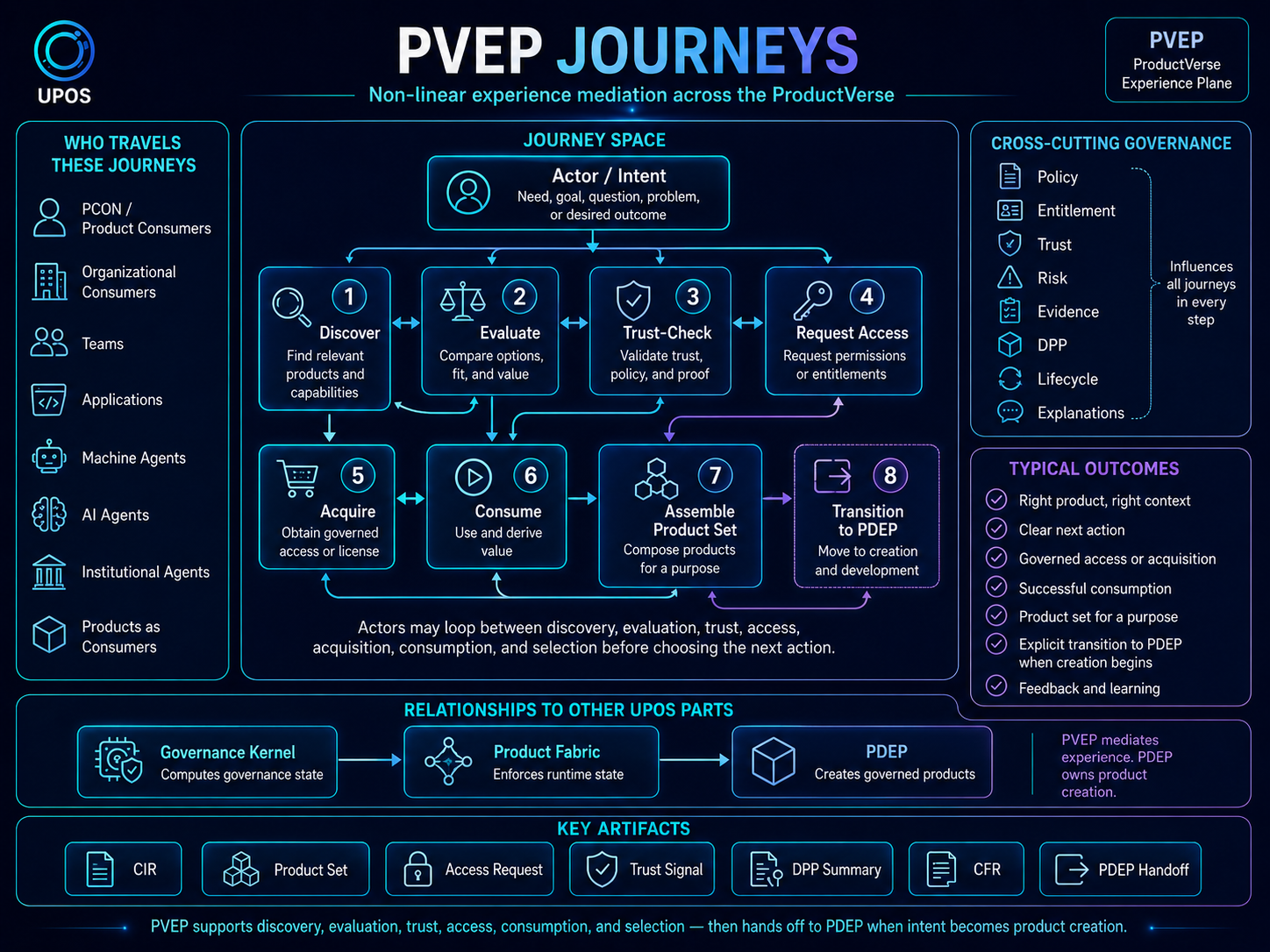
The PVEP Journeys model describes the common journeys that actors may take through the ProductVerse Experience Plane (PVEP).
PVEP is not a single screen, marketplace, catalog, dashboard, or portal. It is an experience mediation plane through which ProductVerse participants discover, evaluate, acquire, consume, navigate, trust, select, assemble, request access to, and prepare products for further action.
This document describes common PVEP journeys, including:
- discover,
- evaluate,
- acquire,
- consume,
- assemble,
- request access,
- trust-check,
- transition to PDEP.
The key principle is:
PVEP journeys guide actors from product intent to product experience, while preserving governance, entitlement, trust, risk, and the boundary with PDEP.
2. What Is a PVEP Journey?
A PVEP Journey is a structured path through which a human, organization, agent, application, or product-as-consumer interacts with products across the ProductVerse.
A journey may begin with:
- a search,
- an intent,
- a recommendation,
- a marketplace listing,
- a product graph exploration,
- a portfolio view,
- an entitlement need,
- a trust concern,
- a product set,
- a consumption task,
- a creation intent.
A journey may end with:
- product consumption,
- product acquisition,
- access request,
- product set creation,
- trust inspection,
- governance review,
- PDEP handoff,
- feedback submission,
- abandonment due to restriction,
- selection of substitute product.
PVEP journeys are not always linear. A user may move between discovery, evaluation, trust checking, entitlement, graph navigation, and product selection before deciding what to do next.
3. Journey Principles
3.1 Intent-Led
PVEP journeys should begin from what the actor is trying to achieve, not only from product categories or catalog structures.
Example:
“I need products to support habitat safety monitoring.”
is richer than:
“Show me all monitoring products.”
3.2 Governance-Aware
Every journey should respect Governance Kernel state where relevant.
This includes:
- policy,
- entitlement,
- trust,
- risk,
- evidence,
- DPP,
- lifecycle,
- relationship governance,
- agent authority.
3.3 Product-Kind Agnostic
PVEP journeys should work across data, AI, software, physical, creative, evidence, governance, infrastructure, agent, and future product kinds.
3.4 Actor-Aware
Journeys may differ for:
- PCON,
- organizational consumers,
- teams,
- applications,
- machine agents,
- AI agents,
- institutional agents,
- products-as-consumers,
- stewards,
- governance actors,
- producers entering PDEP.
3.5 Boundary-Preserving
PVEP can support discovery, consumption, selection, comparison, trust inspection, and product set assembly.
When product creation begins, the journey transitions to PDEP.
3.6 Explainable
PVEP should explain restrictions, denials, warnings, risk states, trust states, and next actions.
3.7 Reversible and Iterative
Actors should be able to move back from acquisition to evaluation, from product set to graph exploration, or from trust warning to substitute discovery.
4. Journey Map Overview
The common PVEP journeys can be summarized as:
Intent / Need
  ↓
Discover
  ↓
Evaluate
  ↓
Trust-Check
  ↓
Acquire / Request Access / Select / Consume
  ↓
Feedback / Portfolio Update / PDEP Handoff
A more complete view is:
Actor expresses or implies intent
  ├─ Discover products
  ├─ Evaluate product suitability
  ├─ Trust-check product state
  ├─ Request access or acquire product
  ├─ Consume product output ports
  ├─ Assemble product set
  ├─ Inspect governance constraints
  ├─ Transition to PDEP if product creation is intended
  └─ Provide feedback after use
These journeys may be combined. For example, a user may discover products through graph navigation, evaluate them through marketplace listings, assemble them into a Product Set, run a trust-check, request access, and then transition to PDEP.
5. Discover Journey
5.1 Purpose
The Discover Journey helps actors find relevant products across the ProductVerse.
Discovery may be search-based, browse-based, graph-based, intent-based, portfolio-based, or agent-mediated.
The core question is:
Which products may help me achieve this intent?
5.2 Actors
Discovery may be performed by:
- PCON,
- organizational consumers,
- team consumers,
- AI agents,
- machine agents,
- institutional agents,
- products-as-consumers,
- producers researching reusable inputs,
- governance actors looking for products under review.
5.3 Starting Points
The Discover Journey may start from:
- search query,
- marketplace category,
- product graph node,
- existing product detail page,
- portfolio view,
- agent recommendation,
- business intent,
- product kind,
- governance requirement,
- PDEP input search,
- consumer problem statement.
Example starting intents:
Find products for internal risk monitoring.
Find AI Products that can classify safety incidents.
Find products related to Rocket Telemetry Product.
Find trusted Comic Asset Products for commercial publication.
Find products my team is already entitled to use.
5.4 Journey Flow
Actor expresses intent
  → PVEP captures Discovery Intent or CIR
  → PVEP queries Marketplace, Product Registry, Product Graph, and Governance Kernel state
  → Candidate products are returned
  → PVEP applies filters and ranking
  → Governance-aware discovery results are shown
  → Actor opens product detail, compares, adds to Product Set, or requests access
5.5 Governance Integration
Discovery should consider:
- product visibility,
- entitlement visibility,
- policy restrictions,
- trust posture,
- DPP status,
- lifecycle state,
- risk state,
- jurisdiction,
- agent authority,
- hidden or restricted relationships.
PVEP should avoid showing products in ways that imply usability when they are not usable.
Example:
Visible but restricted:
Product appears in search, but API use requires approval.

Hidden:
Product is not visible because the actor lacks permission to know it exists.

Visible summary only:
Product appears, but detailed evidence is restricted.
5.6 Outputs
The Discover Journey may produce:
- search results,
- candidate products,
- recommended products,
- product comparison list,
- Product Set,
- Product Selection Records,
- Marketplace Listing views,
- Discovery Intent,
- CIR,
- agent recommendation record.
6. Evaluate Journey
6.1 Purpose
The Evaluate Journey helps actors determine whether a product is suitable for their intent.
The core question is:
Is this product suitable for my purpose, context, constraints, and authority?
Evaluation goes beyond reading a product description. It includes product fit, trust, risk, entitlement, evidence, licensing, output ports, lifecycle state, and relationship context.
6.2 Actors
Evaluation may be performed by:
- PCON,
- organizational consumers,
- team consumers,
- AI agents,
- procurement agents,
- governance actors,
- stewards,
- products-as-consumers,
- producers preparing product composition.
6.3 Evaluation Dimensions
Product evaluation may include:
| Dimension | Question |
|---|---|
| Functional fit | Does the product do what I need? |
| Product kind | Is this the right kind of product? |
| Output ports | How can the product be consumed? |
| Entitlement | Can I or my organization use it? |
| Policy | Are my intended uses allowed? |
| Trust | Is it evidence-backed and fit for purpose? |
| Risk | What risks and controls apply? |
| DPP | Is the passport valid and suitable? |
| Evidence | Are claims supported? |
| License | Are usage and derivative rights acceptable? |
| Lifecycle | Is the product active, deprecated, or under review? |
| Relationships | What does it depend on or complement? |
| Cost | What acquisition or usage economics apply? |
| Support | Who supports it and under what model? |
6.4 Journey Flow
Actor opens product or candidate set
  → PVEP displays product detail and marketplace listing
  → PVEP retrieves Governance Kernel state
  → PVEP shows fit, trust, risk, DPP, entitlement, policy, and license state
  → Actor compares alternatives or inspects Product Graph
  → Actor chooses next action: acquire, request access, consume, add to Product Set, trust-check, or abandon
6.5 Outputs
The Evaluate Journey may produce:
- Product Suitability Assessment,
- comparison view,
- Product Selection Record,
- Trust Signal view,
- DPP Summary view,
- Governance Explanation,
- Governance Warning,
- acquisition decision,
- access request,
- Product Set update,
- PDEP handoff decision.
7. Acquire Journey
7.1 Purpose
The Acquire Journey helps actors obtain rights to use a product through subscription, purchase, license acceptance, trial activation, onboarding, approval, or access provisioning.
The core question is:
How do I obtain the right to use this product under governed conditions?
Acquisition is not the same as entitlement, and entitlement is not the same as runtime usability.
7.2 Actors
Acquisition may be performed by:
- individual PCON,
- organizational consumer,
- procurement actor,
- marketplace account owner,
- institutional agent,
- authorized AI agent with human confirmation,
- team lead,
- product-as-consumer workflow,
- PDEP creator acquiring input products.
7.3 Acquisition States
PVEP should distinguish:
Interested
Selected
Trial available
License required
Subscription required
Approval required
Purchased
Subscribed
Approved
Provisioning required
Provisioned
Entitled
Usable
These are not equivalent states.
Example:
A product may be subscribed to but not usable until license acceptance, policy approval, and runtime provisioning are complete.
7.4 Journey Flow
Actor chooses acquire / subscribe / trial / onboard
  → PVEP displays offer, price, license, permitted use, DPP summary, and restrictions
  → Governance Kernel evaluates acquisition eligibility
  → Marketplace handles acquisition or subscription process
  → License acceptance and approval workflows run where required
  → Entitlement is granted or denied
  → Product Fabric provisions runtime access where required
  → Portfolio & Entitlement view is updated
7.5 Governance Integration
Acquire Journey requires checks for:
- acquisition eligibility,
- license compatibility,
- subscription eligibility,
- permitted use,
- policy restrictions,
- risk approval,
- trust state,
- DPP suitability,
- evidence sufficiency,
- organizational authority,
- agent authority,
- budget or commercial approval if applicable.
7.6 Outputs
The Acquire Journey may produce:
- marketplace acquisition record,
- subscription record,
- license acceptance record,
- entitlement request,
- entitlement record,
- approval record,
- onboarding task,
- portfolio update,
- Product Fabric provisioning signal.
8. Consume Journey
8.1 Purpose
The Consume Journey helps actors use an existing product through one or more output ports.
The core question is:
Can I use this product now, through this output port, for this purpose, under these constraints?
Consumption is the use of existing product output ports. It is not product creation.
8.2 Actors
Consumption may be performed by:
- PCON,
- team consumer,
- organizational consumer,
- application consumer,
- machine agent,
- AI agent,
- institutional agent,
- product-as-consumer.
8.3 Consumption Modes
Consumption may occur through:
- dashboard,
- API,
- SQL endpoint,
- file,
- event stream,
- model endpoint,
- reader,
- workflow,
- tool interface,
- physical interface,
- embedded application,
- agent invocation.
8.4 Journey Flow
Actor selects product output port
  → PVEP submits decision context to Governance Kernel
  → Governance Kernel evaluates entitlement, policy, trust, risk, DPP, and purpose
  → Product Fabric enforces runtime controls
  → PVEP opens or mediates the consumption experience
  → Runtime and experience signals are captured
  → Consumption feedback may be requested
8.5 Governance Integration
Consumption must consider:
- output-port entitlement,
- purpose-specific permission,
- runtime constraints,
- policy restrictions,
- trust posture,
- risk controls,
- DPP validity,
- audit logging,
- masking or filtering,
- rate limits,
- jurisdiction routing,
- agent authority.
Example:
User can view dashboard.
API invocation requires approval.
File export is prohibited.
8.6 Outputs
The Consume Journey may produce:
- consumption session record,
- runtime invocation log,
- audit record,
- consumption feedback record,
- governance signal,
- portfolio usage signal,
- product value signal.
9. Assemble Journey
9.1 Purpose
The Assemble Journey helps actors select and organize products into a Product Set for comparison, acquisition planning, consumption planning, governance review, or possible PDEP handoff.
The core question is:
Can these selected products be used together for my intent, and what should happen next?
This journey belongs to PVEP as long as it remains selection and pre-assembly reasoning.
If the actor wants to create a new governed product, the journey transitions to PDEP.
9.2 Actors
Assembly may be performed by:
- PCON,
- team consumer,
- organizational consumer,
- AI agent,
- machine agent,
- product-as-consumer,
- producer preparing a PDEP workflow,
- governance actor reviewing product combinations.
9.3 Assemble Journey Flow
Actor selects products
  → PVEP creates or updates Product Set
  → Actor declares or refines Product Set Intent
  → PVEP requests product-set suitability assessment
  → Governance Kernel evaluates policy, entitlement, trust, risk, evidence, DPP, licensing, and relationships
  → PVEP shows suitability, inherited restrictions, gaps, and next actions
  → Actor chooses consume, acquire, request access, revise set, trust-check, or transition to PDEP
9.4 Product Set Outcomes
A Product Set may be:
- suitable for direct consumption,
- suitable with constraints,
- ready for acquisition,
- blocked by missing entitlement,
- blocked by trust or evidence gap,
- unsuitable for intended purpose,
- requiring governance review,
- requiring PDEP transition,
- ready for PDEP handoff.
9.5 Outputs
The Assemble Journey may produce:
- Product Set,
- Product Set Intent,
- Product Selection Records,
- Product Suitability Assessment,
- Governance Warnings,
- inherited restriction summary,
- acquisition plan,
- access request bundle,
- PVEP-to-PDEP Handoff Package.
10. Request Access Journey
10.1 Purpose
The Request Access Journey helps actors request rights to use a product, output port, evidence view, DPP detail, product relationship, or product capability.
The core question is:
How do I request the specific right I need, for the specific purpose and context I have?
Requesting access should be more precise than clicking a generic “request access” button.
10.2 Actors
Access may be requested by:
- individual PCON,
- team consumer,
- organizational consumer,
- application consumer,
- machine agent,
- AI agent,
- institutional agent,
- product-as-consumer,
- producer entering PDEP.
10.3 Access Request Dimensions
An access request may specify:
- subject,
- product,
- product version,
- output port,
- action,
- purpose,
- environment,
- jurisdiction,
- duration,
- justification,
- license acceptance,
- delegated authority,
- downstream use,
- product-to-product relationship,
- urgency.
Example:
Request API access to Product A for internal monitoring in production for 180 days.
This is better than:
Request access to Product A.
10.4 Journey Flow
Actor selects unavailable or restricted action
  → PVEP explains why access is unavailable
  → Actor starts Access Request
  → PVEP captures purpose, output port, duration, justification, and context
  → Governance Kernel evaluates policy, entitlement, trust, risk, and evidence
  → Request routes to steward, governance actor, or automated approval path
  → Outcome is approved, denied, pending, or more information required
  → Entitlement is provisioned if approved
  → Portfolio & Entitlement view is updated
10.5 Access Request Outcomes
Possible outcomes include:
- approved,
- denied,
- pending,
- more information required,
- approval required,
- exception required,
- license acceptance required,
- subscription required,
- provisioning required,
- expired,
- withdrawn.
10.6 Outputs
The Request Access Journey may produce:
- Access Request,
- Governance Explanation,
- Entitlement Decision,
- Entitlement Record,
- Approval Record,
- Exception Request,
- Product Fabric provisioning signal,
- audit record.
11. Trust-Check Journey
11.1 Purpose
The Trust-Check Journey helps actors inspect whether a product, output port, DPP, evidence claim, relationship, product set, or product-to-product dependency can be relied upon in a specific context.
The core question is:
Can I rely on this product or product set for this purpose, and what evidence supports that?
Trust-check is not only a technical validation journey. It is a consumer, agent, producer, steward, and governance journey.
11.2 Actors
Trust-check may be performed by:
- PCON,
- organizational consumer,
- team consumer,
- AI agent,
- machine agent,
- institutional agent,
- product-as-consumer,
- product steward,
- governance actor,
- auditor,
- producer preparing PDEP handoff.
11.3 Trust-Check Scope
A trust-check may apply to:
- a product,
- product version,
- output port,
- DPP,
- product claim,
- evidence record,
- product relationship,
- product chain,
- product flow,
- Product Set,
- agent recommendation,
- marketplace listing.
11.4 Journey Flow
Actor opens trust or governance view
  → PVEP submits context to Governance Kernel
  → Kernel evaluates trust, DPP, evidence, risk, policy, entitlement, and lifecycle state
  → PVEP renders trust posture, evidence summary, DPP state, risk state, and restrictions
  → Actor drills into explanation, evidence, DPP, policy, or graph context
  → Actor chooses next action: consume, request access, select substitute, request evidence refresh, escalate, or transition to PDEP
11.5 Trust-Check Outputs
The journey may produce:
- Trust Signal,
- DPP Summary,
- Governance Explanation,
- Product Suitability Assessment,
- Governance Warning,
- evidence gap record,
- trust timeline view,
- product set trust assessment,
- audit summary view.
11.6 Trust-Check Examples
Product is trusted for internal analytics but not external sharing.
DPP is valid, but regulatory-reporting evidence is incomplete.
Product Set is conditionally trusted because one input product has expired evidence.
AI agent recommendation is acceptable, but acquisition requires human confirmation.
12. Transition to PDEP Journey
12.1 Purpose
The Transition to PDEP Journey occurs when a PVEP actor’s intent shifts from discovering, evaluating, acquiring, consuming, or selecting products to creating or changing a governed product.
The core question is:
Has this experience become product creation?
If yes, PVEP should transition to PDEP.
12.2 Transition Triggers
PVEP should transition to PDEP when the actor intends to:
- create a new product,
- compose products into a new governed product,
- create a derivative product,
- define new output ports,
- generate product descriptors,
- generate or update DPP,
- bind evidence to product claims,
- create product version,
- publish product,
- create marketplace listing for a new product,
- govern lifecycle,
- validate product readiness,
- retire or materially change a product.
12.3 Journey Flow
Actor creates or selects Product Set
  → Actor indicates creation intent
  → PVEP detects PDEP transition trigger
  → Governance Kernel evaluates boundary conditions
  → PVEP prepares PDEP Handoff Package
  → Actor confirms transition
  → PDEP receives selected products, intent, and governance context
  → PDEP begins governed product creation or lifecycle workflow
12.4 PDEP Handoff Package
The handoff should include:
- actor,
- persona,
- product set,
- selected products,
- product versions,
- intended outcome,
- intended product kind,
- purpose,
- known constraints,
- entitlement state,
- trust state,
- risk state,
- evidence gaps,
- DPP state,
- licensing constraints,
- inherited restrictions,
- agent involvement,
- recommended next actions.
12.5 Transition Outcomes
Possible outcomes include:
- transition allowed,
- transition allowed with warnings,
- transition requires additional context,
- transition blocked due to entitlement,
- transition blocked due to policy,
- transition blocked due to trust or evidence gap,
- transition requires approval,
- transition requires exception,
- transition pending governance review.
12.6 Boundary Principle
PVEP prepares product creation context.
PDEP performs governed product creation.
A Product Set does not become a product until PDEP creates the governed product artifact.
13. Feedback Journey
13.1 Purpose
The Feedback Journey captures consumer, agent, or product-as-consumer feedback after discovery, evaluation, acquisition, consumption, or failed usage.
The core question is:
What did the actor experience, and what should the ProductVerse learn from it?
Feedback is essential for ProductVerse health because products should evolve based on real consumption, value, friction, and trust signals.
13.2 Feedback Types
Feedback may include:
- product quality feedback,
- usability feedback,
- output-port feedback,
- marketplace listing feedback,
- trust clarity feedback,
- DPP usefulness feedback,
- entitlement friction feedback,
- onboarding feedback,
- pricing feedback,
- governance warning clarity,
- agent recommendation quality,
- substitute recommendation quality,
- product set suitability feedback.
13.3 Journey Flow
Actor completes or abandons a journey
  → PVEP requests or captures feedback
  → Actor submits CFR or implicit feedback signal
  → Feedback is routed to producer, steward, marketplace, governance, or recommendation system
  → Product, listing, trust experience, or entitlement process may be improved
13.4 Outputs
The Feedback Journey may produce:
- Consumption Feedback Record,
- product rating,
- governance clarity signal,
- entitlement friction signal,
- marketplace listing improvement signal,
- steward notification,
- product improvement request,
- recommendation tuning signal.
CFRs should not automatically change trust state, but they may trigger review.
14. Journey Compositions
PVEP journeys often combine.
14.1 Discover → Evaluate → Acquire
User searches marketplace
  → compares products
  → checks DPP summary
  → subscribes
  → entitlement is provisioned
14.2 Discover → Trust-Check → Consume
User finds product
  → inspects trust posture
  → confirms entitlement
  → opens dashboard
14.3 Graph Navigate → Assemble → PDEP
User explores product graph
  → selects related products into Product Set
  → checks suitability
  → transitions to PDEP to create new product
14.4 Agent Discover → Evaluate → Request Access
AI agent recommends product
  → user reviews trust and risk
  → API access unavailable
  → access request submitted
14.5 Portfolio → Trust-Check → Substitute
User opens portfolio
  → sees trust downgraded product
  → inspects DPP expiry
  → selects substitute product
15. Journey Decision Points
PVEP journeys should include clear decision points.
| Decision point | Question |
|---|---|
| Relevance | Does this product match the intent? |
| Visibility | May this actor see the product or relationship? |
| Entitlement | May this actor use it? |
| Trust | Is it fit for purpose? |
| Risk | What controls or approvals apply? |
| DPP | Is the passport valid and suitable? |
| Evidence | Are claims supported? |
| License | Are usage and derivative rights acceptable? |
| Output port | Is the required interface available and entitled? |
| Lifecycle | Is the product active and supported? |
| Relationship | Are dependencies and restrictions acceptable? |
| Boundary | Does this remain PVEP or transition to PDEP? |
| Runtime | Can Product Fabric enforce required controls? |
16. Journey Artifacts
PVEP journeys may create or reference several artifacts.
| Journey | Common artifacts |
|---|---|
| Discover | Discovery Intent, CIR, Marketplace Listing, Agent Recommendation Record |
| Evaluate | Product Suitability Assessment, Trust Signal, DPP Summary, Governance Explanation |
| Acquire | Marketplace Listing, License Record, Subscription Record, Entitlement Record |
| Consume | Consumption Session Record, runtime signal, CFR |
| Assemble | Product Set Intent, Product Set, Product Selection Records, Suitability Assessment |
| Request Access | Access Request, Entitlement Decision, Approval Record, Entitlement Record |
| Trust-Check | Trust Signal, DPP Summary, Evidence Summary, Governance Warning |
| Transition to PDEP | Product Set, Product Set Intent, PVEP-to-PDEP Handoff Package |
| Feedback | Consumption Feedback Record, value signal, governance friction signal |
17. Journey and Governance Kernel Integration
All material PVEP journeys should be capable of calling the Governance Kernel.
The Governance Kernel may provide:
- decisions,
- entitlement state,
- policy state,
- trust state,
- risk state,
- evidence state,
- DPP state,
- lifecycle state,
- relationship governance,
- explanations,
- signals,
- audit references.
PVEP should not invent governance state locally.
Boundary statement:
PVEP renders journey state.
Governance Kernel computes governance state.
Product Fabric enforces runtime state.
PDEP governs product creation.
18. Journey and Product Fabric Integration
The Product Fabric becomes relevant when a journey reaches runtime consumption.
Product Fabric may enforce:
- authentication,
- authorization,
- entitlement,
- output-port access,
- masking,
- filtering,
- rate limits,
- audit logging,
- environment routing,
- agent invocation constraints.
PVEP may render the action, but Product Fabric enforces it.
Example:
PVEP shows “Open API.”
Product Fabric checks token, entitlement, policy, rate limit, and audit logging.
19. Journey and PDEP Boundary
PVEP journeys should transition to PDEP when product creation begins.
Examples:
Create new product from selected products.
Publish product set as governed bundle.
Generate new DPP.
Define new output port.
Version product.
PVEP should not silently create product artifacts.
The transition should include a structured handoff package.
20. Journey Design Guidance
20.1 Start with Intent
Capture what the actor is trying to achieve.
20.2 Show Governance Early
Do not wait until late in the journey to reveal entitlement, trust, risk, license, or DPP blockers.
20.3 Keep Next Actions Clear
Every restriction should lead to a next action where possible.
20.4 Avoid False Readiness
Do not show products or product sets as ready if they are blocked by governance or runtime constraints.
20.5 Preserve Product-Kind Agnosticism
Journeys should work across many product kinds.
20.6 Support Agents
Agents need machine-readable decision state, constraints, and authority checks.
20.7 Make PDEP Transition Explicit
Users should know when they have crossed from product experience into product creation.
20.8 Capture Feedback
Consumption and failed journeys should feed back into product improvement and ProductVerse health.
20.9 Use Progressive Disclosure
Show simple state first, with deeper trust, evidence, policy, and audit detail available as needed.
21. Anti-Patterns
21.1 Catalog-Only Journey
Discovery should not be limited to static category browsing.
21.2 Trust Hidden Until Consumption
Users should see trust and DPP state before using or acquiring a product.
21.3 Access Request Without Purpose
Generic access requests weaken governance.
21.4 Product Set Treated as Product
A selected set is not a governed product until PDEP creates one.
21.5 Acquisition Equals Usability
Subscription or purchase does not automatically mean runtime entitlement is active.
21.6 Agent Recommendation Without Authority
Agents need explicit authority and should not infer rights from visibility.
21.7 Runtime Enforcement by UI Only
PVEP should not be the only enforcement layer.
21.8 Feedback Ignored
CFRs and journey signals should improve products, listings, trust clarity, and entitlement flows.
21.9 PDEP Handoff Without Context
PDEP handoff should carry intent, selected products, and governance state.
22. Summary
PVEP journeys describe how actors move through the ProductVerse experience.
Common journeys include:
- Discover - find relevant products.
- Evaluate - assess product fit and suitability.
- Acquire - obtain subscription, license, approval, or entitlement.
- Consume - use an existing product output port.
- Assemble - select products into a Product Set.
- Request Access - request specific governed rights.
- Trust-Check - inspect trust, evidence, DPP, risk, and policy state.
- Transition to PDEP - move from product experience to governed product creation.
- Feedback - return consumption and experience signals to the ProductVerse.
The central journey boundary is:
PVEP supports discovery, evaluation, acquisition, consumption, trust, access, and selection.
PDEP owns governed product creation, composition, validation, versioning, and publication.
In short:
PVEP journeys turn ProductVerse intent into governed product experience, while ensuring that product creation transitions explicitly into PDEP.