Consumption Experience Zone
1. Purpose
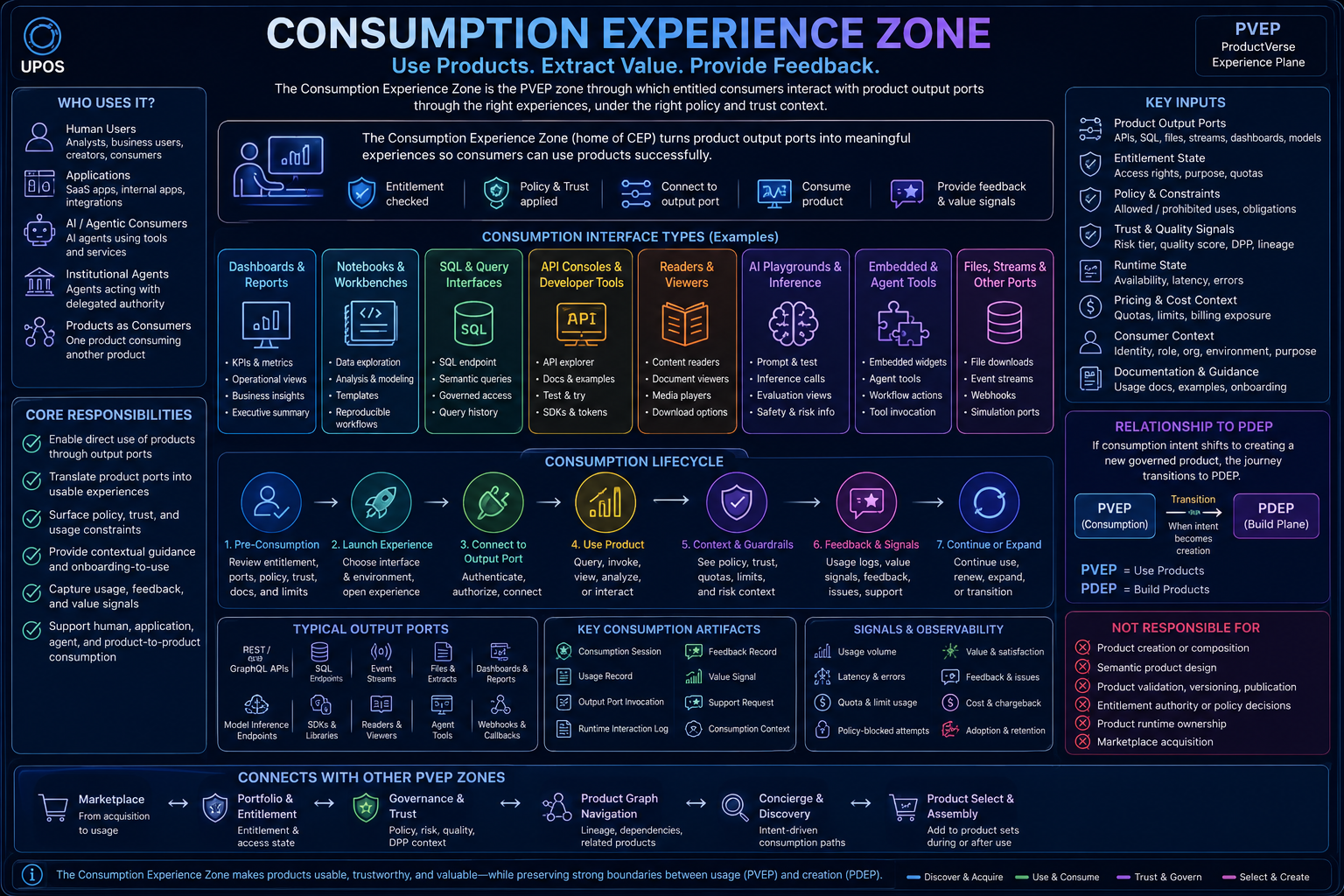
The Consumption Experience Zone is the PVEP zone through which entitled consumers directly use products across the ProductVerse.
It provides the experience layer for interacting with product outputs, services, interfaces, capabilities, content, data, models, agents, APIs, dashboards, readers, and other product output ports.
Where the Marketplace Experience Zone helps consumers discover and acquire products, the Consumption Experience Zone helps them use those products.
It answers questions such as:
- How do I use this product?
- Which interface should I use?
- Which output ports are available to me?
- What am I allowed to do with this product?
- What constraints apply during use?
- How do I provide feedback?
- How do I measure value from consumption?
- How do I move from acquisition to active usage?
The Consumption Experience Zone is the primary home of the earlier Consumer Experience Plane (CEP) within PVEP.
2. Definition
The Consumption Experience Zone is the PVEP capability zone that enables consumers, applications, AI agents, institutional agents, and products-as-consumers to interact with product output ports through appropriate human, machine, or embedded experiences.
It includes interfaces such as dashboards, notebooks, readers, API consoles, SQL workbenches, model playgrounds, embedded applications, report viewers, agent tools, and product-specific consumption surfaces.
The key principle is:
Consumption experiences consume product output ports; they do not redefine the product itself.
A dashboard consuming a Data Product is not the Data Product.
A reader displaying a Comic Product is not the Comic Product.
An API console invoking an AI Product is not the AI Product.
They are consumption experiences over product ports.
3. Scope
The Consumption Experience Zone covers:
- product usage experiences,
- product output port interaction,
- dashboards and reporting interfaces,
- notebooks and analytical workbenches,
- SQL and query interfaces,
- API consoles and developer tools,
- content readers and viewers,
- model inference playgrounds,
- agent-facing tool interfaces,
- embedded product experiences,
- file and artifact download experiences,
- product usage guidance,
- contextual policy and trust display,
- usage metering visibility,
- value and feedback capture,
- runtime error and support escalation,
- consumption observability signals.
The Consumption Experience Zone does not own:
- product creation,
- product composition,
- semantic product design,
- product artifact generation,
- product publishing,
- entitlement authority,
- governance decisioning,
- product runtime ownership,
- marketplace acquisition,
- product lifecycle steering.
Those responsibilities belong to PDEP, the Governance Kernel, product runtime services, entitlement services, marketplace services, and other UPOS capabilities.
4. Position within PVEP
The Consumption Experience Zone is one of the seven PVEP experience zones.
ProductVerse Experience Plane (PVEP)
├─ Marketplace Experience Zone
├─ Consumption Experience Zone
│  └─ Consumer Experience Plane (CEP)
├─ Concierge & Agentic Discovery Zone
├─ Product Graph Navigation Zone
├─ Portfolio & Entitlement Experience Zone
├─ Product Select & Assembly Zone
└─ Governance & Trust Experience Zone
It is the zone where products become operationally usable by consumers.
It interacts closely with:
| Related PVEP Zone | Relationship |
|---|---|
| Marketplace Experience Zone | Acquisition and onboarding flows may lead into consumption experiences. |
| Portfolio & Entitlement Experience Zone | Determines what the consumer is allowed to consume and under what conditions. |
| Governance & Trust Experience Zone | Provides policy, trust, risk, quality, and usage constraints during consumption. |
| Product Graph Navigation Zone | Helps consumers understand dependencies, lineage, related products, and downstream effects. |
| Concierge & Agentic Discovery Zone | May recommend a consumption pathway or interface based on intent. |
| Product Select & Assembly Zone | Selected products may be consumed individually or as a candidate product set. |
| PDEP Boundary | If usage intent shifts into creation of a governed product, the flow transitions to PDEP. |
5. Relationship to CEP
The Consumer Experience Plane (CEP) is positioned within UPOS as a specialized sub-plane of the Consumption Experience Zone.
PVEP
└─ Consumption Experience Zone
   └─ Consumer Experience Plane (CEP)
CEP focuses on persona- and task-specific consumption experiences. It may include dashboards, analytical tools, readers, notebooks, embedded applications, agent tools, and product-specific interfaces.
PVEP is broader than CEP. PVEP also includes marketplace, discovery, graph navigation, entitlement, trust, and product selection experiences.
The distinction can be summarized as:
| Construct | Scope |
|---|---|
| PVEP | Full consumer-oriented experience plane across the ProductVerse. |
| Consumption Experience Zone | PVEP zone focused on direct product usage. |
| CEP | Specialized consumption sub-plane for persona- and task-specific product use experiences. |
6. Product Output Ports
Consumption experiences interact with products through output ports.
An output port is a product-exposed access mechanism through which a consumer can use, retrieve, invoke, view, subscribe to, or interact with product value.
Examples of output ports include:
- REST APIs,
- GraphQL APIs,
- SQL endpoints,
- semantic query endpoints,
- event streams,
- batch extracts,
- files,
- dashboards,
- reports,
- readers,
- model inference endpoints,
- agent tools,
- notebook templates,
- SDKs,
- webhooks,
- embedded UI components,
- simulation endpoints,
- command interfaces,
- digital artifact packages.
A single product may expose multiple output ports.
For example:
Data Product
├─ SQL endpoint
├─ API endpoint
├─ event stream
├─ dashboard
└─ downloadable extract
Or:
AI Product
├─ inference API
├─ batch scoring endpoint
├─ evaluation report
├─ model card / DPP view
└─ playground interface
Or:
Comic Product
├─ reader view
├─ PDF export
├─ CBZ package
├─ web bundle
└─ marketplace preview
Consumption experiences should make the appropriate output port usable by the appropriate consumer in the appropriate context.
7. Core Responsibilities
7.1 Enable Direct Product Use
The primary responsibility of the Consumption Experience Zone is to help entitled consumers use products successfully.
This includes:
- launching the correct consumption interface,
- connecting to the correct output port,
- providing usage instructions,
- showing available environments,
- presenting usage constraints,
- helping users understand what they are consuming,
- providing a clear path to support and feedback.
7.2 Translate Product Ports into Experiences
Output ports are not always human-friendly. A raw API, SQL endpoint, event stream, model endpoint, or file package may require an experience layer.
The Consumption Experience Zone translates product ports into usable experiences such as:
- dashboards over data,
- readers over content,
- notebooks over analytical endpoints,
- consoles over APIs,
- playgrounds over AI models,
- embedded widgets over services,
- agents over tool endpoints.
7.3 Preserve Product Boundary
The Consumption Experience Zone should not collapse the distinction between product and experience.
The product remains the governed object with its descriptor, ports, trust posture, lifecycle, version, ownership, and policy state.
The consumption experience is an interface through which the product is used.
7.4 Surface Usage Constraints
Consumers should understand what they are allowed to do while consuming the product.
Usage constraints may include:
- permitted purposes,
- prohibited purposes,
- jurisdiction restrictions,
- retention limits,
- redistribution limits,
- derivative-use limits,
- export restrictions,
- model usage restrictions,
- data sensitivity warnings,
- privacy constraints,
- commercial-use restrictions,
- license obligations,
- attribution requirements,
- rate limits,
- quotas,
- access expiry,
- approval conditions.
7.5 Capture Feedback and Value Signals
Consumption is a major source of product intelligence.
The Consumption Experience Zone should capture:
- usage signals,
- satisfaction signals,
- quality feedback,
- value feedback,
- error signals,
- support requests,
- enhancement requests,
- abandonment signals,
- policy-blocked usage events,
- cost and quota signals.
These signals can feed product improvement, marketplace ranking, governance analytics, FinOps, producer dashboards, and ProductVerse intelligence.
8. Consumption Interface Types
8.1 Dashboard Experiences
Dashboards present product outputs through visual analytics, KPIs, charts, metrics, operational views, or executive summaries.
They are common for:
- Data Products,
- analytics products,
- observability products,
- operational intelligence products,
- portfolio products,
- governance products.
Dashboards should clearly indicate the product source, freshness, quality posture, trust posture, and usage constraints.
8.2 Notebook Experiences
Notebook experiences allow technical or semi-technical consumers to explore products through code, queries, analysis, experiments, or workflows.
They are common for:
- Data Products,
- AI Products,
- analytics products,
- simulation products,
- research products.
Notebook templates may include preconfigured connections, sample queries, usage guidance, policy warnings, and trust metadata.
8.3 SQL and Query Workbenches
SQL and semantic query workbenches allow consumers to query product data through governed access endpoints.
They may support:
- SQL,
- semantic query languages,
- graph query,
- natural-language-to-query,
- saved queries,
- query history,
- preview limits,
- policy-aware row and column filtering,
- cost estimation,
- query governance.
8.4 API Consoles
API consoles allow consumers and developers to understand, test, and invoke product APIs.
They may include:
- API documentation,
- endpoint explorer,
- request examples,
- authentication guidance,
- response previews,
- rate-limit visibility,
- SDK examples,
- error explanations,
- sandbox calls.
8.5 Reader and Viewer Experiences
Reader and viewer experiences present content, documents, creative assets, media, evidence packs, dashboards, reports, or digital product bundles.
They are common for:
- Comic Products,
- media products,
- document products,
- report products,
- evidence products,
- training content,
- knowledge products.
8.6 AI Playground Experiences
AI playground experiences allow consumers to interact with AI Products in controlled environments.
They may include:
- prompt testing,
- inference calls,
- batch scoring tests,
- model behavior exploration,
- confidence or explanation display,
- safety guidance,
- input and output restrictions,
- evaluation result display,
- risk-tier visibility.
AI playgrounds must be tightly connected to Governance Kernel controls, especially where risk, safety, privacy, or policy obligations apply.
8.7 Embedded Experiences
Embedded experiences allow products to be consumed inside other workflows or applications.
Examples include:
- embedded recommendations,
- embedded dashboards,
- embedded product widgets,
- embedded forms,
- embedded model decisions,
- embedded readers,
- embedded trust panels,
- embedded entitlement checks.
8.8 Agent-Facing Tool Interfaces
Agent-facing interfaces allow AI agents, institutional agents, applications, or other products to consume products programmatically.
They may include:
- tool descriptors,
- machine-readable product descriptors,
- API schemas,
- DPP retrieval endpoints,
- entitlement-check endpoints,
- usage policy endpoints,
- invocation endpoints,
- response contracts,
- audit hooks.
9. Consumption Lifecycle
A typical consumption lifecycle includes the following stages:
Entitled Consumer
  → Select consumption mode
  → Launch consumption experience
  → Connect to product output port
  → Use product
  → View policy and trust context
  → Emit usage and value signals
  → Provide feedback
  → Continue, renew, expand, or stop consumption
9.1 Pre-Consumption
Before consuming, the consumer should be able to understand:
- entitlement status,
- available output ports,
- usage constraints,
- product version,
- trust posture,
- quality status,
- pricing or cost exposure,
- expected usage pattern,
- onboarding requirements.
9.2 Active Consumption
During consumption, the experience should support:
- product usage,
- contextual guidance,
- policy-aware interaction,
- trust signal visibility,
- quota awareness,
- error handling,
- support escalation,
- feedback capture.
9.3 Post-Consumption
After consumption, the experience may support:
- usage review,
- value feedback,
- product rating,
- issue reporting,
- renewal,
- subscription change,
- access expansion,
- output export,
- product-set selection,
- transition to PDEP if creation intent emerges.
10. Key Consumption Artifacts
10.1 Consumption Session
A bounded interaction between a consumer and a product through a consumption experience.
10.2 Usage Record
A record of product usage, such as API calls, queries, dashboard views, downloads, inference requests, or reader sessions.
10.3 Consumption Feedback Record
A structured record of consumer feedback, product value, satisfaction, quality concerns, improvement suggestions, or issue reports.
10.4 Output Port Invocation Record
A record of a consumer invoking or accessing a product output port.
10.5 Runtime Interaction Log
A technical or operational log of runtime interactions, errors, performance, latency, availability, or failures.
10.6 Value Signal
A signal indicating that product consumption produced value, such as adoption, reuse, business outcome contribution, cost avoidance, decision support, or productivity improvement.
10.7 Support Request
A request for help related to product usage, access, errors, documentation, interpretation, or output quality.
10.8 Consumption Context
The context around consumption, including consumer identity, purpose, role, environment, jurisdiction, output port, version, policy posture, and entitlement state.
11. Inputs to the Consumption Experience Zone
The Consumption Experience Zone relies on multiple underlying sources.
| Input | Description | Likely Authority |
|---|---|---|
| Product output ports | APIs, SQL endpoints, readers, dashboards, files, models, streams, tools. | Product Runtime / Port Registry |
| Product metadata | Product name, type, description, version, owner, usage model. | Product Registry / PROD Services |
| Entitlement state | Whether the consumer may access the product or port. | Entitlement Services / Governance Kernel |
| Policy constraints | Permitted and prohibited uses, obligations, restrictions. | Governance Kernel / Policy Registry |
| Trust signals | Quality, maturity, risk, DPP state, certification, evidence. | Governance Kernel / Trust Services |
| Runtime state | Availability, latency, errors, environment, endpoint health. | Runtime / Operations Services |
| Pricing and quotas | Cost, usage limits, rate limits, billing or chargeback state. | Pricing / Billing / FinOps Services |
| Documentation | Usage guidance, API documentation, examples, onboarding material. | Product Documentation Services |
| Consumer context | User, role, organization, agent identity, purpose, environment. | Identity / Context Services |
| Product relationships | Dependencies, upstream sources, downstream consumers, related products. | Product Graph / Relationship Registry |
12. Outputs and Signals
Consumption experiences should emit useful signals.
Examples include:
- product launched,
- output port selected,
- API invoked,
- query executed,
- dashboard viewed,
- report opened,
- file downloaded,
- reader session started,
- model inference requested,
- playground test run,
- agent tool invoked,
- usage limit approached,
- quota exceeded,
- policy warning shown,
- policy block encountered,
- trust signal viewed,
- error encountered,
- support requested,
- feedback submitted,
- value signal recorded,
- consumption abandoned,
- product selected for product set,
- transition to PDEP initiated.
These signals may feed:
- product observability,
- producer dashboards,
- marketplace ranking,
- recommendation systems,
- governance analytics,
- trust analytics,
- FinOps,
- entitlement review,
- product lifecycle evolution,
- product retirement decisions.
13. Relationship to Governance & Trust
The Consumption Experience Zone should be trust-aware and policy-aware during actual use.
Governance and trust context may include:
- permitted use,
- prohibited use,
- usage constraints,
- data sensitivity,
- model risk tier,
- AI safety constraints,
- quality warning,
- certification status,
- lineage summary,
- freshness status,
- retention requirements,
- export restrictions,
- redistribution restrictions,
- attribution requirements,
- audit obligations,
- evidence status,
- DPP summary.
The Governance & Trust Experience Zone provides specialized trust views, while the Consumption Experience Zone embeds the relevant trust and policy context at the point of use.
Example:
Consumption Experience
  → Displays usage constraints
  → Checks entitlement
  → Connects to output port
  → Captures usage
  → Emits policy-aware consumption signal
The key principle is:
Consumers should not discover critical trust or usage constraints after consumption. The constraints should be visible at or before the point of use.
14. Relationship to Portfolio & Entitlement
The Consumption Experience Zone depends on entitlement state.
Before launching a consumption experience, PVEP may need to check:
- whether the consumer is entitled to the product,
- whether the consumer is entitled to the specific output port,
- whether the consumer is entitled for the declared purpose,
- whether the entitlement is current,
- whether usage limits have been reached,
- whether additional approval is required,
- whether license acceptance is complete,
- whether the environment is allowed.
Entitlement states may include:
- entitled,
- not entitled,
- request required,
- approval pending,
- denied,
- expired,
- suspended,
- restricted,
- trial access,
- read-only access,
- limited access,
- conditional access.
If the consumer is not entitled, the flow may move to the Portfolio & Entitlement Experience Zone or Marketplace Experience Zone.
15. Relationship to Marketplace Experience
The Marketplace Experience Zone often leads into consumption.
Example journey:
Marketplace Search
  → Product Detail Page
  → Review Pricing and Licensing
  → Acquire or Request Access
  → Onboarding
  → Launch Consumption Experience
Marketplace onboarding should make the transition to consumption clear.
For example:
- “Open dashboard”
- “Launch notebook”
- “Connect API”
- “Download sample”
- “Start trial”
- “Open reader”
- “Run first query”
- “Invoke model playground”
The Consumption Experience Zone turns acquisition into actual usage.
16. Relationship to Product Graph Navigation
Product consumption often requires relationship awareness.
A consumer may need to understand:
- what upstream products feed this product,
- which products depend on it,
- what products are commonly used with it,
- what substitutes exist,
- what complements exist,
- what lineage supports the output,
- which policies or trust signals affect usage.
The Consumption Experience Zone may embed small relationship summaries, while the Product Graph Navigation Zone provides deeper exploration.
Example:
Dashboard Consumption Experience
  → View Source Products
  → Open Product Graph Navigation
  → Explore upstream lineage and downstream dependencies
17. Relationship to Product Select & Assembly
During consumption, a consumer may decide to add the product to a product set.
Examples:
- “Add this Data Product to my reporting set.”
- “Add this API to my integration set.”
- “Add this AI Product to a candidate surveillance solution.”
- “Add this Comic Product to a curated bundle.”
- “Add this evidence product to a regulatory package.”
This action belongs to the Product Select & Assembly Zone.
If the consumer later intends to build a governed, reusable, publishable product using the selected set, the flow transitions to PDEP.
18. Relationship to PDEP
The Consumption Experience Zone must preserve the boundary with PDEP.
PVEP consumption may involve using products, configuring views, running queries, invoking APIs, or selecting products into sets.
PDEP begins when the consumer’s intent becomes product creation.
Examples of transitions to PDEP:
- A user consumes several data products and wants to create a new derived Data Product.
- A user tests an AI Product and wants to package a new AI-enabled decision product.
- A user combines creative assets and wants to publish a new Comic Product.
- A team uses several APIs and wants to create a reusable solution product.
- An agent identifies a reusable workflow and initiates product authoring.
The boundary rule is:
PVEP supports product consumption. PDEP owns product creation and governed composition.
19. Human and Agentic Consumption
19.1 Human Consumers
Human consumers may interact through:
- dashboards,
- readers,
- reports,
- notebooks,
- workbenches,
- consoles,
- embedded apps,
- model playgrounds,
- search and exploration views.
The design should support role-specific experiences and accessible, understandable interfaces.
19.2 Application Consumers
Applications may consume products through:
- APIs,
- streams,
- files,
- SDKs,
- webhooks,
- embedded components,
- runtime service endpoints.
Application consumption should be governed through product contracts, entitlement checks, authentication, authorization, observability, and usage metering.
19.3 AI and Agentic Consumers
AI agents may consume products through:
- tool APIs,
- machine-readable product descriptors,
- model endpoints,
- knowledge APIs,
- product graph APIs,
- DPP endpoints,
- policy and entitlement APIs,
- runtime invocation endpoints.
Agentic consumption requires special attention to delegated authority, scope, purpose, auditability, and policy compliance.
19.4 Products as Consumers
One product may consume another product.
For example:
- an AI Product consumes a Data Product,
- a dashboard product consumes multiple data products,
- a report product consumes an analytics product,
- a Comic Product bundle consumes asset products,
- a decision product consumes policy and evidence products.
When product-to-product consumption becomes part of a governed product design, PDEP and product registries must capture the dependency formally.
20. Consumption Metrics
Consumption experiences should be observable.
Useful metrics include:
- active consumers,
- first consumption after acquisition,
- time to first successful use,
- output port usage,
- API call volume,
- query volume,
- dashboard views,
- reader sessions,
- downloads,
- inference calls,
- error rate,
- latency,
- availability,
- consumption abandonment,
- policy-blocked attempts,
- entitlement failures,
- quota exhaustion,
- usage growth,
- repeat usage,
- feedback volume,
- satisfaction score,
- value signal count,
- support request rate,
- cost per consumer,
- cost per use case,
- conversion from trial to active use.
These metrics support product evolution, producer stewardship, marketplace ranking, governance review, and FinOps.
21. Security, Privacy, and Policy Considerations
Consumption experiences must be secure by design.
Key considerations include:
- authentication,
- authorization,
- product-specific entitlement checks,
- output-port-specific entitlement checks,
- purpose-based access control,
- row and column filtering for data products,
- masking or redaction where appropriate,
- rate limiting,
- quota enforcement,
- session logging,
- auditability,
- secure token handling,
- secure API invocation,
- sensitive data handling,
- model input/output safety controls,
- prevention of unauthorized downloads,
- privacy-preserving telemetry,
- retention and export controls,
- delegated authority checks for agents,
- environment restrictions,
- secure handling of product secrets and credentials.
Consumption should be governed at the point of use, not only at the point of acquisition.
22. Design Guidance
22.1 Make the First Use Easy
Consumption experiences should reduce friction between acquisition and first successful use.
Consumers should know what to do next.
22.2 Keep Product Context Visible
Consumers should always understand which product they are using, which version, which output port, and under what conditions.
22.3 Surface Trust at Point of Use
Trust, quality, risk, and policy context should be visible when it affects consumption.
22.4 Support Multiple Consumer Types
Design for humans, applications, agents, institutional agents, and products-as-consumers.
22.5 Preserve Product Boundaries
Do not confuse the product with the interface that consumes it.
22.6 Capture Feedback Naturally
Feedback should be captured as part of the consumption journey, not as a separate administrative burden.
22.7 Enable Transition Without Confusion
If consumption leads to creation intent, provide a clear transition to PDEP without turning PVEP into the build plane.
23. Anti-Patterns
23.1 Consumption Interface as Product
A dashboard, reader, or API console should not be mistaken for the product unless the experience itself is explicitly the product.
23.2 Entitlement-Blind Consumption
Allowing consumers to launch or invoke product ports without entitlement checks creates compliance and security risk.
23.3 Hidden Usage Constraints
Usage restrictions, licensing obligations, or policy limitations should not be hidden after the consumer begins using the product.
23.4 Human-Only Consumption
Designing consumption only for portal users ignores applications, AI agents, institutional agents, and product-to-product consumption.
23.5 No Feedback Loop
Consumption without feedback, value signals, or observability prevents product improvement and weakens ProductVerse intelligence.
23.6 PVEP Becoming PDEP
Allowing consumption experiences to create, validate, version, or publish governed products collapses the boundary with PDEP.
23.7 Trust as Static Decoration
Trust signals shown during consumption should be current, kernel-derived, and context-aware, not static labels.
24. Example Consumption Journeys
24.1 Data Product Consumption
Entitled Data Consumer
  → Opens product detail page
  → Reviews output ports
  → Launches SQL workbench
  → Runs governed query
  → Views quality and freshness status
  → Saves query result
  → Submits feedback
24.2 AI Product Consumption
Entitled AI Consumer
  → Opens AI Product playground
  → Reviews risk tier and usage constraints
  → Tests inference request
  → Reviews response, confidence, and explanation
  → Invokes API in approved context
  → Emits usage and feedback signals
24.3 Content Product Consumption
Entitled Content Consumer
  → Opens product reader
  → Reviews license restrictions
  → Reads or views product content
  → Downloads permitted format
  → Rates product
  → Adds product to collection
24.4 Agentic Consumption
AI Agent
  → Reads machine-readable product descriptor
  → Checks entitlement and permitted purpose
  → Invokes product API
  → Records tool invocation
  → Handles output according to policy
  → Emits audit and usage signals
24.5 Product-to-Product Consumption
Product A
  → Requires Product B as input
  → Checks relationship and entitlement
  → Consumes Product B output port
  → Records dependency
  → Emits lineage and usage signal
If Product A is being designed as a new governed product, the dependency should be formalized through PDEP and product registries.
25. Summary
The Consumption Experience Zone is the PVEP zone where products are actually used.
It provides the experiences through which consumers interact with product output ports such as APIs, dashboards, notebooks, readers, files, streams, model endpoints, and agent tools.
Its essential responsibilities are to:
- enable direct product use,
- translate output ports into usable experiences,
- preserve the distinction between product and interface,
- surface policy, trust, entitlement, and usage constraints,
- support human and agentic consumption,
- capture usage, feedback, and value signals,
- transition to PDEP when consumption intent becomes creation intent.
The key boundary remains:
PVEP supports product consumption. PDEP owns product creation and governed composition.