Concierge & Agent-Mediated Discovery Zone
1. Purpose
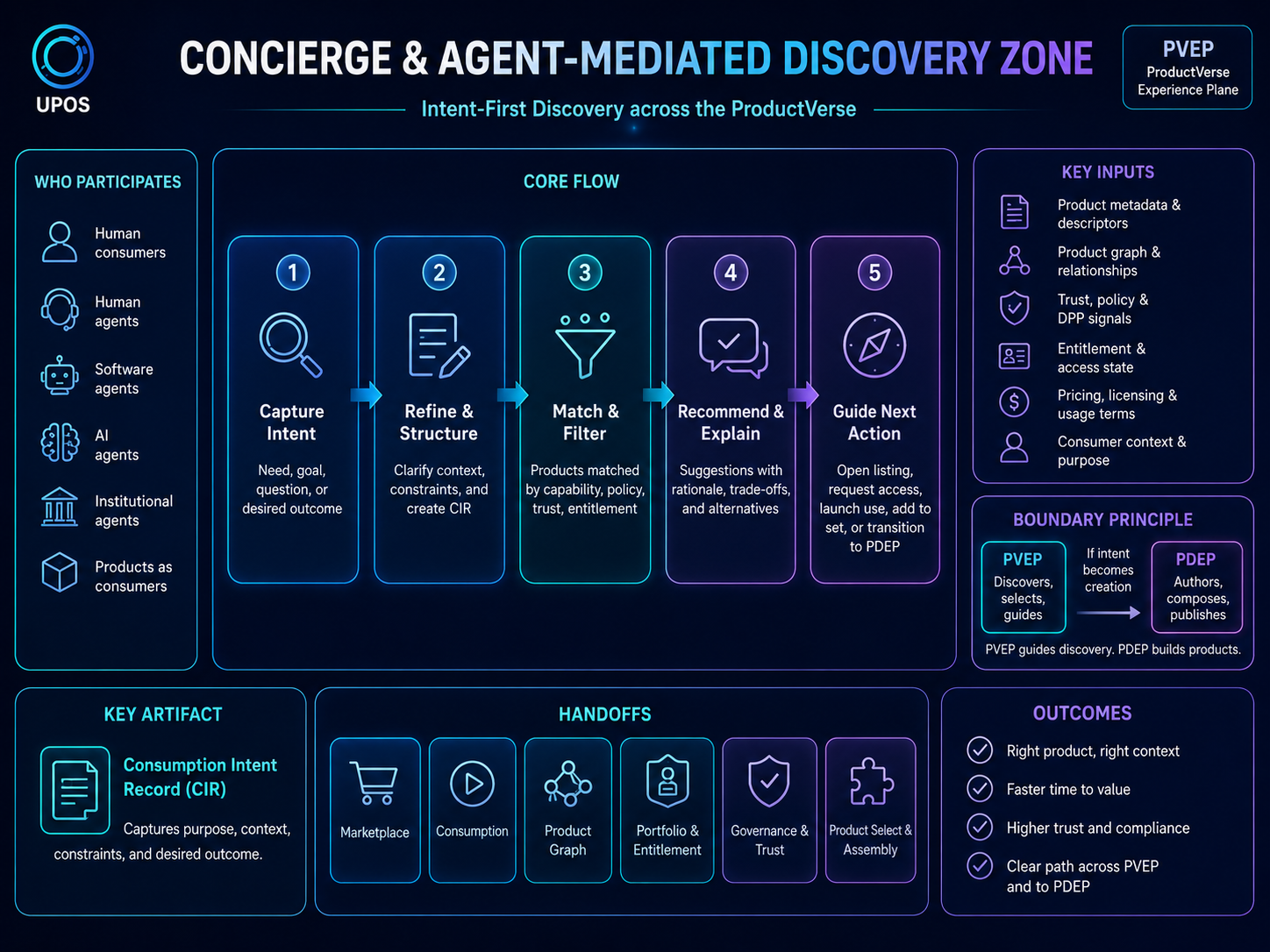
The Concierge & Agent-Mediated Discovery Zone is the PVEP zone through which consumers express intent and receive guided support in discovering suitable products across the ProductVerse.
It supports intent-first discovery, where the consumer does not necessarily begin by browsing a marketplace or searching a catalog. Instead, the consumer may express a need, goal, question, constraint, or desired outcome. That intent may then be interpreted, refined, and matched to relevant products or product sets by a concierge, human agent, software agent, AI agent, institutional agent, recommendation service, or other discovery intermediary.
This zone exists because the ProductVerse can become too large, complex, and dynamic for consumers to navigate only through manual search and browsing.
The zone helps consumers answer questions such as:
- What product should I use for this purpose?
- Which products match my intent, role, jurisdiction, and constraints?
- Which products am I allowed to use?
- Which products are trustworthy enough for my use case?
- Which products are commonly used together?
- Which product is a lower-cost, lower-risk, or better-governed substitute?
- Which product set should I select for further evaluation or possible transition to PDEP?
2. Definition
The Concierge & Agent-Mediated Discovery Zone is the PVEP capability zone that supports intent capture, intent refinement, product matching, guided recommendation, and discovery assistance through human, software, institutional, or AI-mediated interaction patterns.
It is called agent-mediated deliberately.
In UPOS, agentic does not mean “AI agent” by default. Agentic means pertaining to an agent or agent-like behavior. Agents may be human, organizational, software-based, AI-enabled, institutional, or product-based.
Therefore, this zone may involve:
- human concierges,
- human agents,
- support agents,
- procurement agents,
- stewardship agents,
- software agents,
- workflow agents,
- deterministic recommendation agents,
- AI agents,
- institutional agents,
- products acting as consumers,
- hybrid human-machine symbiants.
The key principle is:
Agent-mediated discovery is broader than AI discovery. AI agents are one possible form of discovery agent, not the whole category.
3. Scope
The Concierge & Agent-Mediated Discovery Zone covers:
- intent-first product discovery,
- natural-language product discovery,
- guided search,
- product recommendation,
- product matching,
- product-set recommendation,
- policy-aware discovery,
- entitlement-aware discovery,
- trust-aware discovery,
- context-aware discovery,
- substitute discovery,
- complement discovery,
- guided evaluation,
- discovery explanation,
- intent refinement,
- consumption intent capture,
- product-set intent capture,
- cross-marketplace discovery,
- human-assisted discovery,
- AI-assisted discovery,
- institutional-agent discovery,
- transition guidance to marketplace, consumption, product graph navigation, product selection, entitlement, trust review, or PDEP.
The zone does not own:
- product creation,
- product composition,
- product publication,
- product artifact generation,
- governance decisioning,
- entitlement authority,
- authoritative product metadata,
- runtime product consumption,
- marketplace commercial execution.
Those responsibilities belong to PDEP, the Governance Kernel, registries, runtime services, marketplace services, entitlement services, and other UPOS capabilities.
4. Position within PVEP
The Concierge & Agent-Mediated Discovery Zone is one of the seven PVEP experience zones.
ProductVerse Experience Plane (PVEP)
├─ Marketplace Experience Zone
├─ Consumption Experience Zone
│  └─ Consumer Experience Plane (CEP)
├─ Concierge & Agent-Mediated Discovery Zone
├─ Product Graph Navigation Zone
├─ Portfolio & Entitlement Experience Zone
├─ Product Select & Assembly Zone
└─ Governance & Trust Experience Zone
It is the zone most directly associated with intent-first discovery.
It interacts closely with:
| Related PVEP Zone | Relationship |
|---|---|
| Marketplace Experience Zone | Recommended products may be opened as marketplace listings or product detail pages. |
| Consumption Experience Zone | Discovery may recommend a consumption pathway or output port. |
| Product Graph Navigation Zone | Discovery may use product relationships, substitutes, complements, dependencies, and bundles. |
| Portfolio & Entitlement Experience Zone | Discovery may consider what the consumer already owns, subscribes to, or is entitled to use. |
| Product Select & Assembly Zone | Discovery may recommend product sets that can be selected, shortlisted, or assembled. |
| Governance & Trust Experience Zone | Discovery may filter and explain products using trust, risk, quality, policy, and DPP signals. |
| PDEP | If discovery reveals creation intent, PVEP may hand off to PDEP. |
5. Why This Zone Exists
Traditional marketplaces assume that consumers can find what they need by searching, browsing, filtering, or comparing listings.
That assumption weakens as the ProductVerse expands.
In a post-modern productized environment, consumers may face:
- too many products,
- too many product types,
- too many providers,
- too many versions,
- too many governance constraints,
- too many entitlement conditions,
- too many pricing and licensing options,
- too many substitutes and complements,
- too many product dependencies,
- too many possible product combinations.
The Concierge & Agent-Mediated Discovery Zone addresses this complexity by shifting from browse-first discovery to intent-first discovery.
Instead of asking:
“Which product should I search for?”
the consumer can express:
“This is what I am trying to achieve.”
The zone then helps translate that intent into candidate products, product sets, explanations, and next actions.
6. Core Responsibilities
6.1 Capture Consumer Intent
The zone captures what the consumer is trying to achieve.
Intent may include:
- business purpose,
- operational goal,
- analytical question,
- decision need,
- content need,
- automation need,
- product capability need,
- regulatory purpose,
- audience,
- desired outcome,
- constraints,
- urgency,
- quality expectations,
- trust expectations,
- jurisdiction,
- budget,
- preferred consumption mode,
- required output port type.
Intent capture may be conversational, form-based, API-based, workflow-based, or inferred from context.
6.2 Refine and Structure Intent
Consumer intent may initially be vague.
The zone may refine intent by asking clarifying questions or deriving additional structure.
Examples:
- What jurisdiction applies?
- Is this for internal use or external sharing?
- Do you need real-time or batch access?
- Do you need a dashboard, API, file, SQL endpoint, or agent tool?
- Is the output for human review or automated decisioning?
- Do you need personally identifiable information?
- What quality or freshness level is acceptable?
- Are you creating a one-off analysis or a reusable product?
The refined intent can become a structured artifact such as a Consumption Intent Record (CIR).
6.3 Match Intent to Products
The zone matches intent to products using product metadata, semantic descriptors, tags, categories, output ports, relationships, trust signals, entitlement posture, and policy constraints.
Matching may consider:
- capability fit,
- semantic fit,
- domain fit,
- output-port fit,
- quality fit,
- freshness fit,
- jurisdiction fit,
- trust fit,
- entitlement fit,
- pricing fit,
- licensing fit,
- risk fit,
- interoperability fit,
- consumption-mode fit.
6.4 Recommend Products and Product Sets
The zone may recommend:
- individual products,
- substitute products,
- complementary products,
- product sets,
- product bundles,
- product chains,
- marketplace listings,
- output ports,
- consumption experiences,
- onboarding paths,
- graph navigation paths,
- PDEP transition paths.
A recommendation should be explainable enough for the consumer or agent to understand why it was suggested.
6.5 Explain Discovery Results
The zone should provide explanation, not merely ranking.
Explanations may include:
- why the product matches the intent,
- which constraints it satisfies,
- which constraints it does not satisfy,
- what trust signals support it,
- whether the consumer is entitled,
- what approval is needed,
- what output ports are available,
- what restrictions apply,
- what substitutes exist,
- what trade-offs exist,
- why a product was excluded.
6.6 Guide the Next Action
Discovery should lead to useful next actions.
Possible next actions include:
- open marketplace listing,
- compare products,
- request access,
- subscribe or acquire,
- open DPP view,
- open trust explanation,
- launch consumption experience,
- add to product set,
- explore product graph,
- ask another question,
- refine intent,
- transition to PDEP.
7. Agent Types in This Zone
7.1 Human Concierge
A human concierge may help consumers discover products, interpret needs, recommend options, explain usage constraints, or route the consumer to the right PVEP zone.
Examples include:
- product support specialist,
- marketplace advisor,
- procurement support,
- data steward,
- product librarian,
- customer success representative.
7.2 Human Agent
A human agent may act on behalf of another person, team, organization, or institution.
Examples include:
- buyer acting for a business unit,
- analyst acting for a reporting team,
- steward acting for a data domain,
- compliance officer acting for a regulatory function,
- broker acting for a client.
7.3 Software Agent
A software agent may perform discovery or matching using deterministic logic, workflows, rules, or automation.
Examples include:
- recommendation service,
- search orchestration service,
- policy-filtering service,
- matching engine,
- workflow bot,
- catalog assistant,
- procurement bot.
A software agent does not need to be AI-based.
7.4 AI Agent
An AI agent may assist with natural-language understanding, semantic matching, reasoning, recommendation, summarization, explanation, or adaptive guidance.
Examples include:
- product discovery copilot,
- AI marketplace assistant,
- AI recommendation agent,
- AI product-matching agent,
- AI procurement assistant.
When AI is specifically meant, UPOS should use terms such as AI agent, AI-assisted discovery, or AI-agentic interaction, rather than using “agentic” as a synonym for AI.
7.5 Institutional Agent
An institutional agent acts with recognized authority on behalf of an organization, function, or governance body.
Examples include:
- procurement agent,
- compliance agent,
- risk agent,
- delegated purchasing agent,
- institutional AI agent,
- enterprise product-selection agent.
Institutional agents require clear authority profiles, scope constraints, auditability, accountability, and review mechanisms.
7.6 Product as Consumer
A product may act as a consumer when it needs to discover or select another product as an input, dependency, tool, or service.
Examples include:
- an AI Product discovering relevant Data Products,
- a dashboard product selecting underlying data products,
- an evidence product selecting source products,
- a workflow product selecting API products.
When this becomes governed product design, the flow must transition to PDEP.
8. Consumption Intent Record (CIR)
The Consumption Intent Record (CIR) is a central artifact in the Concierge & Agent-Mediated Discovery Zone.
A CIR captures a consumer’s purpose, context, constraints, and desired outcome.
8.1 Typical CIR Contents
A CIR may include:
- consumer identity,
- consumer type,
- role,
- organization,
- delegated authority context,
- business purpose,
- desired outcome,
- use case,
- audience,
- jurisdiction,
- environment,
- urgency,
- required product kind,
- required output port type,
- quality expectations,
- freshness expectations,
- trust expectations,
- policy constraints,
- entitlement context,
- budget or cost constraints,
- license constraints,
- preferred consumption mode,
- excluded product types,
- required interoperability,
- privacy constraints,
- risk tolerance,
- whether creation intent is present.
8.2 CIR Creation Points
Although this zone is a natural origin point for CIR, CIRs may also be created in other PVEP zones, including:
- Marketplace Experience Zone,
- Consumption Experience Zone,
- Product Graph Navigation Zone,
- Portfolio & Entitlement Experience Zone,
- Product Select & Assembly Zone,
- Governance & Trust Experience Zone.
The key rule is:
A CIR is created wherever consumer intent is captured and structured.
8.3 CIR Usage
A CIR may be used to:
- drive product search,
- drive product recommendation,
- filter products by policy,
- evaluate entitlement eligibility,
- rank candidate products,
- explain recommendations,
- create product sets,
- initiate access requests,
- launch consumption experiences,
- support handoff to PDEP.
9. Discovery Patterns
9.1 Intent-First Discovery
The consumer expresses a goal or need, and the zone identifies suitable products.
Example:
Consumer intent:
“I need a trusted data product for EU customer-risk reporting.”

Discovery response:
- recommends relevant Data Products,
- filters by EU usage constraints,
- checks entitlement eligibility,
- shows trust and quality signals,
- suggests consumption modes.
9.2 Constraint-Aware Discovery
The consumer provides constraints that shape the result set.
Constraints may include:
- jurisdiction,
- budget,
- trust threshold,
- risk tolerance,
- quality threshold,
- freshness requirement,
- output port type,
- license type,
- entitlement status,
- internal or external use,
- automated or human-reviewed use.
9.3 Substitute Discovery
The consumer asks for alternatives to a product.
Example:
“Find a lower-cost substitute for this product that I am entitled to use.”
The zone may compare:
- capability,
- cost,
- trust,
- license,
- output ports,
- quality,
- risk,
- entitlement,
- adoption,
- provider support.
9.4 Complement Discovery
The consumer asks what products work well with another product.
Example:
“What products are commonly used with this fraud detection model?”
The zone may use product graph relationships, co-consumption signals, bundle records, provider metadata, and ProductVerse intelligence.
9.5 Product-Set Discovery
The consumer asks for a set of products to satisfy a larger purpose.
Example:
“Suggest a product set for payment surveillance.”
The result may include:
- input data products,
- AI products,
- rules or policy products,
- dashboard products,
- evidence products,
- workflow products,
- trust and governance requirements.
Product-set recommendations may flow into the Product Select & Assembly Zone.
9.6 Cross-Marketplace Discovery
The consumer may need discovery across multiple marketplaces, catalogs, registries, or provider ecosystems.
The zone should be able to coordinate discovery across those surfaces while preserving policy, entitlement, and trust constraints.
10. Product Matching Logic
Product matching may combine multiple signals.
Product Match Score =
  Capability Fit
+ Semantic Fit
+ Output-Port Fit
+ Policy Fit
+ Entitlement Fit
+ Trust Fit
+ Quality Fit
+ Freshness Fit
+ Cost Fit
+ Licensing Fit
+ Relationship Fit
+ Consumer Context Fit
This formula is illustrative rather than prescriptive.
The important point is that product matching in UPOS should not be based only on keyword relevance or popularity.
A product that appears relevant may still be unsuitable if:
- the consumer is not entitled,
- the intended purpose is prohibited,
- the jurisdiction is restricted,
- the trust posture is insufficient,
- the license does not permit the use,
- the output port does not fit the consumer’s need,
- the product depends on unavailable products,
- the cost exceeds the consumer’s constraints.
11. Recommendation Explainability
Recommendations should be explainable.
A recommendation explanation may include:
- matched capabilities,
- matched product type,
- matched domain,
- matched output ports,
- matched usage mode,
- trust reasons,
- entitlement status,
- policy fit,
- licensing fit,
- cost fit,
- relationship reasons,
- substitute or complement rationale,
- known limitations,
- recommended next step.
Example:
Recommended Product: EU Customer Risk Indicators

Reason:
- matches customer-risk reporting purpose,
- supports EU jurisdiction,
- exposes SQL and dashboard output ports,
- has high data quality score,
- currently available to your department,
- requires manager approval for export use,
- commonly used with Regulatory Evidence Pack Product.
12. Relationship to Marketplace Experience Zone
The Concierge & Agent-Mediated Discovery Zone often routes consumers into the Marketplace Experience Zone.
Example:
Consumer expresses intent
  → Concierge captures CIR
  → Product matching returns candidates
  → Consumer opens product detail pages
  → Marketplace supports evaluation, pricing, licensing, acquisition
The distinction is:
| Zone | Discovery Style |
|---|---|
| Concierge & Agent-Mediated Discovery Zone | Intent-first, guided, agent-supported discovery. |
| Marketplace Experience Zone | Browse-first, search-first, listing-based discovery and acquisition. |
Both zones should be integrated.
13. Relationship to Product Graph Navigation Zone
The Concierge & Agent-Mediated Discovery Zone may use Product Graph data to improve recommendations.
It may consider:
- substitutes,
- complements,
- dependencies,
- lineage,
- bundles,
- product chains,
- product ecosystems,
- downstream usage,
- provider networks,
- policy relationships,
- trust relationships.
Example:
Consumer asks:
“What else do I need to use this AI Product safely?”

Agent-mediated discovery:
  → checks Product Graph
  → identifies required Data Products,
     evaluation products,
     policy products,
     monitoring products,
     and evidence products
  → recommends a candidate product set
For deeper exploration, the user may transition into the Product Graph Navigation Zone.
14. Relationship to Portfolio & Entitlement Experience Zone
Discovery should be entitlement-aware where appropriate.
The zone may use portfolio and entitlement state to:
- show products already available,
- prioritize products the consumer can use immediately,
- identify products requiring approval,
- exclude products the consumer cannot see,
- explain why a product is restricted,
- suggest substitutes that are already entitled,
- route to access request workflows.
Example:
“Find a product like this one that I can use today.”
The recommendation should prefer products for which the consumer already has entitlement or can obtain entitlement quickly.
15. Relationship to Governance & Trust Experience Zone
Discovery should be trust-aware by design.
The zone may use governance and trust signals to:
- filter unsafe or non-compliant products,
- rank products by trust posture,
- explain risk and usage constraints,
- identify required approvals,
- show DPP summaries,
- recommend products with better quality or maturity,
- avoid products with unresolved exceptions,
- detect prohibited usage.
Example:
“Find an AI Product for customer segmentation that is approved for external campaign use.”
The zone must check policy, risk, licensing, and permitted-use constraints rather than recommending solely by capability.
16. Relationship to Product Select & Assembly Zone
Discovery often produces candidate product sets.
Those sets may flow into the Product Select & Assembly Zone for further refinement.
Example:
Intent:
“I need a product set for payment surveillance.”

Concierge result:
- Payment Events Data Product
- Customer Risk Indicators Data Product
- Anomaly Detection AI Product
- Surveillance Dashboard Product
- Evidence Ledger Product

Next action:
“Add these to Product Select & Assembly.”
The Product Select & Assembly Zone allows the consumer to shortlist, compare, curate, and prepare the product set.
If the consumer decides to create a new governed product from the selected set, the flow transitions to PDEP.
17. Relationship to Consumption Experience Zone
The zone may recommend a direct path to consumption when the consumer is already entitled and the desired product is available.
Example:
Consumer:
“Open the best dashboard for monthly risk reporting.”

Discovery:
  → identifies suitable product,
  → checks entitlement,
  → selects dashboard output port,
  → launches Consumption Experience.
In this case, agent-mediated discovery acts as a smart entry point into consumption.
18. Relationship to PDEP
The Concierge & Agent-Mediated Discovery Zone must preserve the boundary with PDEP.
It may identify that the consumer’s intent is not merely consumption but product creation.
Examples:
- “Create a reusable regulatory evidence product from these data sources.”
- “Build a new AI Product using these training products.”
- “Package these assets into a new marketplace product.”
- “Compose these products into a governed reporting product.”
When creation intent is detected, the zone should initiate a transition to PDEP.
Intent captured in PVEP
  → Creation intent detected
  → Selected products and constraints packaged
  → Handoff to PDEP
  → PDEP handles authoring, composition, validation, versioning, and publication
The key principle is:
PVEP may recognize creation intent. PDEP realizes product creation.
19. Human and Machine Interfaces
19.1 Human Interfaces
Human-facing interfaces may include:
- conversational assistants,
- guided search forms,
- recommendation panels,
- product advisors,
- marketplace copilots,
- procurement assistants,
- support concierge interfaces,
- discovery wizards,
- side-by-side recommendation explanations.
19.2 Machine and Agent Interfaces
Machine-facing interfaces may include:
- intent submission API,
- product recommendation API,
- product matching API,
- entitlement-aware discovery API,
- policy-aware discovery API,
- trust-aware recommendation API,
- product graph query API,
- DPP-aware discovery API,
- product-set recommendation API,
- CIR creation API,
- PDEP transition API.
19.3 Hybrid Interfaces
Hybrid interfaces may combine human and machine participation.
Examples:
- AI assistant proposes products, human steward validates.
- Procurement agent selects options, business user approves.
- Institutional agent filters products, compliance officer reviews.
- Concierge drafts CIR, consumer confirms.
- Machine recommender produces product set, human user edits it.
These hybrid patterns are important for accountable discovery.
20. Governance, Accountability, and Auditability
Agent-mediated discovery can influence decisions, procurement, access, and product creation. Therefore, it requires governance and auditability.
Important controls include:
- clear identification of the acting subject,
- clear distinction between human, software, AI, and institutional agents,
- delegated authority profile,
- scope of action,
- permitted recommendation domains,
- audit trail of recommendations,
- explanation of recommendation logic,
- record of user confirmation,
- policy checks,
- entitlement checks,
- exception handling,
- bias and fairness controls where AI is used,
- provenance of product metadata,
- logging of transition to PDEP,
- monitoring of recommendation quality.
When AI agents are involved, additional controls may include:
- prompt and tool governance,
- model risk controls,
- hallucination mitigation,
- source-grounded recommendation,
- human review for high-risk decisions,
- safety constraints,
- evaluation records.
21. Events and Signals
The Concierge & Agent-Mediated Discovery Zone should emit structured signals.
Examples include:
- intent captured,
- CIR created,
- intent refined,
- clarification requested,
- product recommended,
- product rejected,
- recommendation accepted,
- recommendation explanation viewed,
- substitute requested,
- complement requested,
- product-set suggested,
- product-set accepted,
- product-set modified,
- entitlement filter applied,
- policy filter applied,
- trust filter applied,
- marketplace handoff initiated,
- graph navigation handoff initiated,
- consumption handoff initiated,
- access request initiated,
- PDEP transition initiated,
- recommendation feedback submitted.
These signals may feed:
- ProductVerse intelligence,
- recommendation improvement,
- marketplace ranking,
- product lifecycle feedback,
- governance analytics,
- trust analytics,
- portfolio optimization,
- producer insights.
22. Metrics
Useful metrics include:
- number of intents captured,
- number of CIRs created,
- recommendation acceptance rate,
- recommendation rejection rate,
- recommendation explanation usage,
- intent-to-product success rate,
- zero-match intent rate,
- entitlement-filtered recommendation rate,
- policy-blocked recommendation rate,
- trust-filtered recommendation rate,
- time to suitable product,
- time to first consumption,
- time to access request,
- product-set creation rate,
- PDEP transition rate,
- human override rate,
- AI recommendation correction rate,
- user satisfaction with recommendations,
- repeat discovery usage,
- substitute recommendation success,
- complement recommendation success.
These metrics help determine whether agent-mediated discovery is improving ProductVerse usability.
23. Security, Privacy, and Policy Considerations
The zone must handle intent and context securely.
Important considerations include:
- privacy of consumer intent,
- protection of sensitive business purpose,
- policy-aware product visibility,
- entitlement-aware recommendation,
- secure handling of delegated authority,
- auditability of agent actions,
- prevention of unauthorized metadata leakage,
- prevention of manipulation of recommendation results,
- consent-aware personalization,
- purpose limitation,
- secure API access,
- rate limiting,
- explainability for consequential recommendations,
- human review for high-impact or high-risk recommendations,
- safe handling of AI-generated recommendations.
The zone should not reveal products, relationships, metadata, pricing, trust details, or entitlements that the consumer is not permitted to see.
24. Design Guidance
24.1 Use “Agent-Mediated” Precisely
Do not use “agentic” as shorthand for AI. Be explicit about the agent type when it matters.
Use:
- human agent,
- software agent,
- AI agent,
- institutional agent,
- machine agent,
- product-as-consumer.
24.2 Make Discovery Intent-First
Allow consumers to express what they are trying to achieve, not just what they want to search for.
24.3 Make Recommendations Explainable
Consumers should understand why a product was recommended and what trade-offs apply.
24.4 Make Discovery Trust-Aware
Trust, policy, entitlement, licensing, risk, and quality must be considered during discovery.
24.5 Preserve Human Confirmation Where Needed
Agent-mediated discovery should not silently make high-impact decisions without appropriate confirmation or authority.
24.6 Support Cross-Zone Handoffs
Discovery should route smoothly into marketplace, graph, entitlement, consumption, trust, product select, or PDEP flows.
24.7 Preserve PDEP Boundary
Recognizing creation intent is allowed. Building the product is not a PVEP responsibility.
25. Anti-Patterns
25.1 Agentic Means AI
Using “agentic” as a synonym for AI agents weakens the UPOS ontology. Agentic behavior is broader than AI.
25.2 Recommendation Without Authority
An agent should not recommend, acquire, or trigger actions beyond its authority scope.
25.3 Search Wrapped in Chat
A conversational interface that only performs keyword search without intent structure, policy context, trust awareness, or explanation is not mature agent-mediated discovery.
25.4 Hallucinated Product Discovery
AI-assisted discovery must not invent products, capabilities, trust signals, pricing, licenses, or entitlements.
25.5 Entitlement-Blind Recommendations
Recommending products that the consumer cannot see or cannot use may create poor experience or compliance risk.
25.6 Trust-Blind Recommendations
Recommending products solely because they match capability, while ignoring risk, quality, DPP, or policy posture, is unsafe.
25.7 PVEP Acting as PDEP
The discovery zone must not build, compose, validate, version, or publish products.
25.8 No Explanation
A recommendation without explanation is weak in governed product environments.
26. Example Journeys
26.1 Human Concierge Journey
Business consumer
  → Describes need to product concierge
  → Concierge structures intent
  → CIR is created
  → Candidate products are recommended
  → Consumer opens marketplace listings
  → Consumer requests access or launches consumption
26.2 AI-Assisted Discovery Journey
Consumer
  → Asks natural-language question
  → AI agent refines intent
  → Product matching service checks metadata, policy, trust, and entitlement
  → AI agent explains recommended products
  → Consumer selects product or product set
26.3 Institutional Agent Journey
Procurement agent
  → Receives organizational need
  → Applies budget, licensing, policy, and trust constraints
  → Recommends approved products
  → Routes product set for human approval
  → Initiates acquisition or access workflow
26.4 Product-as-Consumer Journey
AI Product under design
  → Needs suitable Data Product inputs
  → Discovery service identifies candidate Data Products
  → Trust and entitlement are checked
  → Selected inputs are passed into PDEP for governed product design
26.5 Creation Intent Detection Journey
Consumer asks:
“Create a reusable monitoring product using these three products.”

PVEP:
  → Captures intent
  → Recognizes creation intent
  → Builds PDEP transition package
  → Hands off to PDEP

PDEP:
  → Authors, composes, validates, versions, and publishes product
27. Summary
The Concierge & Agent-Mediated Discovery Zone is the PVEP zone for intent-first, guided product discovery across the ProductVerse.
It allows consumers to express what they are trying to achieve and receive product recommendations, product-set suggestions, explanation, trust context, entitlement awareness, and next-action guidance.
It is deliberately named agent-mediated to avoid treating “agentic” as synonymous with AI. In UPOS, agentic behavior can be human, organizational, software-based, institutional, AI-enabled, or product-based.
The essential principles are:
- Agent-mediated discovery is broader than AI discovery.
- Intent should be captured and structured.
- Recommendations should be policy-aware, entitlement-aware, and trust-aware.
- Discovery should provide explanations and next actions.
- CIR is a key artifact but may arise across PVEP.
- Product-set recommendations may flow into Product Select & Assembly.
- Creation intent must transition to PDEP.
- PVEP may guide discovery, but PDEP builds products.
In short:
The Concierge & Agent-Mediated Discovery Zone helps consumers express intent and find the right products, while preserving clear boundaries around governance authority, entitlement authority, and product creation.