ProductVerse Experience Plane (PVEP) Overview
1. Purpose
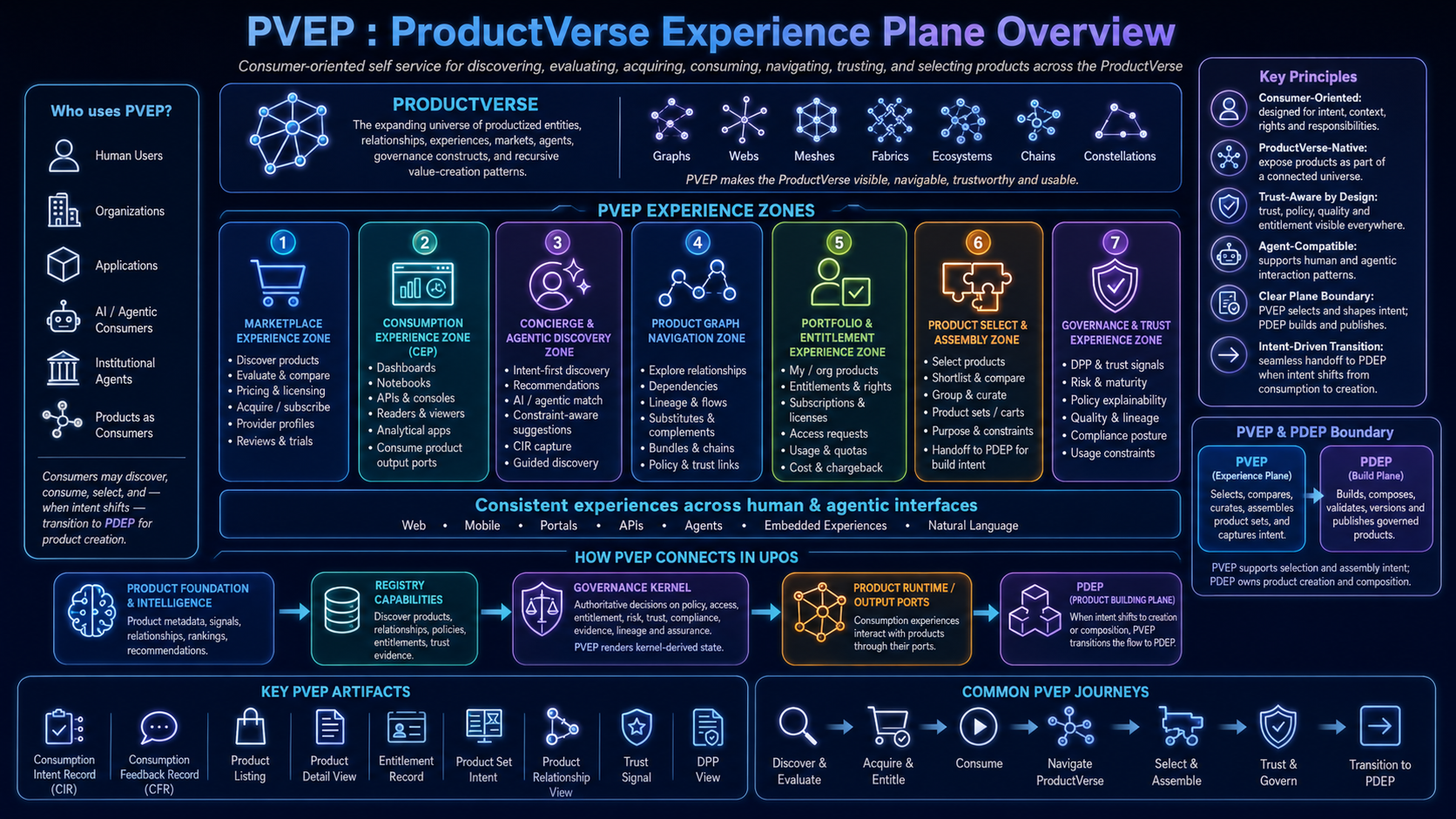
The ProductVerse Experience Plane (PVEP) is the UPOS experience plane through which consumers, organizations, and agents discover, evaluate, acquire, consume, navigate, trust, and select products across the ProductVerse.
PVEP provides the consumer-oriented surface of UPOS. It allows participants to interact with productized value without needing to understand the internal mechanics of product development, deployment, governance compilation, or runtime execution.
PVEP is broader than a marketplace, broader than a catalog, and broader than a consumption interface. It is the experiential layer through which the ProductVerse becomes visible, understandable, navigable, trustworthy, and usable.
2. Relationship to the ProductVerse
The ProductVerse is the expanding universe of productized entities, relationships, experiences, markets, agents, governance constructs, and recursive value-creation patterns.
Within the ProductVerse, products may appear in many topological forms, including:
- product graphs,
- product webs,
- product meshes,
- product fabrics,
- product marketplaces,
- product ecosystems,
- product constellations,
- product chains and flows.
PVEP is the experience plane that allows participants to interact with these topologies.
A product in the ProductVerse is not merely an item in a catalog. It may simultaneously be:
- a node in a product graph,
- a listing in a marketplace,
- a governed asset in a product fabric,
- a dependency in a product chain,
- a component in a bundle,
- a consumable service or output port,
- a trusted object with a Digital Product Passport,
- an input to the creation of another product.
PVEP provides the experiences through which these different product roles become discoverable and actionable.
3. Scope of PVEP
PVEP supports the consumer-side lifecycle of product interaction.
It enables actors to:
- express consumption intent,
- discover relevant products,
- compare and evaluate products,
- understand trust, risk, policy, and entitlement posture,
- acquire or request access to products,
- consume products through appropriate experiences,
- navigate relationships between products,
- view portfolios and entitlements,
- select and assemble candidate product sets,
- transition into product-building flows when creation intent emerges.
PVEP is therefore not a single application. It is a plane of experiences that may be realized through marketplaces, portals, dashboards, graph explorers, readers, notebooks, agents, catalog views, entitlement workbenches, trust viewers, or embedded product interfaces.
4. PVEP as a Consumer-Oriented Plane
PVEP is primarily a consumer-oriented experience plane.
A consumer may be:
- a human user,
- a business team,
- an organization,
- a software application,
- an AI agent,
- an institutional agent,
- another product acting as a consumer of product output ports.
The consumer’s purpose may vary. They may want to discover a product, use a product, evaluate whether a product is trustworthy, understand what products they already have access to, or select a set of products for a future solution.
PVEP does not assume that all consumers are passive end users. In a ProductVerse, consumers may become creators when their intent shifts from consumption to product creation. This transition is handled through a boundary with PDEP.
5. Boundary with PDEP
The Product Development and Execution Plane (PDEP) is the authoritative UPOS plane for product building.
PVEP may support product selection, shortlisting, curation, comparison, configuration, and product-set assembly. However, PVEP does not build governed products.
The boundary can be summarized as:
PVEP selects and shapes intent. PDEP builds and publishes products.
PVEP is responsible for consumer-side interaction:
- discovering products,
- evaluating products,
- acquiring or requesting access,
- consuming products,
- selecting product sets,
- expressing composition or creation intent.
PDEP is responsible for product-building activities:
- product creation,
- product composition,
- semantic design,
- artifact generation,
- validation,
- deployment preparation,
- versioning,
- governance integration,
- publication back into the ProductVerse.
When a consumer’s intent shifts from selecting or consuming products to creating a governed, reusable, publishable product, the flow transitions from PVEP into PDEP.
6. PVEP Experience Zones
PVEP is organized into seven experience zones.
ProductVerse Experience Plane (PVEP)
├─ Marketplace Experience Zone
├─ Consumption Experience Zone
│  └─ Consumer Experience Plane (CEP)
├─ Concierge & Agentic Discovery Zone
├─ Product Graph Navigation Zone
├─ Portfolio & Entitlement Experience Zone
├─ Product Select & Assembly Zone
└─ Governance & Trust Experience Zone
Each zone represents a distinct mode of interaction with the ProductVerse.
7. Marketplace Experience Zone
The Marketplace Experience Zone supports product discovery, evaluation, acquisition, onboarding, and commercial interaction.
It includes experiences such as:
- product listings,
- search and filtering,
- product detail pages,
- product comparison,
- provider profiles,
- pricing and licensing,
- subscription and acquisition flows,
- trial or sandbox access,
- marketplace ranking,
- reviews and ratings.
This zone helps consumers find and acquire products, but it does not own the full consumption lifecycle.
A marketplace is therefore one expression of PVEP, not the whole of PVEP.
8. Consumption Experience Zone
The Consumption Experience Zone supports direct use of products through appropriate consumer-facing interfaces.
It includes experiences such as:
- dashboards,
- readers,
- notebooks,
- SQL workbenches,
- API consoles,
- analytical applications,
- embedded application views,
- report viewers,
- inference playgrounds,
- simulation interfaces,
- agent-facing tool interfaces.
The earlier Consumer Experience Plane (CEP) is positioned as a specialized sub-plane within this zone.
The key principle is:
Consumption experiences consume product ports; they do not redefine the product itself.
For example, a dashboard consuming a Data Product is not the Data Product. It is an experience over the product.
9. Concierge & Agentic Discovery Zone
The Concierge & Agentic Discovery Zone supports intent-first discovery.
Instead of browsing a marketplace directly, a consumer may express an intent and be guided toward suitable products by a concierge, recommendation engine, AI agent, institutional agent, or other discovery intermediary.
Examples of intent-first requests include:
- “Find products suitable for EU regulatory reporting.”
- “Recommend an AI Product for payment anomaly detection.”
- “Find trusted data products for customer-risk analysis.”
- “Identify products I am entitled to use for this business purpose.”
- “Suggest a lower-cost substitute for this product.”
This zone is a natural place for creating a Consumption Intent Record (CIR).
However, CIR creation is not exclusive to this zone. A CIR may also arise in marketplace flows, embedded consumption experiences, product graph navigation, portfolio views, or other PVEP touchpoints.
10. Product Graph Navigation Zone
The Product Graph Navigation Zone enables consumers and agents to explore relationships across the ProductVerse.
It supports navigation of:
- upstream dependencies,
- downstream dependencies,
- product lineage,
- product composition relationships,
- substitutes,
- complements,
- bundles,
- provider networks,
- entitlement dependencies,
- policy relationships,
- trust relationships,
- product-to-agent relationships,
- product-to-marketplace relationships,
- product-to-DPP relationships.
This zone makes the ProductVerse visible as a connected topology rather than a flat catalog.
It supports questions such as:
- What does this product depend on?
- Which products consume this product?
- What products are similar or substitutable?
- What products are commonly bundled together?
- What trust, policy, or lineage relationships affect this product?
11. Portfolio & Entitlement Experience Zone
The Portfolio & Entitlement Experience Zone helps consumers understand what products they have, what products they can access, and what obligations or limits apply.
It includes experiences such as:
- my products,
- team products,
- organization products,
- subscribed products,
- purchased products,
- licensed products,
- accessible products,
- denied products,
- pending access requests,
- expiring entitlements,
- usage quotas,
- consumption limits,
- cost and chargeback views,
- product access history,
- agent entitlements,
- organizational product inventory.
This zone connects PVEP to identity, access, policy, licensing, contract, and metering capabilities.
The key principle is:
Marketplace acquisition initiates or requests access; portfolio and entitlement experiences manage the ongoing subject-product relationship.
12. Product Select & Assembly Zone
The Product Select & Assembly Zone supports consumer-side selection, grouping, comparison, and preparation of product sets for a purpose.
It enables consumers, organizations, and agents to:
- select products,
- shortlist candidate products,
- group products around a use case,
- compare product-set options,
- create product carts or collections,
- prepare solution candidates,
- express product-set intent,
- initiate a handoff to PDEP when the intent becomes product creation.
This zone is intentionally not named “composition” or “product building” because governed product composition belongs to PDEP.
PVEP may help a consumer assemble a candidate product set such as:
- a group of data products for a reporting need,
- a set of AI and data products for a risk workflow,
- a collection of creative assets for a media product,
- a set of software capabilities for an operational solution.
However, once the user intends to create a governed, reusable, publishable product from those selected products, the flow must transition to PDEP.
The key principle is:
PVEP supports product selection and assembly intent. PDEP owns product composition and product building.
13. Governance & Trust Experience Zone
The Governance & Trust Experience Zone exposes trust, policy, compliance, assurance, and accountability information in a form that consumers and agents can understand and act upon.
It includes experiences such as:
- Digital Product Passport views,
- trust badges,
- product maturity indicators,
- policy explainability,
- entitlement explainability,
- usage constraints,
- allowed and prohibited uses,
- data quality scorecards,
- AI risk tier displays,
- lineage summaries,
- compliance posture,
- certification status,
- evaluation evidence,
- audit evidence,
- exception status,
- stewardship and ownership information.
This zone is the PVEP-facing surface of the Governance Kernel.
The Governance Kernel computes, evaluates, enforces, and records governance decisions. PVEP presents those decisions and trust signals in experience-native form.
The key principle is:
The Governance Kernel is the decision and assurance engine. PVEP is the experiential interpretation layer.
14. PVEP and the Governance Kernel
PVEP depends on the Governance Kernel for authoritative governance state.
The Governance Kernel may provide:
- policy decisions,
- access eligibility,
- entitlement state,
- risk tier,
- trust posture,
- product maturity,
- compliance status,
- evidence state,
- lineage and provenance signals,
- permitted usage,
- obligation and restriction information.
PVEP should not manually curate or invent governance signals. It should render kernel-derived governance state in a clear, explainable, and actionable form.
This ensures that governance information shown to consumers is consistent with the underlying policy, evidence, and assurance machinery of UPOS.
15. Key PVEP Artifacts
PVEP may create, display, or consume several important artifacts.
Examples include:
| Artifact | Description |
|---|---|
| Consumption Intent Record (CIR) | Captures a consumer’s purpose, context, constraints, and desired outcome. |
| Consumption Feedback Record (CFR) | Captures consumer feedback, value signals, usage experience, and improvement suggestions. |
| Product Listing | Marketplace-facing representation of a product. |
| Product Detail View | Consumer-readable product description, trust posture, usage model, and access information. |
| Entitlement Record | Represents a subject’s rights or permissions to access a product. |
| Product Set Intent | Captures a selected group of products for a use case or candidate solution. |
| Product Relationship View | Shows graph relationships among products. |
| Trust Signal | Consumer-facing representation of governance, assurance, risk, quality, or maturity state. |
| DPP View | Human- or agent-readable rendering of a Digital Product Passport. |
Some artifacts are native to PVEP. Others are generated elsewhere and surfaced through PVEP.
16. Common PVEP Journeys
PVEP supports several common journeys.
16.1 Discover and Evaluate
A consumer searches for or is recommended products, compares options, reviews trust signals, and decides whether a product is suitable.
16.2 Acquire and Entitle
A consumer subscribes to, purchases, requests access to, or is granted entitlement to a product.
16.3 Consume
A consumer uses the product through a suitable experience such as a dashboard, API console, notebook, reader, or embedded interface.
16.4 Navigate the ProductVerse
A consumer explores relationships between products, including dependencies, substitutes, complements, lineage, or composition opportunities.
16.5 Select and Assemble
A consumer selects a set of products for a purpose, creates a product set, and may initiate a handoff to PDEP if the intent becomes product creation.
16.6 Trust and Govern
A consumer reviews trust signals, DPP information, policy posture, risk tier, compliance state, quality metrics, evidence, and usage constraints.
16.7 Transition to Product Building
A consumer becomes a product creator when the intent shifts from consumption or selection to creation of a governed product. At that point, the journey transitions into PDEP.
17. Relationship to Other UPOS Planes
PVEP interacts with several other UPOS planes and capabilities.
| UPOS construct | Relationship to PVEP |
|---|---|
| ProductVerse | PVEP is the experience plane over the ProductVerse. |
| PDEP | PVEP hands off to PDEP when consumer intent becomes product creation or composition. |
| Governance Kernel | PVEP renders kernel-derived governance, trust, access, and assurance state. |
| Product Foundation / Intelligence capabilities | PVEP consumes product metadata, relationships, signals, and rankings from foundational services. |
| Marketplace capabilities | Marketplace experiences are a zone within PVEP. |
| Product runtime / output ports | Consumption experiences interact with products through their ports. |
| Registry capabilities | PVEP uses registries to discover products, relationships, policies, trust evidence, and entitlements. |
18. Design Principles
PVEP should follow several design principles.
18.1 Consumer-Oriented
PVEP should be designed around the needs, intent, context, rights, and responsibilities of product consumers.
18.2 ProductVerse-Native
PVEP should expose products as members of a wider ProductVerse, not as isolated catalog entries.
18.3 Marketplace-Aware but Not Marketplace-Limited
Marketplaces are important PVEP experiences, but PVEP also includes consumption, trust, graph navigation, entitlement, and agentic discovery experiences.
18.4 Trust-Aware by Design
Trust, policy, quality, risk, provenance, and entitlement state should be visible and actionable across PVEP experiences.
18.5 Agent-Compatible
PVEP should support both human and agentic interaction patterns, including natural-language discovery, machine-readable product descriptions, policy-aware recommendations, and agent-consumable trust signals.
18.6 Clear Plane Boundary
PVEP must not absorb PDEP responsibilities. Product building, product composition, artifact generation, validation, deployment preparation, versioning, and publication belong to PDEP.
18.7 Intent-Driven Transition
PVEP should recognize when a consumer’s intent changes from consumption to creation and provide a clean transition into PDEP.
19. Summary
The ProductVerse Experience Plane is the consumer-facing experience layer of UPOS.
It enables participants to discover, evaluate, acquire, consume, navigate, trust, and select products across the ProductVerse.
PVEP is organized into seven experience zones:
- Marketplace Experience Zone
- Consumption Experience Zone
- Concierge & Agentic Discovery Zone
- Product Graph Navigation Zone
- Portfolio & Entitlement Experience Zone
- Product Select & Assembly Zone
- Governance & Trust Experience Zone
PVEP is not the product-building plane. It may support selection and assembly of candidate product sets, but product creation and governed composition belong to PDEP.
In short:
PVEP is where consumers experience the ProductVerse. PDEP is where products are built.